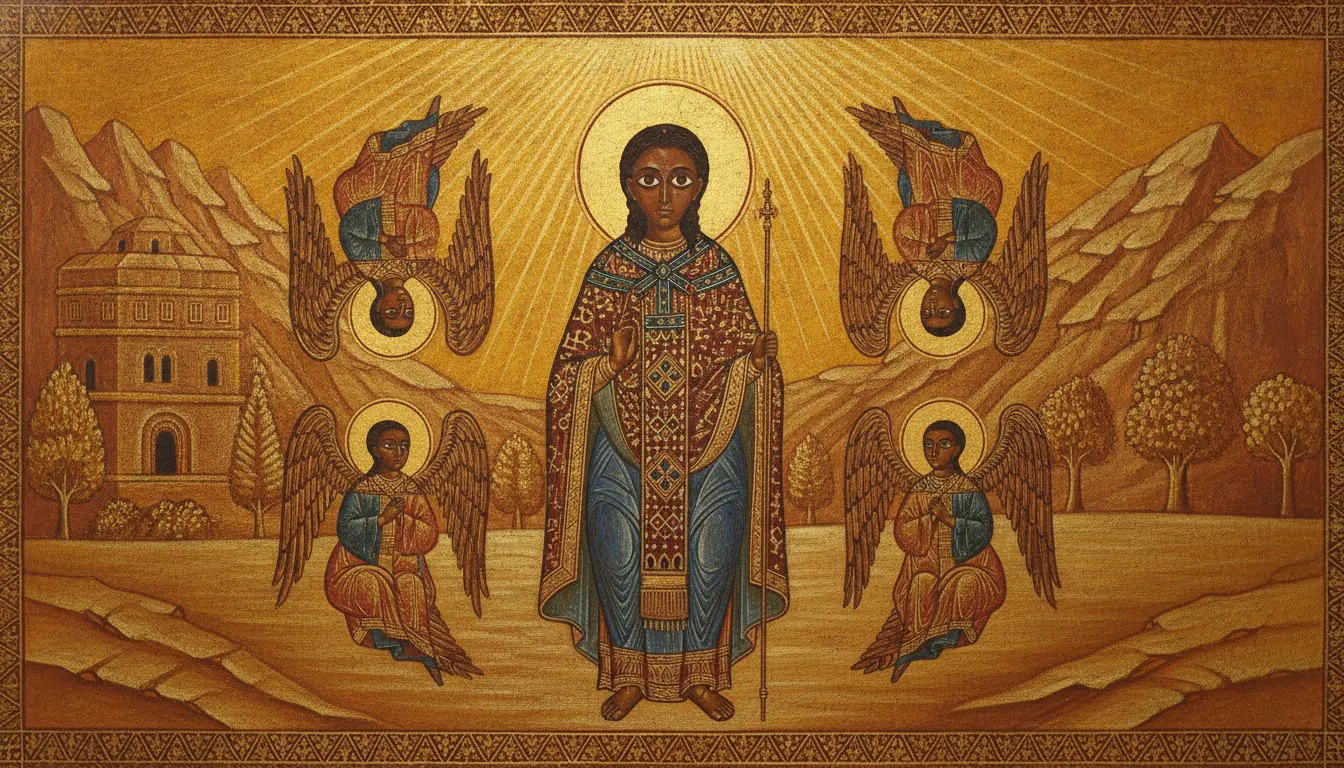
Psalter of Yekuno Amlak (c. 1280s)
one of the earliest Solomonic illuminated manuscripts
In the tradition of Ethiopian Orthodox icon painting. Wide-eyed saints and angels in tempera on gessoed wood, with stylized symmetrical hieratic composition.
The moves a human crew would use to get here. Cue applies them for you, and knowing their names is how you ask for a change.
gazing almond eyes dominating the facial structure, outlined in black with minimal iris variation
lapis blue, vermillion, chrome yellow, malachite green – with no graduated shading
quarter face view with body in frontal pose, creating a characteristic head-turn effect
In the tradition of Ethiopian Orthodox Christian icon painting developed under the Solomonic dynasty from the 14th century onward, this look encodes a distinctive visual theology: frontal, hieratic figures rendered in flat mineral pigments against gold-and-ochre grounds, with an immediacy and directness that distinguishes Ethiopian icons from their Byzantine predecessors.
Ethiopian Christianity is among the oldest in the world, tracing its roots to the 4th-century conversion of King Ezana of Axum. The visual tradition of illuminated manuscripts and panel icons flourished from the 14th century during the restored Solomonic dynasty, reaching its zenith in the 15th century under Emperor Zara Yaqob (r. 1434-1468), who commissioned extensive manuscript production to unify the kingdom's faith.
The Liber Aksumae and the Kebra Nagast (Glory of Kings) were among the most celebrated illuminated texts. The monastery of Debre Damo in Tigray and the island monasteries of Lake Tana (particularly Ura Kidane Mehret) preserve extraordinary mural and panel painting traditions that continue to be produced by debtera (scholar-priests) and lay artists trained in the monastic ateliers.
The defining characteristics of Ethiopian icon painting are immediately recognizable: faces drawn in near-profile three-quarter view with enormous, forward-looking almond-shaped eyes; simplified, flattened anatomy with minimal modeling; brilliant lapis lazuli blue, vermillion red, chrome yellow, and verdant green laid flat without atmospheric perspective; and gilt or yellow ochre grounds that suggest transcendent light.
Figures are typically depicted in strict frontal or three-quarter poses. The Virgin Mary (Maryam) appears frequently with a tilted head and elongated neck. Equestrian saints such as Saint George (Giyorgis) spearing a dragon are among the most iconic compositions. Border decorations use interlace patterns derived from both Byzantine and Coptic sources, while marginal script in Ge'ez (the classical Ethiopian liturgical language) anchors the image in its theological context.
This look translates powerfully into title cards, documentary lower-thirds, and editorial illustration where spiritual weight and cultural specificity are needed. The palette – deep cobalt, red ochre, warm gold, and verdant green on parchment-tone grounds – is distinctive and immediately legible.
one of the earliest Solomonic illuminated manuscripts
Walters Art Museum, Baltimore
scenes from the life of Mary
widespread throughout Ethiopian church collections
A Look is not a filter. It is a set of stored decisions the pipeline reads before it makes a single frame, so two videos in the same Look actually match.