Bagan lacquerware workshops
ongoing production, Myinkaba village, Bagan
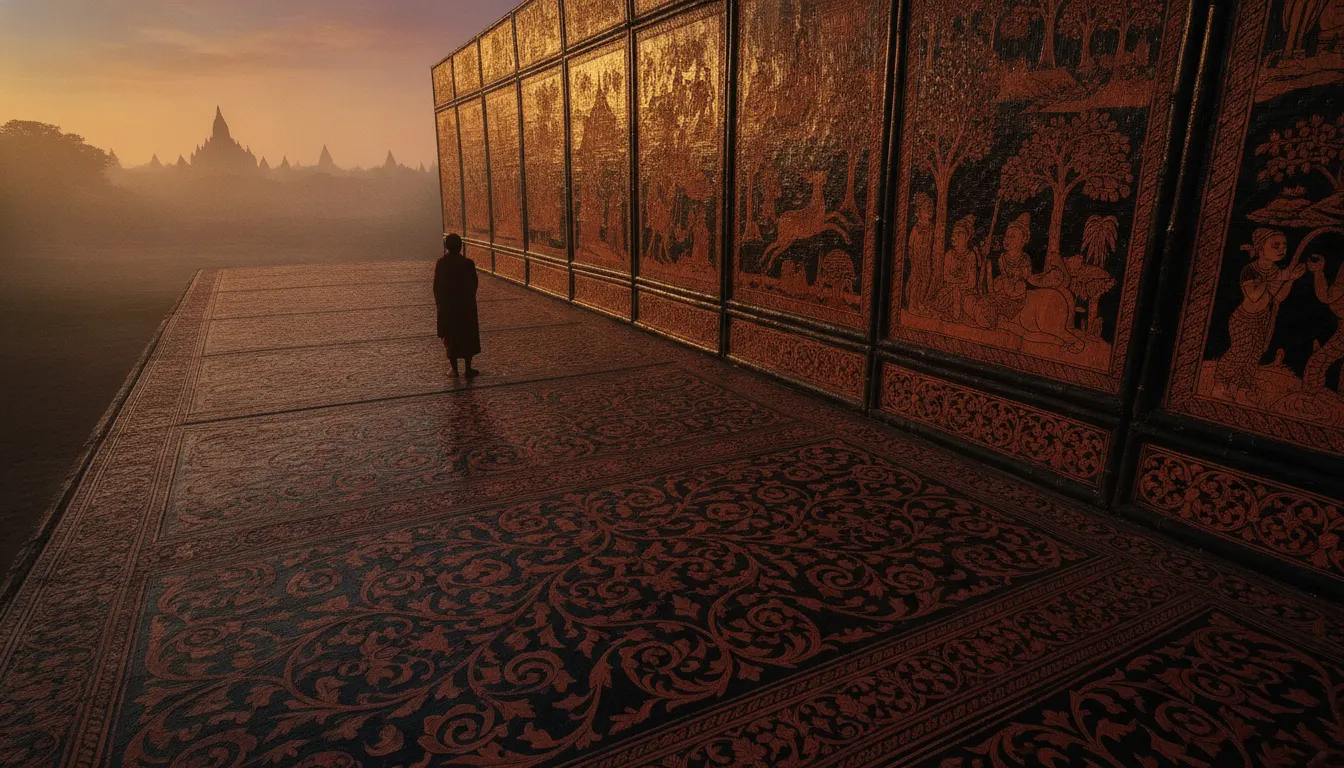
Honoring the craft of Burmese yun lacquerware from Bagan in Myanmar. Layered black lacquer over woven bamboo, hand-incised vermilion floral and Jataka tale figurative motifs.
The moves a human crew would use to get here. Cue applies them for you, and knowing their names is how you ask for a change.
black or cinnabar-red lacquer ground with gold leaf figural and floral decoration
fine stylus lines incised into the lacquer surface, filled with contrasting color
relief gilded designs built up in multiple lacquer-putty layers before gold-leafing
kha*) fills in background spaces between figural scenes
ok tiered offering vessel form as the canonical shape for figural decoration
In the tradition of Burmese lacquerware production centered in Bagan (Pagan) and Kyaukka, Myanmar, this look draws on a craft tradition that has flourished for over 1,000 years along the Irrawaddy River valley – a tradition distinguished by its technical sophistication, its luminous palette of black and cinnabar red, and its intricate figural decoration derived from Buddhist narrative.
Burmese lacquerware (shwe-zawa and yun-de) has been produced in the Bagan region since at least the 11th century, when the Pagan Empire (849-1297 CE) established the city as a center of Buddhist civilization and commissioned lacquerware for royal and monastery use. Bagan remains the primary center of lacquerware production today, with workshops maintained by families who have practiced the craft for generations.
The base forms – bowls, betel-leaf boxes (kun-it), trays, water vessels, and the characteristic tall Burmese offering vessels (hsun-ok) – are constructed from coiled bamboo or horse-tail hair woven into flexible forms, then coated with multiple layers of thitsi (raw lacquer tapped from the Melanorrhoea usitata tree). Each coat is applied, dried in humid underground chambers, and sanded before the next is applied – a single high-quality vessel may require months and twelve or more lacquer coats.
The two dominant decorative techniques are: yun (engraved lacquerware) – in which the final surface is engraved with a fine metal stylus to create the design, then filled with colored lacquer or clay pigment and polished; and shwe-zawa (gold-leaf lacquerware) – in which designs are built up in raised relief using thayo (a putty of lacquer and ash), gilded with gold leaf, and set against deep red or black grounds.
The color vocabulary of Burmese lacquerware is built on three fundamental tones: jet black (ni), cinnabar red (ngar-swe), and gold. Secondary colors – green, yellow, and deep brown – appear in multicolor yun work. Figural decoration draws from Buddhist Jataka tales (stories of the Buddha's previous lives), the Hindu epic Ramayana (Yama Zatdaw in its Burmese form), floral arabesque scrollwork (pan-kha), and courtly life scenes.
The formal language is two-dimensional: figures are depicted in profile or three-quarter view against plain lacquer grounds, with dense floral scroll fills occupying background space. Fine engraved lines define costumes, facial features, and architectural settings with extraordinary detail.
ongoing production, Myinkaba village, Bagan
royal lacquerware collections
Burmese lacquerware acquisitions including 19th-century royal pieces
shwe-zawa gilded offering vessels from the Konbaung Dynasty (18th-19th century)
surviving royal hsun-ok and betel boxes
distinct regional variant with raised thayo floral relief
A Look is not a filter. It is a set of stored decisions the pipeline reads before it makes a single frame, so two videos in the same Look actually match.