Brown Bear, Brown Bear, What Do You See?
Eric Carle (illustrator), Bill Martin Jr. (author) · 1967
Debut collaboration; first full deployment of the tissue paper collage technique in publication
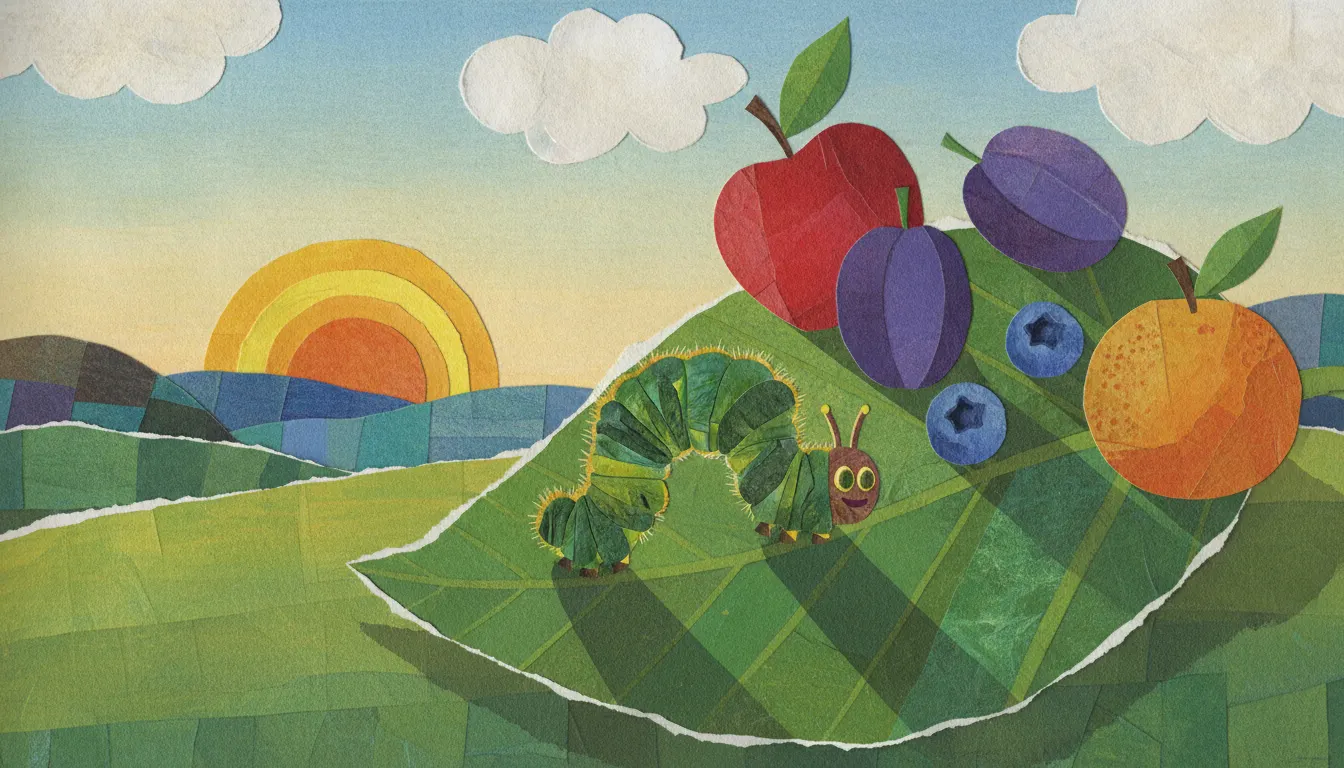
Eric Carle Very Hungry Caterpillar tissue-paper collage. Painted-tissue cut shapes, layered torn edge, bold primary creatures.
The moves a human crew would use to get here. Cue applies them for you, and knowing their names is how you ask for a change.
Sheets of tissue paper painted in advance with brushes, combs, sponges, and fingers create a stockpile of textured color surfaces from which shapes are cut and assembled.
Multiple layers of semi-transparent tissue paper allow underlying colors to show through, producing color depth that flat paint or digital color cannot match.
Subjects cut as clear, simple shapes - oval caterpillar segments, elliptical leaves - with rich internal surface texture from the painted tissue.
Red, yellow, blue, and green at high saturation, with warm orange and pink accents, matching developmental research on high-contrast color for young children.
Subjects placed against minimal or white backgrounds to maximize contrast and visual clarity, ensuring legibility for the youngest readers.
In key books, pages are physically cut into shapes (the caterpillar's food holes in The Very Hungry Caterpillar) making the book's physical form part of the narrative experience.
Eric Carle (1929-2021) was a German-American author-illustrator whose technique is among the most imitated in children's picture books: tissue paper painted with tempera, layered and cut into shapes, then photographed to produce illustrations of unusual textural richness and color vibrancy. No two pages share the same surface quality because every element is a handmade physical collage.
Carle was born in Stuttgart, Germany, and trained at the Kunstgewerbeschule (now Staatliche Akademie der bildenden Künste Stuttgart). He emigrated to the United States in 1952 and worked as an art director and graphic designer before collaborating with educator Bill Martin Jr. on Brown Bear, Brown Bear, What Do You See? (1967), which established his name in children's publishing.
The Very Hungry Caterpillar (1969) is his defining work and one of the best-selling picture books of all time, with over 55 million copies in print. Its formal innovation was as important as its story: die-cut pages of increasing width and with round holes punched through them tracked the caterpillar's eating path, making the physical book an object that demonstrated its own narrative. The tissue paper collage technique was fully deployed - the caterpillar rendered in overlapping layers of green, red, and white painted tissue, each sheet partially translucent, producing luminous color that conventional printing on white paper could not replicate.
The Very Busy Spider (1984), The Very Lonely Firefly (1995), and The Art of Eric Carle (1996) extended the visual system. Carle described his technique in detail in interviews and museum catalog essays: he kept a flat file system of hundreds of pre-painted tissue paper sheets in different colors and textures, prepared in advance, from which he cut and assembled each illustration. The painted surfaces were built up with combs, sponges, and fingers as well as brushes, creating mark variety within a single color area.
The defining visual quality is the combination of flat shape silhouette with complex internal texture. A caterpillar segment is a simple oval shape, but its surface carries the actual physical marks of a painted tissue paper sheet - semi-transparent layers, brush strokes, scraped areas, sponged passages - creating depth within flatness. Colors are saturated and primary, in keeping with the developmental recommendation that young children respond strongly to high-contrast primary palettes.
The composition style is simple and direct: subjects isolated against white or minimal backgrounds, orientation horizontal for page-turn narrative pacing. Scale relationships are exaggerated for legibility and drama.
The Eric Carle Museum of Picture Book Art in Amherst, Massachusetts (opened 2002) was co-founded by Carle and is the only museum in America dedicated to the picture book form. His technique has become a standard elementary school art activity, making it one of the most reproduced visual styles in educational contexts.
Eric Carle (illustrator), Bill Martin Jr. (author) · 1967
Debut collaboration; first full deployment of the tissue paper collage technique in publication
Eric Carle · 1969
Definitive work; 55M+ copies sold; die-cut pages with punched holes tracking caterpillar's eating
Eric Carle · 1984
Raised-surface printing added tactile dimension to the collage illustrations
Eric Carle · 1995
Pages with actual embedded lights activated when book is opened - physical interactivity at its most advanced
Eric Carle · 1996
Behind-the-scenes documentation of the painted tissue paper technique
Eric Carle · 1968
Wordless counting book; early demonstration of full animal collage vocabulary
A Look is not a filter. It is a set of stored decisions the pipeline reads before it makes a single frame, so two videos in the same Look actually match.