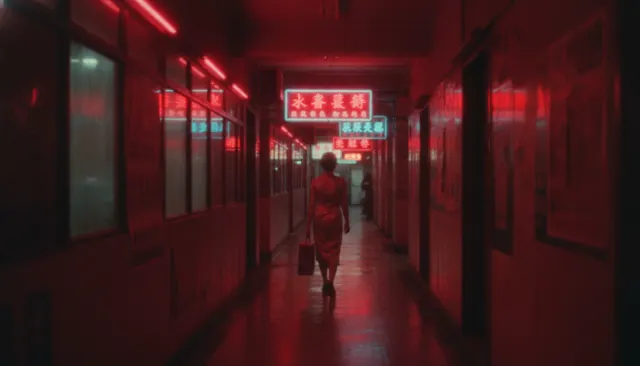
Parasite
Bong Joon-ho / Hong Kyung-pyo (DP) · 2019
Palme d'Or and Academy Award Best Picture; defining class-vertical visual grammar
Bong Joon-ho class-vertical staging. Parasite stair-and-window verticality, Hong Kyung-pyo cool fluorescents, sub-basement to penthouse axis.
The moves a human crew would use to get here. Cue applies them for you, and knowing their names is how you ask for a change.
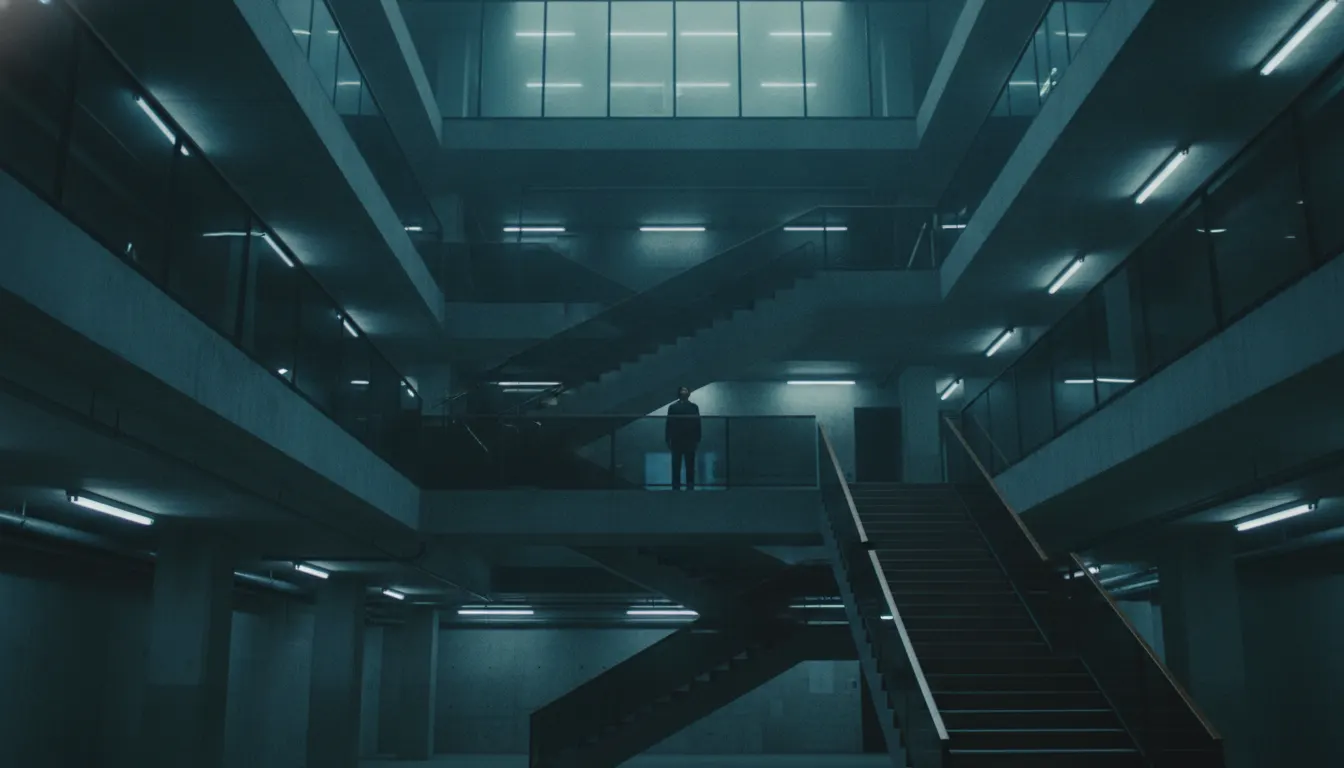
Physical elevation used as consistent metaphor for social class - wealth above, poverty below, transitions as journeys.
Extended staircase sequences filmed in long establishing shots that emphasize physical effort of social mobility.
Basement and low-income spaces lit with cool, slightly green-biased practical fluorescents suggesting institutional indifference.
Camera becomes handheld during sequences of class tension or chaos; remains static in the settled elite spaces.
Wealthy spaces are cool, bright, and gray-white; lower-class spaces are warm, amber, and spatially tight.
Window placement relative to grade level encodes economic position - park-level views vs. ankle-level semi-basement windows.
Bong Joon-ho is South Korea's most internationally celebrated director, and his visual system - developed across Memories of Murder (2003), The Host (2006), Snowpiercer (2013), Okja (2017), and Parasite (2019) - centers on a metaphorically precise use of vertical space to encode class dynamics.
Parasite is Bong Joon-ho's most formally perfect articulation of his class-vertical visual system. The film's spatial architecture is the argument: the Park family lives in a glass-and-concrete modernist villa at the top of a hill, flooded with light and open to sky. The Kim family's semi-basement apartment is at the bottom of a staircase in a sub-grade street, the only windows at shoe-level looking at passing pedestrians' ankles.
Cinematographer Hong Kyung-pyo framed every transition between these spaces as a vertical journey. The long staircase the Kims must climb to reach the Parks' neighborhood is filmed in long shots that emphasize its length and the physical effort of class ascent. The sub-basement flood sequence in the film's third act inverts this: water flows down to the lowest-income residents, social disaster following the physics of gravity.
The film's color design reinforces this vertical axis: the Park home is cool, bright, and gray-white; the Kim semi-basement is warm, amber, and cramped. The temperature shift is legible in every interior scene before any dialogue.
Hong Kyung-pyo used primarily spherical lenses (35-85mm range) for Parasite, avoiding the anamorphic stretch that might aestheticize the class tension into glamour. The choice keeps the imagery functional - it looks like the real world. The handheld camera appears selectively during moments of anxiety or chaos, while the Parks' world is shot more statically, with composed masters that reflect their settled social position.
The fluorescent-lit kitchen and basement interiors use cool, slightly green-biased practical sources that Kyung-pyo augmented with barely perceptible fill. The Kims' world is lit with the institutional indifference of poverty.
Snowpiercer (2013) literalizes the same metaphor horizontally: a class hierarchy mapped onto a single train moving from tail (poor) to engine (elite), the protagonist fighting forward through the cars as class struggle. The Host (2006) uses Seoul's Hangang River embankments and the apartment-block urban periphery as spaces of institutional abandonment.
Parasite won the Palme d'Or at Cannes 2019 and the Academy Award for Best Picture 2020 - the first non-English-language film to win. Its visual grammar has become a global reference point for class-conscious filmmaking and for the South Korean New Wave more broadly (Park Chan-wook, Lee Chang-dong, Hong Sang-soo).
Bong Joon-ho / Hong Kyung-pyo (DP) · 2019
Palme d'Or and Academy Award Best Picture; defining class-vertical visual grammar
Bong Joon-ho / Hong Kyung-pyo (DP) · 2013
Horizontal class metaphor on a single train; tail-to-engine class struggle
Bong Joon-ho / Kim Hyung-koo (DP) · 2003
Serial killer procedural in rain-soaked Korean countryside; institutional spatial critique
Bong Joon-ho / Kim Hyung-koo (DP) · 2006
Monster film using Hangang embankments as spaces of civic abandonment
Bong Joon-ho / Hong Kyung-pyo (DP) · 2009
Rural Korea; spatial confinement and maternal obsession
Bong Joon-ho / Darius Khondji (DP) · 2017
Corporate power vs. rural Korean pastoral; vertical urban-rural spatial contrast
A Look is not a filter. It is a set of stored decisions the pipeline reads before it makes a single frame, so two videos in the same Look actually match.