BoJack Horseman
Raphael Bob-Waksberg, Lisa Hanawalt / Netflix · 2014
The canonical series; the peak of the anthropomorphic prestige-adult animation form
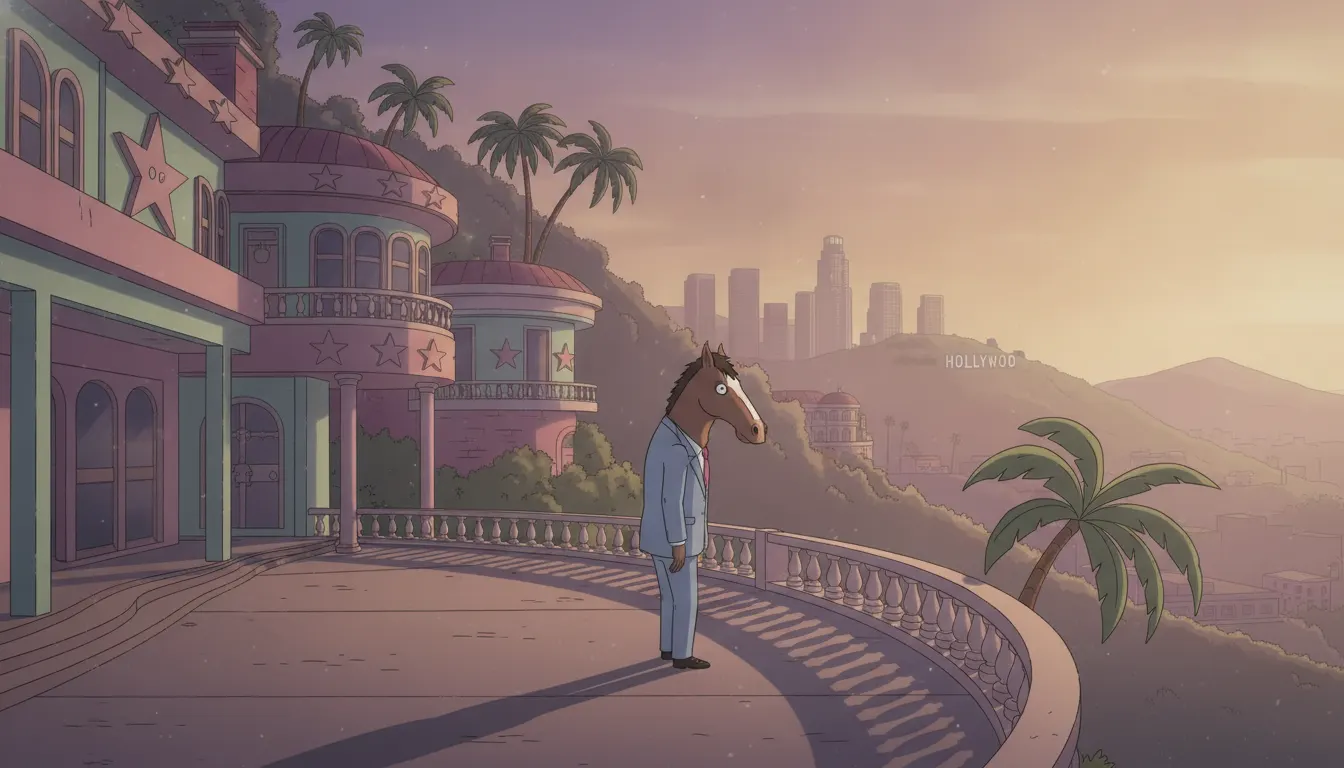
Lisa Hanawalt pastel anthropomorphic Hollywood satire. Animal-headed humans in LA mansions, melancholy palette, deadpan emotional drama.
The moves a human crew would use to get here. Cue applies them for you, and knowing their names is how you ask for a change.
Animal characters move and behave according to their species' actual physical characteristics, not just as humans in animal masks.
Every background frame contains multiple visual puns and jokes embedded in signs, extras, and environmental details referencing the animal-human hybrid world.
The Los Angeles setting uses a deliberately too-bright, high-saturation color palette that evokes the specific quality of Southern California sunlight.
Domestic and professional interiors are art-directed with mid-century modernist specificity, signaling the faded Hollywood-wealth milieu.
Individual episodes abandon the house style entirely for specific visual experiments -- tapestry, silent underwater film, single-location theater.
Interior scenes use warm-to-cool color temperature shifts to signal emotional isolation and connection without dialogue.
BoJack Horseman premiered on Netflix on August 22, 2014, created by Raphael Bob-Waksberg with production design by Lisa Hanawalt. The series ran for six seasons through January 31, 2020, animated by ShadowMachine (also responsible for Robot Chicken and Moral Orel). Production designer Lisa Hanawalt had previously illustrated Bob-Waksberg's work and brought a highly distinctive visual sensibility rooted in her background as a fine art illustrator.
BoJack Horseman's central visual achievement is its systematic anthropomorphization of animals into a Los Angeles celebrity-industrial world. Rather than treating the animal characters as humans in costume (the Zootopia/Fritz-the-Cat approach), Hanawalt designed a world where animal characteristics determine character -- BoJack Horseman actually moves and thinks somewhat like a horse. This creates visual comedy through specificity.
Hanawalt's design philosophy: animal heads on human bodies, but with the animal's physical qualities affecting posture, proportion, and behavior. Mr. Peanutbutter (Labrador retriever) has the loose, enthusiastic physicality of an actual Labrador. Princess Carolyn (Persian cat) has feline precision and fastidiousness. This specificity makes the anthropomorphic world feel internally consistent.
Hanawalt's background art team created a version of Los Angeles saturated with the animal-world visual logic: restaurant names, billboard advertisements, background extras, and environmental details all incorporate the celebrity-animal-Hollywood premise. BoJack's Hollywood Hills home is rendered with period-specific detail -- the Hollywoo Hills sign (the D famously stolen for a Season 1 gag), the canyon landscape, the specific mid-century modernist house that communicates old-Hollywood faded glory.
The color palette is warm and saturated -- the specific LA quality of too-bright sunlight on stucco. Interior scenes use controlled color temperature shifts to signal emotional states with considerable sophistication for television animation.
BoJack Horseman pioneered a visual emotional register in animation that had previously been the territory of live-action prestige drama: the 'quiet devastation' scene. Season 3's 'Fish Out of Water' (2016), a near-silent episode set underwater, represents the furthest extension of this -- a piece of animation that functions as genuine emotional cinema.
The visual language accommodates both broad cartoon comedy (background gag density, visual puns per frame) and intimate emotional drama. Episode-specific stylistic departures -- the tapestry sequence in 'Time's Arrow' (Season 4), the eulogy episode 'Free Churro' (Season 5) -- demonstrate the visual system's flexibility.
BoJack Horseman established that premium streaming could produce animated content with the emotional ambition of prestige live-action drama. Lisa Hanawalt's visual system directly influenced Tuca & Bertie (Netflix, 2019), her spinoff series from the BoJack universe.
Raphael Bob-Waksberg, Lisa Hanawalt / Netflix · 2014
The canonical series; the peak of the anthropomorphic prestige-adult animation form
Lisa Hanawalt / Netflix / Adult Swim · 2019
Direct spinoff by BoJack's production designer; extends the anthropomorphic visual system
Ralph Bakshi · 1972
Foundational anthropomorphic adult animation that established the genre BoJack refines
Byron Howard, Rich Moore / Disney · 2016
Contemporaneous theatrical anthropomorphic animation; more optimistic visual register than BoJack
Nick Kroll / Netflix · 2017
Netflix adult animation contemporary in the same prestige-comedy-for-adults era
Matt Groening / Netflix · 2018
Netflix adult animation in the BoJack-era streaming comedy landscape
A Look is not a filter. It is a set of stored decisions the pipeline reads before it makes a single frame, so two videos in the same Look actually match.