Ansel Adams, 'Moonrise, Hernandez, New Mexico'
1941
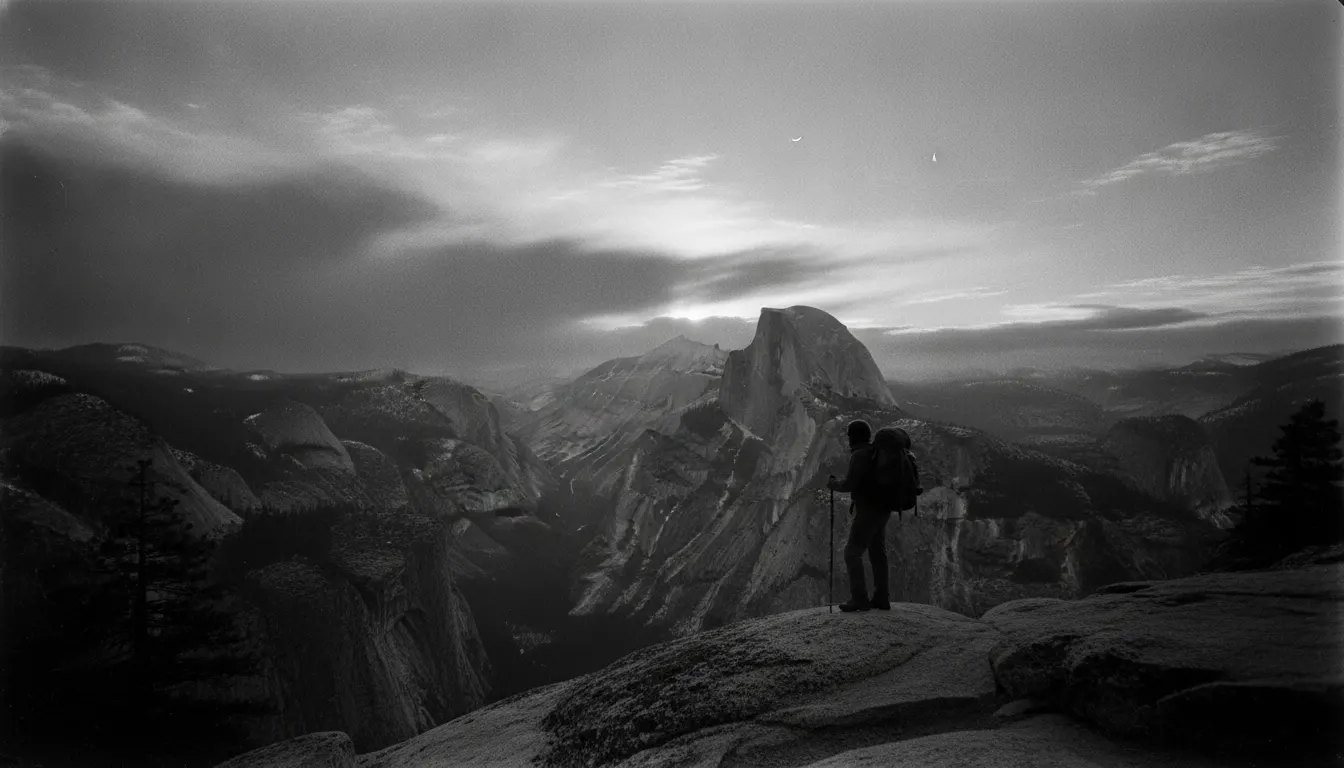
Ansel Adams Yosemite epic bw. Zone System large-format precision, Moonrise Hernandez, Half Dome storm clearing, silver-gelatin clarity.
The moves a human crew would use to get here. Cue applies them for you, and knowing their names is how you ask for a change.
maximum detail, maximum tonal control, zero motion blur
visualization: spot meter every value, choose exposure/development for tonal placement
based silver gelatin printing to maximum D-max black with full detail in highlights
sharp lens rendering: every granite crystal, every pine needle rendered at full resolution
format contact print scale giving 8x10 or 16x20 prints with zero grain enlargement
Ansel Adams (1902-1984) spent six decades photographing the American West with an 8x10 view camera and a technical system he co-developed called the Zone System, producing a body of landscape work that remains the most recognized black and white photography in American history. His images of Yosemite Valley, the Sierra Nevada, and the Southwest have defined the visual language of American landscape preservation and influenced every subsequent generation of fine-art black and white photographers.
Developed with Fred Archer at the Art Center College of Design, Los Angeles around 1940, the Zone System is a framework for correlating scene luminance values with negative density and final print density across eleven zones from Zone 0 (pure black) to Zone X (pure white). Adams' phrase 'visualize the final print before you expose' summarizes the system's intent: to give the photographer deliberate control over where every tonal value in a scene falls in the final print.
Practically, this means photographing with an 8x10 view camera on 4x5 sheet film, taking a careful spot meter reading of every significant value in the scene, choosing an exposure and development combination that places those values in their optimal zones, and then printing on fiber-based silver gelatin paper to extract the full range from maximum black (D-max) to paper white.
Moonrise, Hernandez, New Mexico (1941) - Adams spotted the scene from his car on U.S. Highway 84: a full moon rising above white crosses in a cemetery, the Sangre de Cristo Mountains behind, storm clouds above. He had approximately one minute before the light changed. Having no light meter for the moon, he recalled its luminance from memory (250 candles per square foot) and calculated the exposure. The negative almost didn't print - it was nearly overexposed - but from it Adams made hundreds of prints over forty years, each slightly different in interpretation. It is the most printed landscape photograph in history.
Monolith, The Face of Half Dome (1927) - Adams' first 'visualized' image, shot on the Four-Mile Trail. He made two exposures: one with a yellow filter and one, on his last plate, with a deep red filter. The red filter darkened the blue sky to near-black, making the granite face of Half Dome glow against shadow. Adams cited this as the first image where he had fully pre-visualized the final print before exposure.
Adams worked with Korona and later Calumet 8x10 view cameras, using lenses by Goerz, Cooke, and Schneider. He printed on Ilford Galerie and Oriental Seagull fiber-based paper in his Yosemite darkroom and the Carmel-by-the-Sea studio where he worked until his death.
1941
1927
1944
1960
1942
1938
A Look is not a filter. It is a set of stored decisions the pipeline reads before it makes a single frame, so two videos in the same Look actually match.