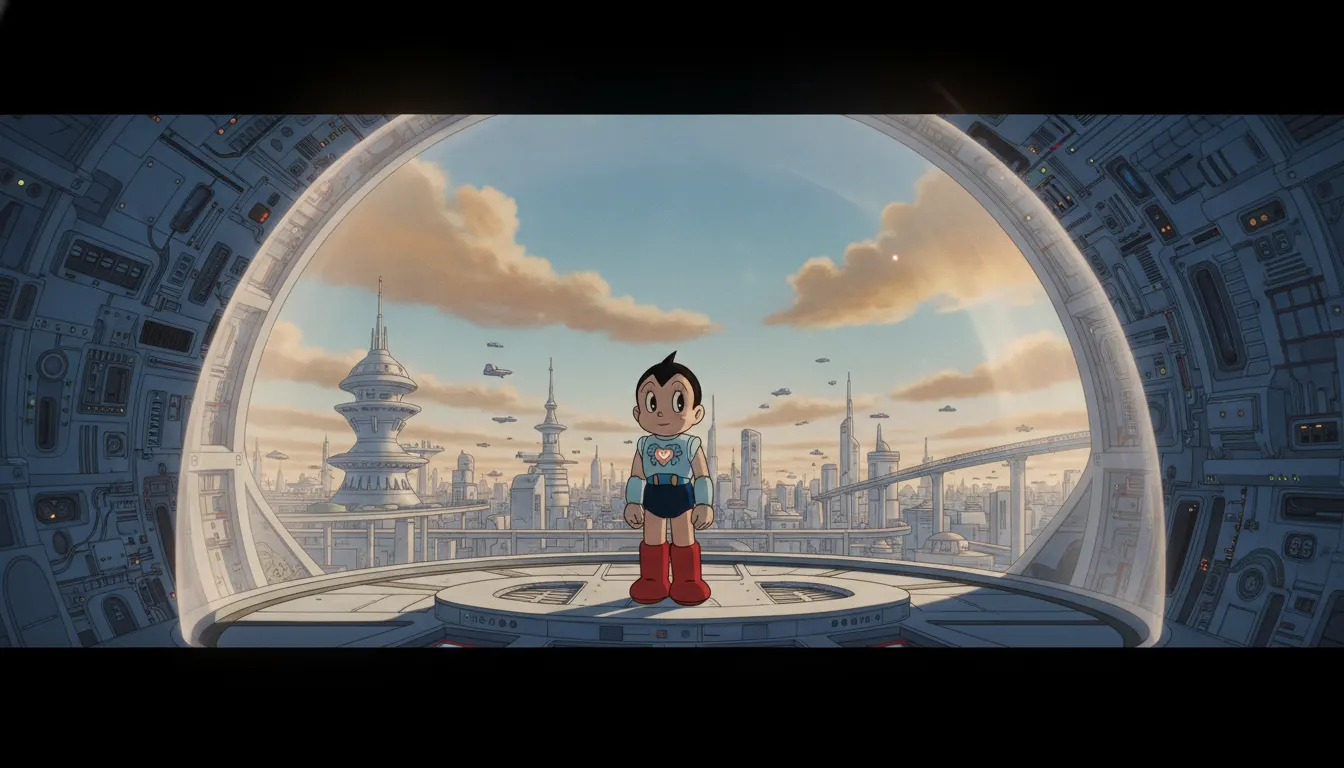
ERA CLASSIC ANIME EXPANDED · 1960S · JAPAN
60s Tezuka Astro Boy Detailed
Detailed 1960s Osamu Tezuka Astro Boy register. Mushi Production sci-fi optimism, robot-boy hero, mechanical interior plates, hopeful flat color world.
vintageoptimisticsci-fihopeful
LUT astro-boy-60s
WHEN TO USE
- Retro or nostalgic content evoking 1960s-1970s Japan and the birth of anime culture
- Educational content about animation history, manga traditions, or post-war Japanese culture
- Science fiction content with humanist themes - robots, AI, and technology with emotional depth
- Children's content referencing classic anime heritage
- Brand campaigns emphasizing craft, heritage, and origination stories
- Documentary-style content covering Japanese pop culture history
WHEN NOT TO USE
- Contemporary action content where the limited-animation style reads as underpowered
- Horror or dark psychological content where the rounded, warm character style breaks tone
- Luxury or sophisticated adult positioning where the simplified character design reads as juvenile
- Content requiring photorealistic environments or detailed background rendering
SIGNATURE TECHNIQUES
How the look is made.
The moves a human crew would use to get here. Cue applies them for you, and knowing their names is how you ask for a change.
- 01Disproportionately large, luminous eyes occupying roughly one-third of the face
- 02Simplified facial geometry
small nose, minimal mouth, maximum expressiveness in the eyes
- 03Limited animation at 8fps with held frames and camera pan/zoom substituting for full movement
- 04High
contrast black ink outlines on white or minimal background
- 05Strong silhouette design
characters readable as pure shape cutout
- 06Disney
influenced rounded forms softening mechanical or inhuman subjects
- 07Dramatic static composition with isolated motion elements for selective emphasis
HISTORY & CONTEXT
Where it comes from.
Osamu Tezuka and the Astro Boy Aesthetic (1960s)
Osamu Tezuka is the foundational figure of modern manga and anime. His 1952 manga Astro Boy (Tetsuwan Atomu) established the visual conventions that defined Japanese animation for the following seventy years. When Tezuka adapted Astro Boy for television in 1963 through his studio Mushi Production, it became the first weekly animated television series produced in Japan, and the large-scale commercial template it created shaped the entire medium.
The Tezuka Character Design System
Tezuka's character design philosophy, heavily influenced by his early exposure to Disney animation (particularly Bambi, 1942) and the expressive faces of Betty Boop, centered on disproportionately large, luminous eyes as the primary vehicle for emotional communication. Unlike Disney's naturalistic proportions, Tezuka's characters have small noses, simplified mouths, and eyes that occupy roughly one-third of the face. This system allowed rapid production while preserving emotional legibility - critical for a weekly television schedule that required 30 episodes per year with minimal budget.
Astro Boy's design specifically features a bullet-shaped hairstyle with two upward horns, a compact athletic body, and a face capable of expressing the full range of human emotion through eye-shape variation alone. The design is both mechanically simple enough to reproduce consistently and expressive enough to carry dramatic weight across 193 television episodes.
Mushi Production Techniques
Mushi Production (founded 1961) pioneered "limited animation" for television: rather than animating every frame at 24fps in the Disney tradition, Tezuka's team produced animation at 8 frames per second with strategic held frames and camera moves substituting for full movement. This economic necessity became an aesthetic principle - static dramatic composition with selective motion emphasis - that remains a defining characteristic of TV anime versus theatrical animation.
Thematic and Cultural Context
Astro Boy premiered September 7, 1963 on Fuji TV, one year before the Tokyo Olympics. Its themes - a robot boy navigating human society while confronting prejudice and longing for acceptance - resonated with post-war Japan's anxieties about modernization, nuclear technology (Astro Boy is powered by nuclear energy), and national identity reconstruction. Tezuka's later manga series Black Jack (1973), Phoenix (Hi no Tori, 1954-1988), and Buddha (1972) deepened his thematic range while maintaining the large-eye character design system.
Legacy and Influence
Virtually every major figure of anime cites Tezuka as foundational. Hayao Miyazaki, Yoshiyuki Tomino, and Isao Takahata all worked in or adjacent to Mushi Production. The large-eye design convention Tezuka introduced became the globally recognized marker of anime as a form, distinguishing it visually from American and European animation traditions.
NOTABLE WORKS
Where you have seen it.
*Astro Boy* anime, Mushi Production, Fuji TV, 1963-1966 (193 episodes)
*Kimba the White Lion* (*Jungle Taitei*), Mushi Production, 1965
*Princess Knight* (*Ribon no Kishi*), Mushi Production, 1967
*Black Jack* manga by Osamu Tezuka, 1973-1983
*Phoenix* (*Hi no Tori*) manga by Osamu Tezuka, 1954-1988
*Buddha* manga by Osamu Tezuka, 1972-1983
Tezuka Productions, Tokyo, ongoing preservation and continuation of Tezuka's catalog
THE RECIPE
The exact knobs
the renderer turns.
A Look is not a filter. It is a set of stored decisions the pipeline reads before it makes a single frame, so two videos in the same Look actually match.
SettingValue
GradeColour LUT applied to every frame
astro-boy-60sTransitionHow one shot becomes the next
hard cuts · 280ms · linearKen BurnsCamera move applied to stills
Static framesTypographyDisplay / body / mono pairing
Hachi Maru Pop · Nunito · JetBrains MonoMusic moodWhat the bed under the voice sounds like
retro-tv-march · orchestral-optimisticPrompt suffixAppended to every shot prompt in this Look
Osamu Tezuka Mushi Production 1960s Astro Boy anime, detailed sci-fi optimism, robot boy hero, mechanical interior plates, hopeful flat colorPALETTE
Primary
#1E40AF
Secondary
#E84B3C
Accent
#F59E0B
Text/Light
#1A1A22
Text/Dark
#FFF8E7
BG 900
#10141F
BG 800
#1A1A22
RELATED LOOKS
Next to it on the shelf.
 Era Classic Anime Expanded70s Future Boy Conan Miyazaki Early
 Era Classic Anime Expanded70s Lupin III Zenigata Action
 Subgenre ChibiChibi Super Deformed
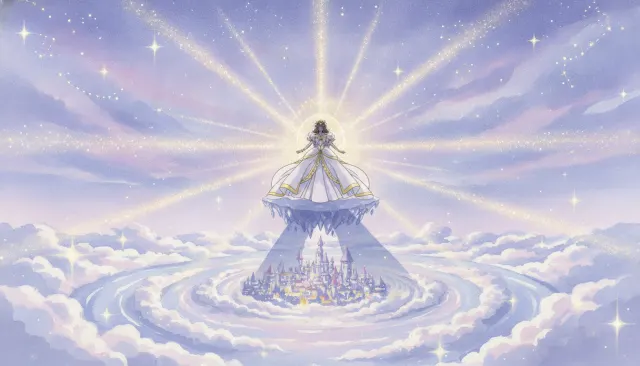 Era Classic Anime90s Magical Girl Anime
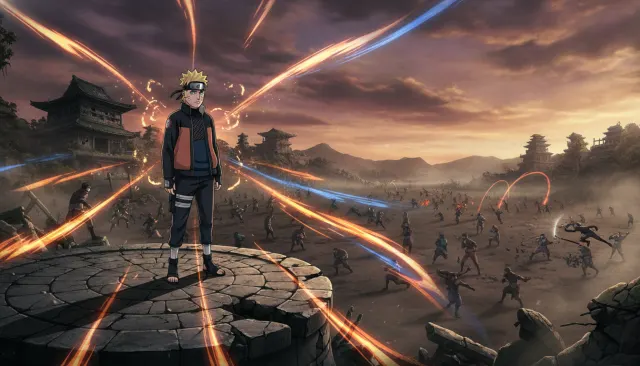 Era Classic Anime Expanded2000s Naruto Shippuden Modern Shonen
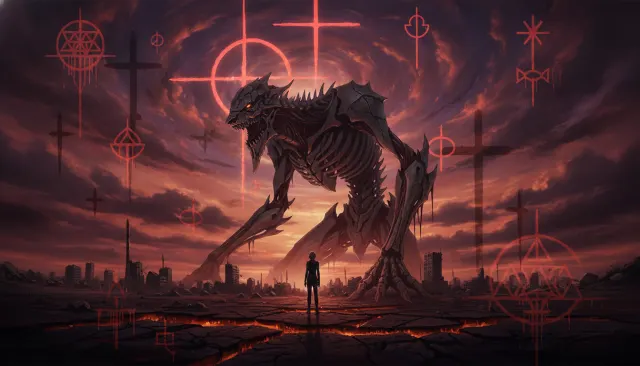 Studio Aesthetic ExpandedGainax Evangelion Mecha Mystical
Your first cut
is on us.
+ New videoFree plan · no card · 1080p export