ERA SPECIFIC COLOR · 1990S · USA
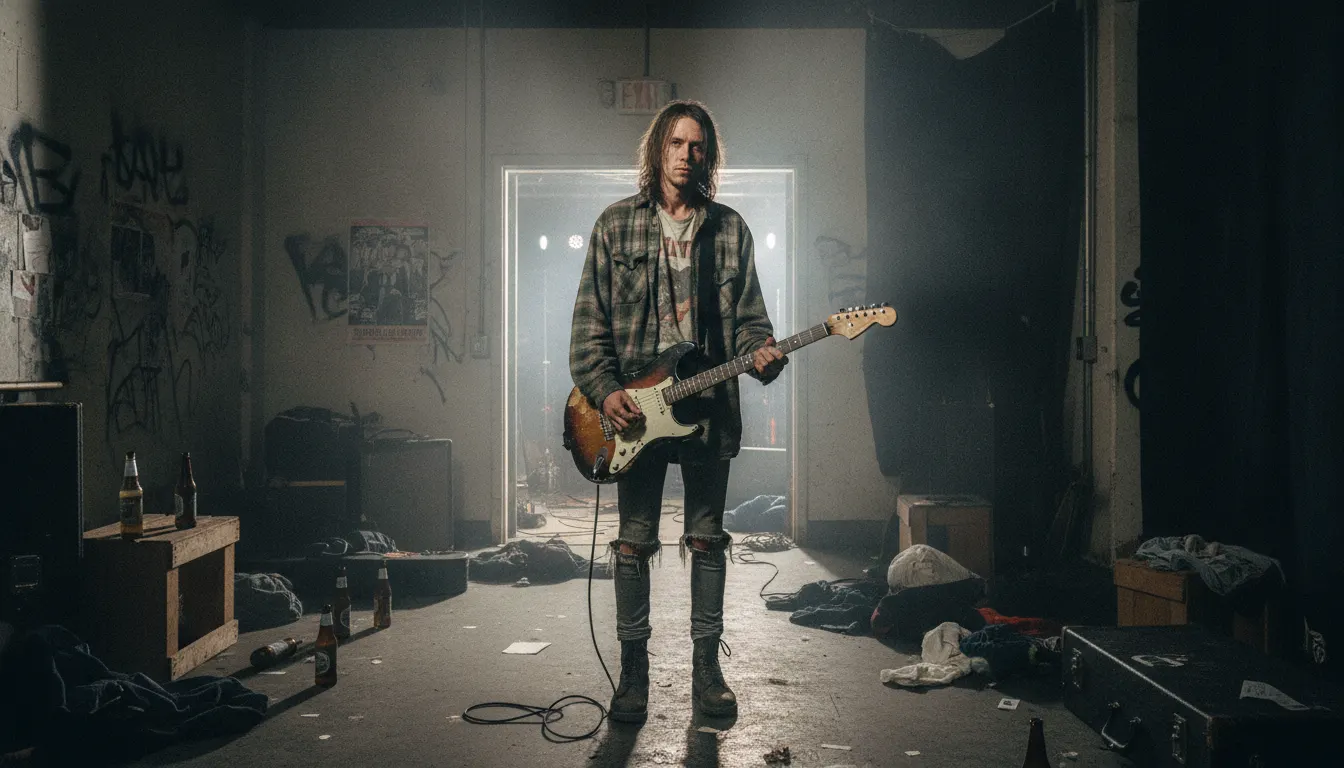
1990s Grunge Music Portrait
1990s grunge music portrait. Seattle band in flannel, Charles Peterson backstage flash, Sub Pop press kit, Spin Rolling Stone era documentary.
grungemusicflashnineties
LUT grunge-press-flash
WHEN TO USE
- Music content referencing the 1990s alternative, grunge, or indie rock era
- Band portraits or artist content seeking an anti-glamour, authentic underground aesthetic
- Fashion editorial that invokes 1990s nostalgia, particularly for younger audiences
- Documentary content about the Seattle music scene, Nirvana, Pearl Jam, or Soundgarden
- Content where deliberate roughness, grain, and imperfection convey authenticity
- Youth culture content referencing Generation X or early Millennial formative aesthetics
WHEN NOT TO USE
- Polished commercial content where the rough aesthetic would undercut professional perception
- Content aimed at audiences seeking aspirational or luxury associations
- Color-critical product content where desaturation would misrepresent the product
- Content about contemporary music genres with different visual cultures (K-pop, EDM, hip-hop)
SIGNATURE TECHNIQUES
How the look is made.
The moves a human crew would use to get here. Cue applies them for you, and knowing their names is how you ask for a change.
- 01Kodak T
MAX 3200 or Ilford Delta 3200 pushed film stock - visible grain structure
- 02Cross
processed slide film (Velvia in C-41) producing greenish color cast and crushed blacks
- 03Available tungsten light or single
source harsh on-camera flash, no fill
- 04Wide
angle lenses (21mm-35mm) at close range for concert floor perspective
- 05Uncontrolled environments
backstage, club bathrooms, parking lots, rehearsal spaces
- 06High contrast printing
blocked blacks, blown highlights, mid-tone compression
- 07Horizontal framing even in portraiture, suggesting reportage rather than formal sitting
- 08Subject caught mid
motion or in unselfconscious relaxation rather than posed
HISTORY & CONTEXT
Where it comes from.
1990s Grunge Music Portrait Photography
The photographic aesthetic of the 1990s grunge era was a direct visual correlate of the music itself: deliberately anti-glamour, high-contrast, shot in available light or with harsh on-camera flash, using consumer-grade film pushed to its grain limits. The look emerged from Seattle club photography in the late 1980s and spread globally as Nirvana, Pearl Jam, Soundgarden, and Alice in Chains achieved mainstream success.
Charles Peterson and the Seattle Scene
Charles Peterson is the defining visual chronicler of grunge's origins. His photographs of early Mudhoney and Nirvana shows at the Central Tavern and Moore Theatre in Seattle (1987-1991) established the genre's visual language: extreme high contrast black and white, shot with wide-angle lenses from the stage floor, capturing bodies in motion against strobed or available light. Peterson's images of Kurt Cobain stage-diving at tiny venues, Mark Arm writhing on stage, and Eddie Vedder climbing speaker stacks have become definitive documents of the movement's early energy.
The Portrait Aesthetic
Beyond concert photography, grunge-era portraits developed a specific set of conventions that distinguished them from 1980s rock glamour photography. Key characteristics include:
Desaturation and color cast: whether shot on Kodak T-MAX 3200 pushed black and white or on color negative film, the palette avoided saturation. Skin tones rendered flat and slightly gray; backgrounds were uncontrolled environments - dressing rooms, parking lots, rehearsal spaces. Mark Seliger and Michael Levine for Rolling Stone in 1992-1994 brought a slightly more refined version of this to national editorial.
Floated or cross-processed slide film, particularly Fujifilm Velvia cross-processed in C-41 chemistry, gave a greenish color cast and extreme contrast that became a signature of alternative music editorial in early-to-mid 1990s.
Fashion Crossover
The grunge aesthetic crossed into fashion photography most visibly in the December 1992 Vogue "Grunge and Glory" editorial - widely criticized as fashion's appropriation of working-class aesthetics - and in Steven Meisel's controversial heroin-chic direction for Vogue through the mid-1990s. The fashion version cleaned up the actual rough edges while retaining the desaturation, harsh light, and slovenly setting.
NOTABLE WORKS
Where you have seen it.
Charles Peterson, 'Screaming Life' photo book (Fantagraphics, 1995)
Mark Seliger, Kurt Cobain for Rolling Stone, January 1992
Michael Lavine, Nirvana pre-Nevermind press shots, 1991
Vogue 'Grunge and Glory' editorial, December 1992
Kevin Estrada, Pearl Jam tour photographs, 1992-1994
Anton Corbijn, Nirvana 'Heart-Shaped Box' video still aesthetic, 1993
Alice Wheeler, Kurt Cobain documentary photography, 1991-1994
THE RECIPE
The exact knobs
the renderer turns.
A Look is not a filter. It is a set of stored decisions the pipeline reads before it makes a single frame, so two videos in the same Look actually match.
SettingValue
GradeColour LUT applied to every frame
grunge-press-flashTransitionHow one shot becomes the next
hard cuts · 200ms · linearKen BurnsCamera move applied to stills
Slow push · 0.018 · centerTypographyDisplay / body / mono pairing
Space Grotesk · Inter · JetBrains MonoMusic moodWhat the bed under the voice sounds like
grunge-rock · alternative-radio-90sPrompt suffixAppended to every shot prompt in this Look
1990s grunge music portrait Seattle flannel band, Charles Peterson backstage flash, Sub Pop press kit, Spin Rolling Stone era documentaryPALETTE
Primary
#5C5040
Secondary
#3A3026
Accent
#7A2030
Text/Light
#1A1410
Text/Dark
#F0E5D0
BG 900
#0F0B08
BG 800
#1F1810
RELATED LOOKS
Next to it on the shelf.
Your first cut
is on us.
+ New videoFree plan · no card · 1080p export