POV vs. omniscient narration: choosing the right narrator
The narrator you pick decides the video before the first frame is generated. A working framework for choosing POV, omniscient, or interviewer - with three worked examples.
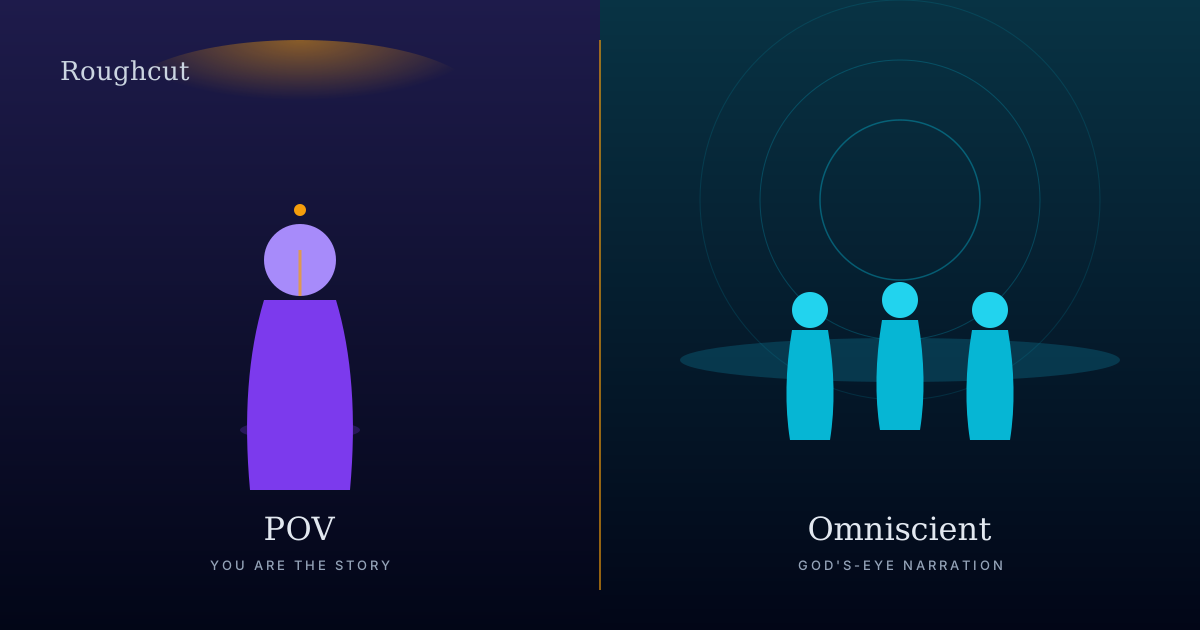
The single biggest editorial choice on an AI video is also the one most creators skip past: who is talking?
Pick the wrong narrator and the script fights itself for five minutes. Pick the right one and the script almost writes itself. Here is the working framework.
The three narrators worth using
We are going to ignore the long tail of academic narrative modes and stick to three that actually show up in production:
- First-person POV - "I" or "you" - the audience is inside an experience.
- Third-person omniscient - a narrator who knows everything and tells the audience what to notice.
- Interview / character voice - a person being themselves, talking to camera or to an off-screen interviewer.
Each one is a different relationship between viewer and subject. The choice should be made before the script outline, never after.
The decision tree
Three questions, in this order:
Question 1: Is there a single experience to inhabit?
If yes - and that experience is sensory, time-bounded, and transformative - use POV. The coffee bean is sensory (smell, heat, water), bounded (seed to cup), and transformative (a bean becomes a memory). POV earns its keep here.
If no, skip to Question 2.
Question 2: Does the audience need to be told things they cannot see?
If yes, use omniscient. Explainers ("how a sneaker is made"), historical pieces ("the rise of the Honda Cub"), and editorial videos ("why we still love Lego") all want a narrator who can step outside the frame and say "here is what is actually happening."
If no, skip to Question 3.
Question 3: Is the story carried by a specific person's perspective?
If yes, use interview. Talking-head documentary, founder origin stories, customer testimonials - none of these want a narrator at all. They want a person.
If you got through all three with no - you are probably writing the wrong video. Step back.
Why this matters more than people think
Three structural consequences ride on the narrator choice. They are why getting it wrong costs you so much time downstream.
Pronouns. POV demands "you" or "I" sustained through the entire piece. The moment you slip into "the bean is washed" instead of "you are washed," the spell breaks. Omniscient demands "the bean" and forbids "you." Mixing them looks like a script that does not know what it is.
Verb tense. POV nearly always wants present tense. ("You are picked. You are washed.") Omniscient can sustain past tense for historical content. Interview is whatever tense the person speaks in.
Image prompting. POV prompts naturally bias toward close-ups, hands, sensory micro-details - the things a first-person consciousness would actually notice. Omniscient prompts bias toward wider establishing shots and clearer subject framing. If your narrator and your images disagree, the video feels off-key even if no single frame is bad.
Three worked examples - same topic, three narrators
Take a topic we have actually shipped: "how a sneaker is made."
Version A - POV ("you are a sneaker")
[contemplative] You start as a roll of canvas.

Cut. [pause] Stitched. [exhales] Pressed against a wooden last that
will give you the shape of a foot you have never met.

The glue dries in the time it takes a phone to ring.
You are a sneaker now, but you do not know it yet.

A box closes around you. Cardboard. Dark.

The next light you see is a stranger's bedroom.
This works because there is a clear experience (becoming a thing), a clear transformation (canvas to sneaker to worn shoe), and a clear emotional payoff (the stranger's bedroom). 90 seconds at this register lands.
Version B - Omniscient explainer
Every Nike sneaker on shelves today started as a roll of canvas in
a factory you have probably never heard of.

The first cut is computer-controlled - twelve hundred panels an hour,
each within half a millimeter of spec.

Stitching is done by hand. We will tell you why later.

Then the upper meets the sole, in a moment that has more glue
chemistry behind it than most cars.

This is how a sneaker is made - and why the ones in your closet
cost what they cost.
This is a different video. The narrator is outside the action, pointing things out, promising to come back to interesting bits. Image prompts will skew wider - a factory floor, a stitching station, a chemistry close-up.
Version C - Interview
A founder of a sneaker brand on camera, in their warehouse:
"People ask me why our sneakers cost forty bucks more than the equivalent. Honest answer? We stitch the uppers by hand. That one decision adds twelve dollars in labor and eight days of lead time. We make it anyway. Here, watch."
Now the video is about a person and a decision. The "how it's made" footage becomes B-roll while we stay on the founder's face for the emotional beats. No narration script at all.
When you have picked wrong (and how to tell)
You will know you have picked the wrong narrator if any of these things start happening during script editing:
- You keep wanting to switch tense halfway through.
- Your image prompts feel generic - you cannot tell whether you want a close-up or a wide.
- You are writing exposition that the camera could just show.
- You start adding "and now we'll see" connective tissue between scenes.
- The voice talent direction you'd give a human would be "just be neutral" - that is a sign your narrator has no voice.
When you notice this, do not rewrite - change the narrator and start over. A wrong-narrator script is faster to scrap than to repair.
Hybrid forms - proceed with caution
You will be tempted to do an omniscient narrator who occasionally drops into POV ("for a moment, you are a bean…"). It almost never works at five-minute length. The audience has to re-orient every time the narrator changes pronouns, which is the opposite of immersion.
The one hybrid we have shipped successfully: omniscient narration that hosts a single 30-second interview clip in the middle. The narrator hands the mic to the person, gets out of the way, and takes it back. Easy to follow because the pronoun shift is signalled by the cut, not by writing.
Quick reference table
| If your topic is… | Use… | Tense | Camera bias |
|---|---|---|---|
| A sensory, time-bounded transformation | POV | Present | Close, tactile |
| An explanation that needs context | Omniscient | Present or past | Wider, clear subjects |
| A specific person's story | Interview | Whatever they speak | Held on face |
| A historical event | Omniscient | Past | Wide, archival-feeling |
| A satirical or comedic piece | Omniscient (dry) | Present | Wider, deadpan |
| A meditation, devotion, or reflection | POV ("I") | Present | Slow, abstract |
What to read next
- Writing for V3: ElevenLabs voice markup we actually use - once you have a narrator, the voice tags that fit it.
- Style anchoring: how to keep 40 AI images consistent - your narrator choice biases your image prompts; here's how to keep them consistent.
- Anatomy of a 5-minute AI narrative: "Your Life as One Coffee Bean" - a POV piece in production form.
Try the POV Narrative template for free - five-minute pieces in either narrator on every plan.
More from the field
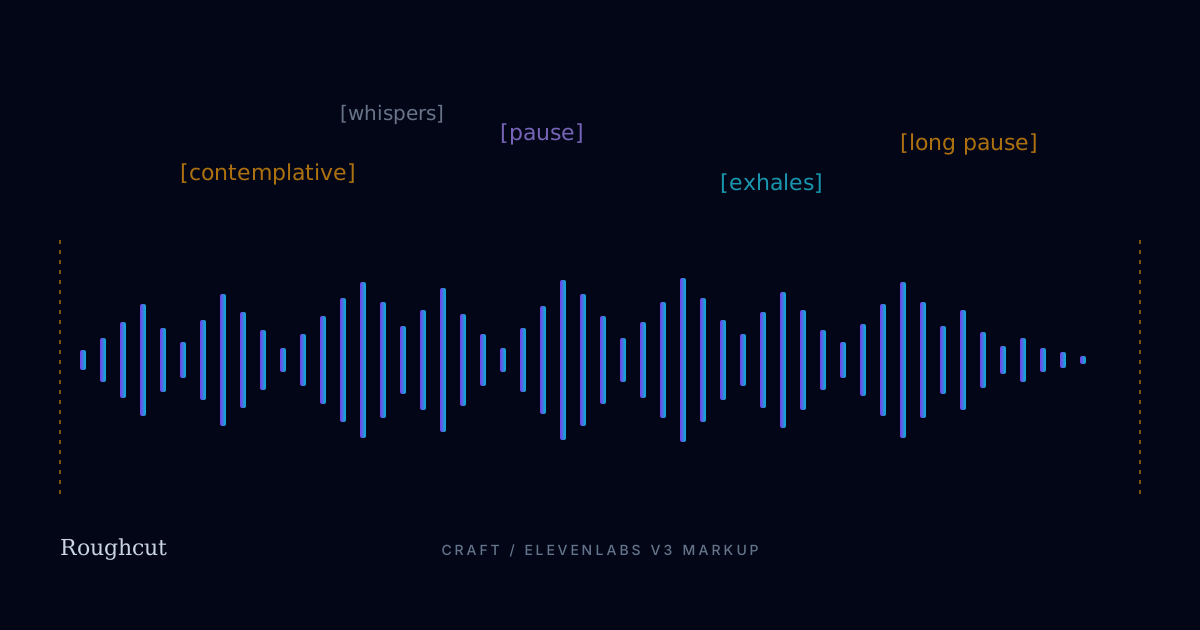
Writing for V3: ElevenLabs voice markup we actually use
A working set of V3 audio tags, pacing rules, and chunking strategies - pulled from the coffee video script. The conventions that survive contact with real production.
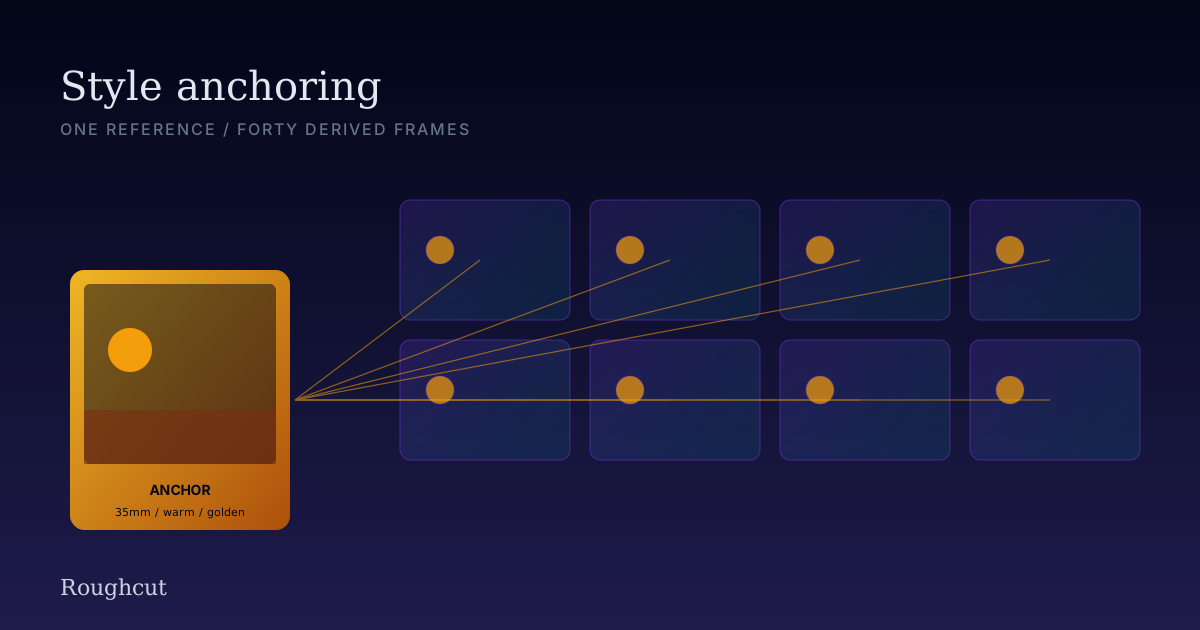
Style anchoring: how to keep 40 AI images consistent
A reference frame, a style suffix, and a discipline. The protocol we use to hold a single visual language across forty Gemini frames in a five-minute video.