Britons: Lord Kitchener Wants YOU
Alfred Leete / London Opinion · 1914
The founding image of the modern recruitment poster - Kitchener pointing at the viewer with 'Your Country Needs You'
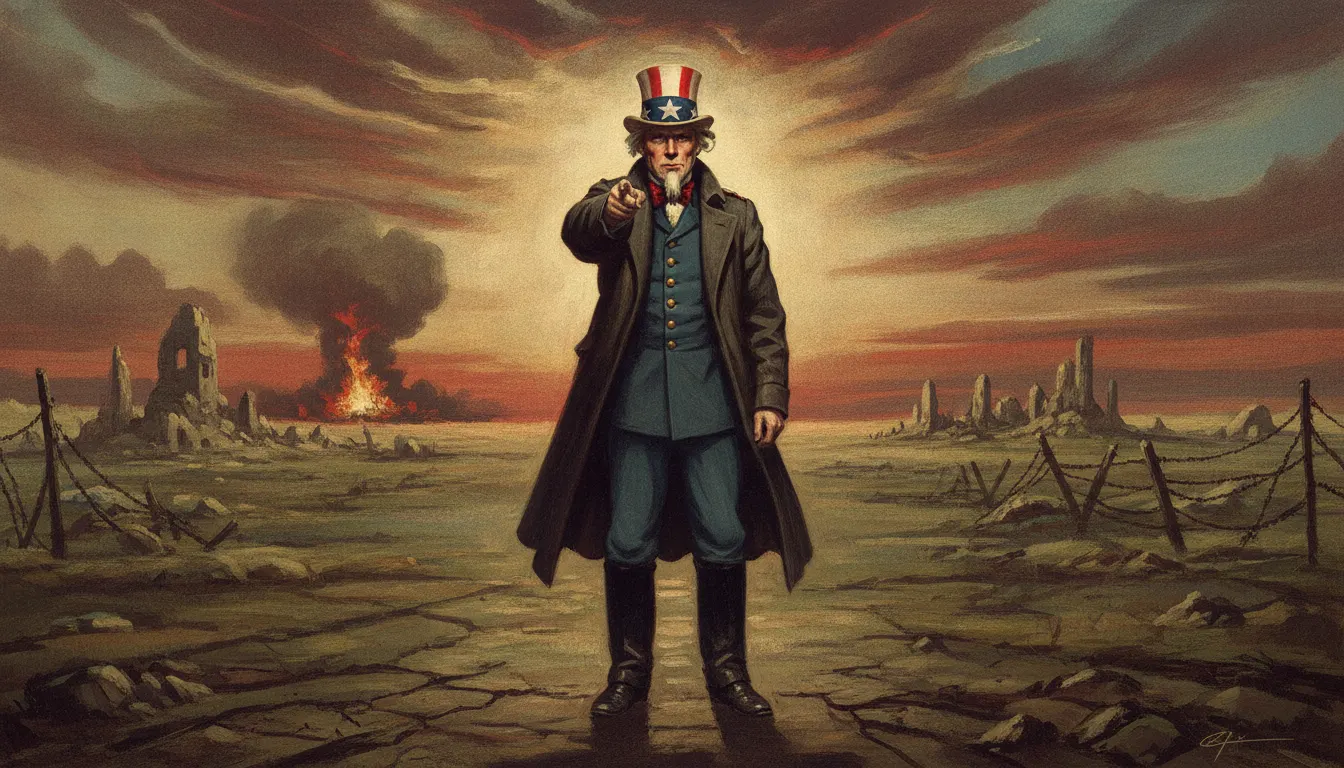
WW1 recruitment poster. James Montgomery Flagg Uncle Sam I Want You, Alfred Leete Kitchener pointing, lithographed painted figure, direct address.
The moves a human crew would use to get here. Cue applies them for you, and knowing their names is how you ask for a change.
The Kitchener/Flagg convention: subject makes eye contact with viewer and points directly at them through the picture plane.
Soldiers, allegorical national figures, and home-front characters rendered in academic illustration style with idealized physique and expression.
Headline text in heavy condensed display type, often in red or black, set at large scale for legibility at distance.
Printing cost constraints produce flat-color illustration in limited palettes - khaki, red, blue-black, flesh tones against cream paper.
Union Jack, Stars and Stripes, Imperial Eagle, or Tricolor integrated compositionally rather than used as decorative borders.
Text and image combined to frame service as personal obligation to family, community, or nation rather than abstract patriotism.
World War I produced the first modern mass-propaganda poster campaigns in history. The scale, urgency, and international scope of the conflict, combined with the absence of broadcast media, made the printed poster the primary tool of wartime public communication in Britain, the United States, Germany, France, and Russia. The visual conventions established in these campaigns - direct address to the viewer, idealized national figures, family responsibility appeals, and shaming strategies - remained templates for propaganda visual communication for the rest of the century.
The British recruiting poster featuring Secretary of State for War Lord Kitchener was designed by Alfred Leete for the front cover of London Opinion magazine on September 5, 1914 - eight weeks after war was declared. The image showed Kitchener's face in three-quarter view with his distinctive large mustache, pointing at the viewer with the phrase 'YOUR COUNTRY NEEDS YOU.' The poster form was adapted by the Parliamentary Recruiting Committee and distributed across Britain in the following months, becoming the most widely seen British image of the war's opening period.
Leete's visual innovation was the direct address and pointing gesture - earlier military recruitment images used allegorical figures or battle scenes; Kitchener pointed at you specifically. The psychological directness of this approach influenced all subsequent recruitment poster design.
James Montgomery Flagg's Uncle Sam poster (1917) was based on Leete's Kitchener, with the allegorical American figure replacing the actual general. The poster was originally created for the cover of Leslie's Weekly magazine (July 6, 1916) and used Flagg's own face as the model for Uncle Sam. The War Department reprinted it as an official recruitment poster upon the United States' entry into the war in April 1917, eventually producing approximately four million copies. The image is the single most reproduced political poster in American history, repurposed for World War II and many subsequent campaigns.
WWI recruitment posters across all combatant nations shared a set of visual strategies: the viewer-address gaze and pointing gesture (derived from Leete's Kitchener); bold, legible display type in high contrast against the image; limited color palettes imposed by chromolithographic printing costs (typically 3-5 colors); idealized figurative illustration rather than photography; and a combination of national symbols with personal or familial responsibility appeals.
British poster designers made extensive use of the 'What did you do in the Great War, Daddy?' shaming strategy, showing home-front scenes in which absent young men would eventually have to account for their inaction. German posters leaned more heavily on heroic military imagery and national symbol iconography. American posters under the Committee on Public Information (George Creel, 1917) used a broader range of strategies including humanitarian appeals and economic arguments.
Alfred Leete / London Opinion · 1914
The founding image of the modern recruitment poster - Kitchener pointing at the viewer with 'Your Country Needs You'
James Montgomery Flagg / Leslie's Weekly · 1917
Uncle Sam pointing figure using Flagg's own face - ~4 million copies printed, most reproduced political poster in American history
E.V. Kealey · 1915
British shaming poster showing women encouraging men to enlist - guilt-and-duty address to male viewers
Savile Lumley · 1915
Domestic scene with child asking father about his wartime service - the peak of the shaming-strategy approach
H.R. Hopps · 1917
American propaganda poster depicting Germany as an ape carrying Liberty - atrocity narrative visual language
CPI / George Creel · 1917-1918
US government propaganda office posters that applied the British recruitment visual language to American circumstances
A Look is not a filter. It is a set of stored decisions the pipeline reads before it makes a single frame, so two videos in the same Look actually match.