Worker and Kolkhoz Woman
Vera Mukhina · 1937
Monumental stainless steel sculpture / poster image - paradigmatic Socialist Realist heroism, became Mosfilm logo
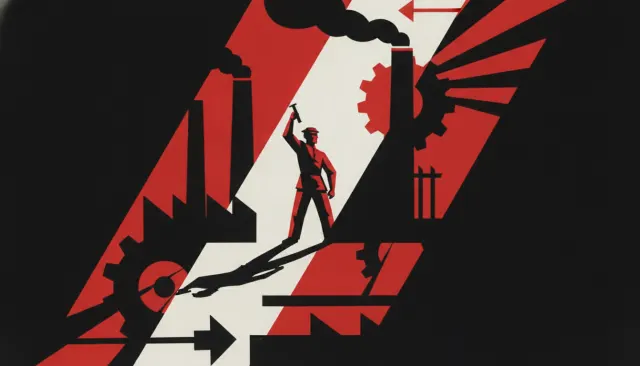
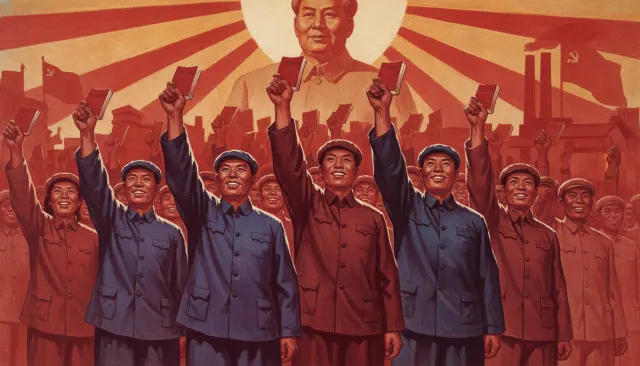
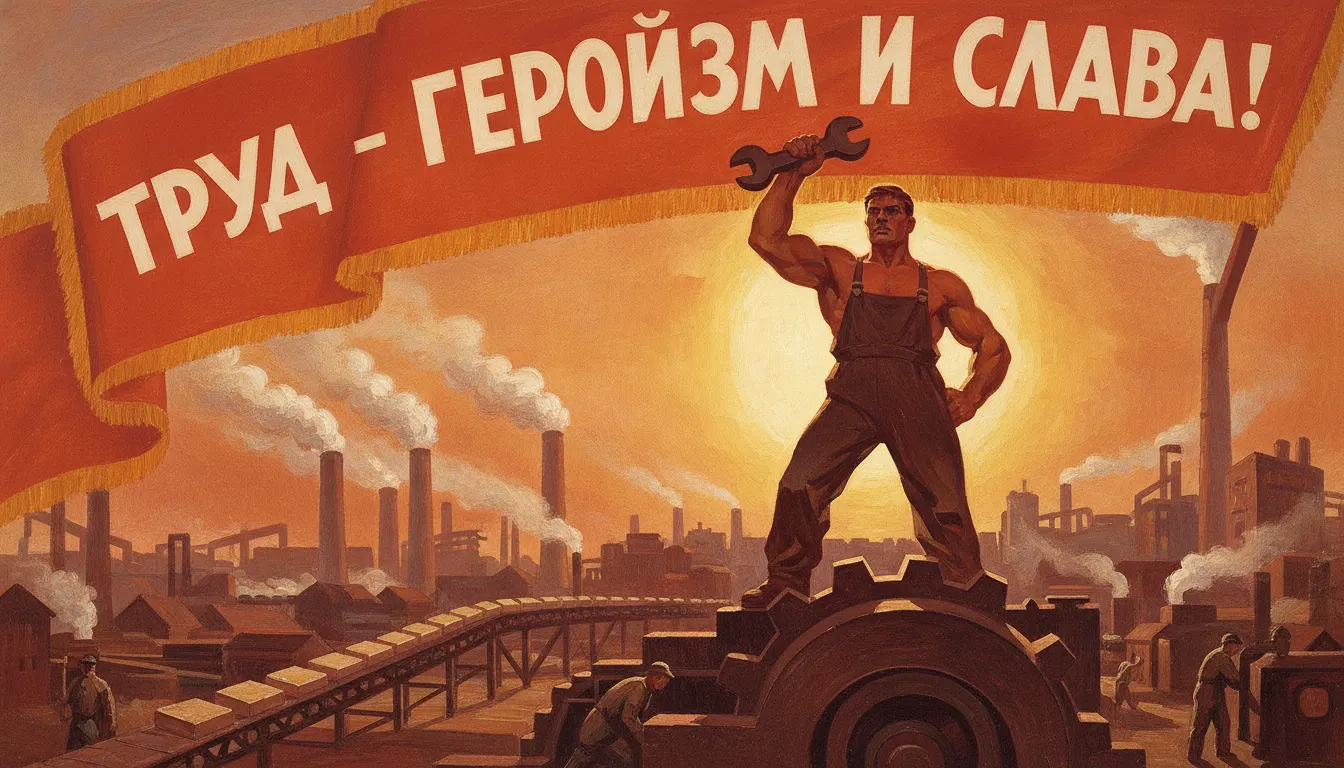
Soviet Socialist Realism poster. Heroic worker and farmer painted realism, red banners, Cyrillic slogan headlines, idealized industrial labor.
The moves a human crew would use to get here. Cue applies them for you, and knowing their names is how you ask for a change.
Subjects photographed or painted from below eye level, making idealized workers and soldiers appear monumental.
Figures painted with healthy, golden-warm skin regardless of setting; no exhaustion, illness, or class marking visible.
Revolutionary red used for flags and accent; golden yellow for wheat, sunlight, and achievement; bright blue for optimistic skies.
Foreground figures sharply lit against a mid-ground of activity and a background of landscape or industrial setting.
Slogans set in heavy-weight Cyrillic display fonts in red or white, placed below or around the central figure composition.
Figures lean or stride toward the viewer or toward the picture's implied future; stasis or backward movement are absent.
Socialist Realism was declared the mandatory artistic doctrine of the Soviet Union in 1932, when Stalin dissolved the competing avant-garde factions and established the Union of Soviet Artists. The aesthetic imposed on graphic and applied art was simultaneously a rejection of Constructivist abstraction and a development of the nineteenth-century Russian academic tradition: human figures rendered with anatomical fidelity, idealized to the point of heroic impossibility, placed in compositions designed to inspire admiration, pride, and conformity.
Andrei Zhdanov's formulation of Socialist Realism at the 1934 First Congress of Soviet Writers - that art must be "realistic in form, socialist in content" - provided the theoretical framework that poster designers were required to implement. The decree was enforced through the Union of Artists' approval process; work that deviated from the formula was rejected, and the careers of artists who persisted in modernist approaches were ended or their lives endangered.
The poster was the primary vehicle of Socialist Realist visual communication because of its mass-reproduction capacity and its display in workplaces, public squares, train stations, and apartment buildings. Production was industrial: the publishing house Iskusstvo (Art) produced millions of copies of approved designs annually.
Vera Mukhina (1889-1953) was the most celebrated sculptor of the Soviet period, and her monumental work Worker and Kolkhoz Woman (1937), designed for the Soviet pavilion at the Paris International Exposition, became the paradigmatic image of Socialist Realist heroism: two idealized figures, a male industrial worker and a female collective farm worker, raising a hammer and sickle above their heads in a forward-surging gesture. The sculpture was reproduced in poster and film-title contexts throughout the Soviet period and became the logo of Mosfilm, the USSR's primary film studio.
Alexander Deineka (1899-1969) was the most important painter of the movement, his images of athletes, workers, and pilots combining genuine formal sophistication with the required ideological content. His Defence of Petrograd (1928) and Future Pilots (1938) represent the highest artistic quality achieved within the socialist realist framework.
Viktor Ivanov and Yuri Pименov were among the leading poster designers; their work from the 1940s and 1950s shows a mastery of figure painting and composition that, stripped of its propagandistic intent, reads as virtuosic academic illustration.
Socialist Realist posters are characterized by monumentally scaled idealized figures, often depicted from a low angle that increases their visual authority. Skin tones are warm and healthy; musculature is visible through clothing. Color palettes are vivid and declarative: red flags, golden wheat fields, blue skies. Typography is bold and authoritative, often Cyrillic display fonts set in red or white against the image. The perspective construction creates theatrical depth that emphasizes the grandeur of the depicted activity.
Since the Soviet collapse in 1991, the visual language of Socialist Realism has been repurposed extensively - in advertising that inverts its heroism comically, in contemporary art by Komar and Melamid and later artists who use the style as critique, and in retro-nostalgic contexts across the former Soviet bloc.
Vera Mukhina · 1937
Monumental stainless steel sculpture / poster image - paradigmatic Socialist Realist heroism, became Mosfilm logo
Alexander Deineka · 1928
Painting that combined genuine compositional virtuosity with required ideological content
Alexander Deineka · 1938
Three boys watching aircraft - optimistic vision of Soviet technological progress and youth
Various Soviet poster artists · 1930s-1980s
Mass-produced industrial poster output published by Iskusstvo (Art) publishing house
Gustav Klutsis · 1930
Photomontage poster bridging Constructivist methods with Socialist Realist content requirements
Irakli Toidze · 1941
WWII recruitment poster showing allegorical Russia as a woman - the most reproduced Soviet wartime image
A Look is not a filter. It is a set of stored decisions the pipeline reads before it makes a single frame, so two videos in the same Look actually match.