Andy Warhol
Campbell's Soup Cans (1962, 32 canvases, MoMA)
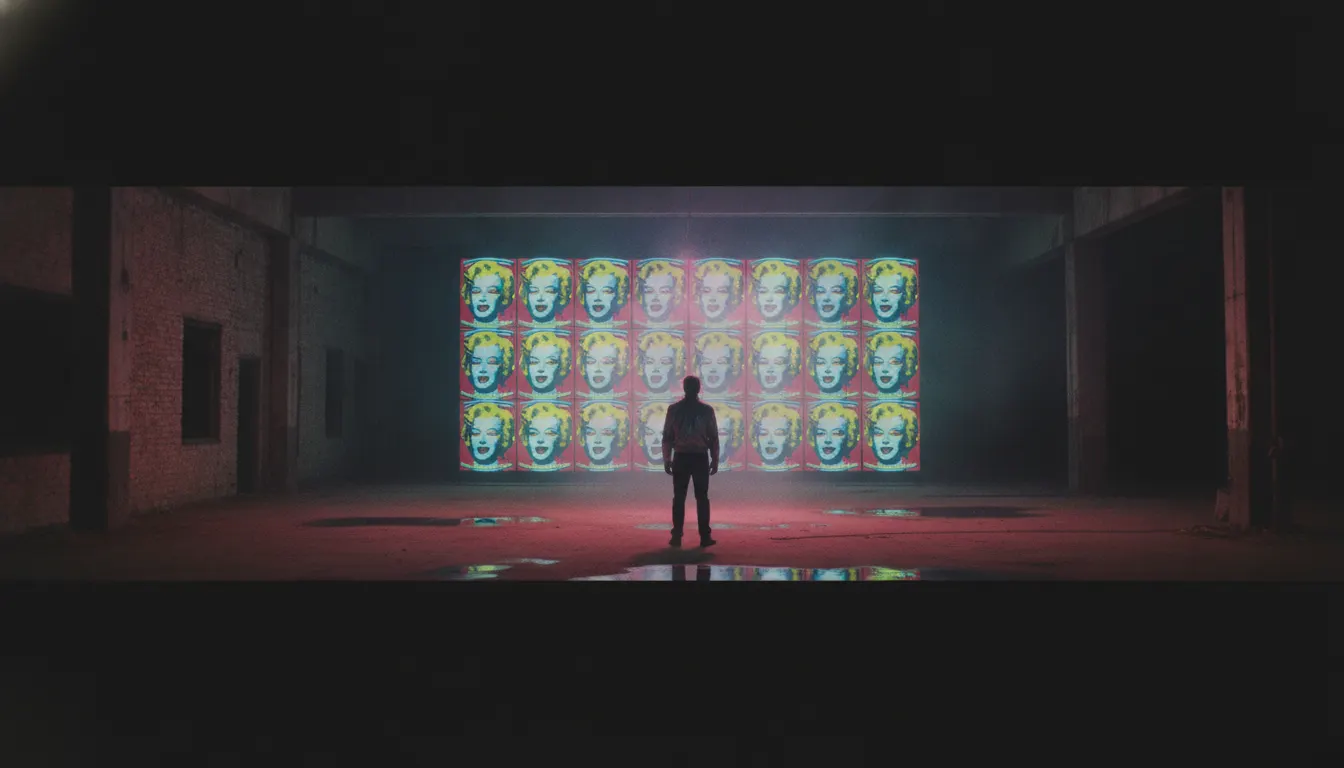
Andy Warhol Factory silkscreen grid. Repeated celebrity portrait, mis-registered neon overlay, Marilyn Soup-Can Pop Art.
The moves a human crew would use to get here. Cue applies them for you, and knowing their names is how you ask for a change.
color over photographic base - colors are assigned zones rather than descriptive of form
the silkscreen color layer sits slightly off from the outline, creating visible manufacturing error
a single image or object repeated in a regular matrix, each instance varying only in color assignment
natural color choices: Monroe's face in acid green, cobalt blue, orange - color as arbitrary and industrial as a spray paint can
contrast black outline lifted from a photographic source, flattened to a single line weight
half or paired-section fade: color grid adjacent to monochrome or fading-to-white grid
multiple identical units stacked or arrayed as spatial sculpture
Andy Warhol (1928–1987) is the central figure of American Pop Art, and his specific contribution was to make the mechanical reproduction process - the silkscreen, the photograph, the commodity package - into the aesthetic content of the work, not merely its means of production. Where his British Pop Art contemporaries (Richard Hamilton, Peter Blake) treated consumer culture as subject matter, Warhol made the look and feel of industrial repetition into the formal language of his art.
Campbell's Soup Cans (July 1962, Ferus Gallery, Los Angeles) consisted of 32 canvases, each 50.8×40.6 cm, each depicting a different variety of Campbell's condensed soup. The canvases were displayed on a shelf, mimicking a supermarket shelf display. The flat, deadpan rendering - uniform, commercially reproduced-looking - was achieved through silkscreen printing over hand-painted grounds. The critical question Warhol posed was simple and devastating: if the supermarket can produce 32 near-identical cans, and if mass production has colonized daily life, what does a unique artist's painting mean? The work is simultaneously an embrace of consumer culture and a deconstruction of it.
Marilyn Diptych (1962, Tate Modern) was made in the weeks following Marilyn Monroe's death in August 1962. The left panel repeats Monroe's face 25 times in vivid, slightly misaligned silkscreen color - the colors oversaturated and clashing, the registration imprecise. The right panel repeats the same image 25 times in black and white, the ink fading toward the right until the faces dissolve into near-white emptiness. The diptych's structure enacts its argument: fame is repetition until it becomes noise; death is the image repeating until it fades to nothing.
Brillo Boxes (1964, installation at Stable Gallery, New York) were plywood boxes painted and silkscreened to replicate the commercial Brillo soap-pad shipping cartons. Stacked in the gallery to floor-to-ceiling, they created a warehouse aesthetic inside a gallery space. The question was whether the Warhol box was art and the supermarket box was not, given that they were visually identical. Philosopher Arthur Danto wrote his theory of the "art world" in response to the Brillo Boxes.
The Factory - Warhol's Silver-sprayed studio at 231 East 47th Street (1963–67) - was designed as an industrial production environment, with assistants helping produce multiples of Warhol's works. The production of art as factory output was itself a conceptual statement.
Warhol's Death and Disaster series (1963–64) applied the same repetition-until-desensitization logic to news photographs of car crashes, suicides, and execution chambers. Electric Chair (1964) used the Department of Corrections' own photograph of the Sing Sing execution chamber, repeated in different color combinations, until the image of state violence became decorative wallpaper.
Warhol's silkscreen aesthetic is one of the most commercially absorbed visual vocabularies in history - it has become the default language for "art" in popular culture, brand design, and political poster-making. As a look for video, it signals cultural celebrity, the critique of celebrity, and the unstable boundary between art and commerce.
Campbell's Soup Cans (1962, 32 canvases, MoMA)
Marilyn Diptych (1962, Tate Modern)
Brillo Boxes (1964, Stable Gallery installation, various collections)
Electric Chair (1964, multiple color versions)
Shot Marilyns (1964, four versions; one sold for $195M in 2022)
Mao (1972, extensive series)
Flowers (1964, Leo Castelli Gallery)
Death Race / Car Crash series (1963–64)
A Look is not a filter. It is a set of stored decisions the pipeline reads before it makes a single frame, so two videos in the same Look actually match.