Tomb Raider
Core Design, PS1/Saturn, 1996, lead designer Toby Gard (primary reference)
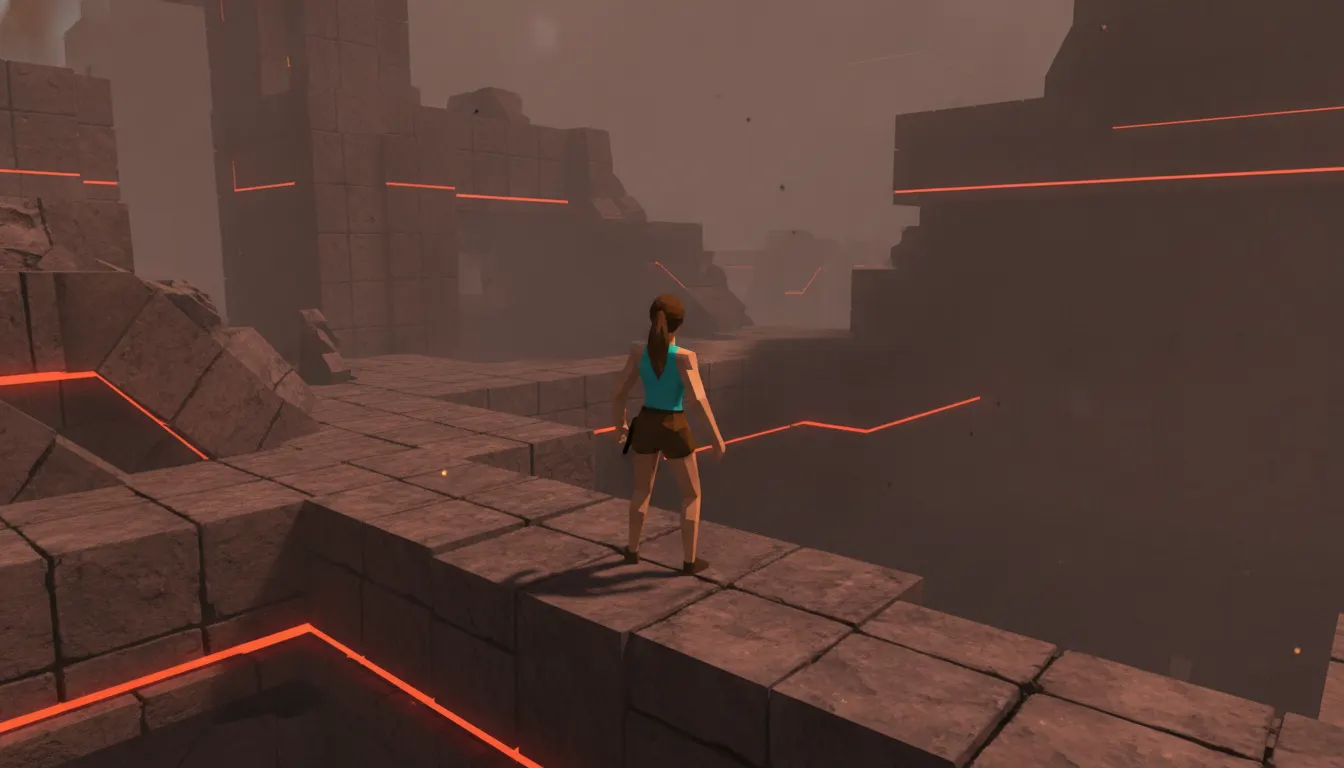
Core Design Tomb Raider 1996 PS1 jagged-polygon CGI. Lara Croft pyramidal pony-tail, blocky bicep, fog-distance culling, Atlantean tomb adventure.
The moves a human crew would use to get here. Cue applies them for you, and knowing their names is how you ask for a change.
shaped flat light gradients across surfaces
based environment geometry with rectangular extrusions along a clear grid
person camera tracking from behind and above emphasizing architectural geometry
shaded texture maps with minimal bilinear filtering showing raw texel texture quality
Core Design's Tomb Raider (1996, produced by Jeremy Heath-Smith, lead designer Toby Gard) launched on Sega Saturn and PlayStation in October 1996 and became one of the defining aesthetic experiences of early 3D gaming. The game's protagonist, Lara Croft, was rendered in roughly 540 polygons - a cone-shaped figure with triangular breasts, square hands, and a blocky braid that moved as a rigid attached object - yet she became one of the most culturally recognized game characters of the decade.
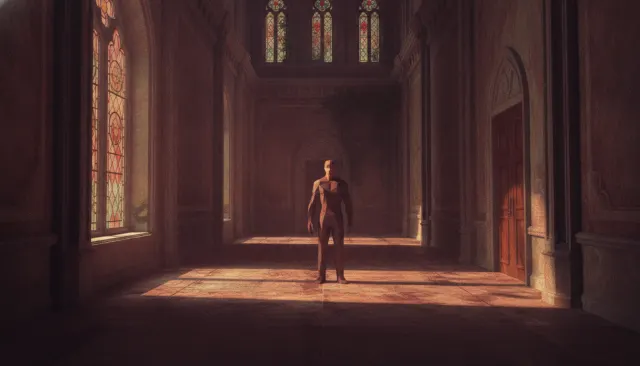
The PS1 rendered geometry as individual triangles with Gouraud (vertex color) shading rather than per-pixel texture filtering. This meant surfaces had a characteristic prismatic quality: curved shapes were approximated by visible facets, and lighting fell in flat wedge gradients across polygon faces rather than smooth blends. The tomb environments - Egyptian chambers, Peruvian ruins, Atlantean platforms - were built from rectangular tile geometry extruded along grid layouts, giving them a modular, architectural quality that emphasized regularity and proportion over organic detail.
Toby Gard's original design specified that Lara should be angular and geometric partly out of artistic choice and partly out of polygon budget reality. The result was that her impossible angular body proportions - exaggerated in the marketing material by a factor that the actual game model didn't match - became a cultural conversation point that persists. The 540-polygon Lara is simultaneously crude and iconic.
The game used a fixed third-person camera that tracked Lara from behind and above, giving a specific perspective on her environment that the square tile geometry amplified: every chamber read as a cubic puzzle box seen from a theatrical viewpoint. The ambient soundtrack by Nathan McCree used sparse droning tones and sudden orchestral stings for combat - a sonic design as specific as the visual one.
Core Design, PS1/Saturn, 1996, lead designer Toby Gard (primary reference)
Core Design, PS1, 1997 (Great Wall and Venice, same engine pushed further)
Core Design, PS1, 1998 (jungle and London, peak of the original PS1 look)
Naughty Dog, PS1, 1996 (contemporary PS1 3D platformer with similar polygon aesthetic)
Crystal Dynamics, 2007 (PS3/360 remake that modernized the 1996 design)
Crystal Dynamics, 2015 (PS4-era photorealist continuation, contrast reference)
A Look is not a filter. It is a set of stored decisions the pipeline reads before it makes a single frame, so two videos in the same Look actually match.