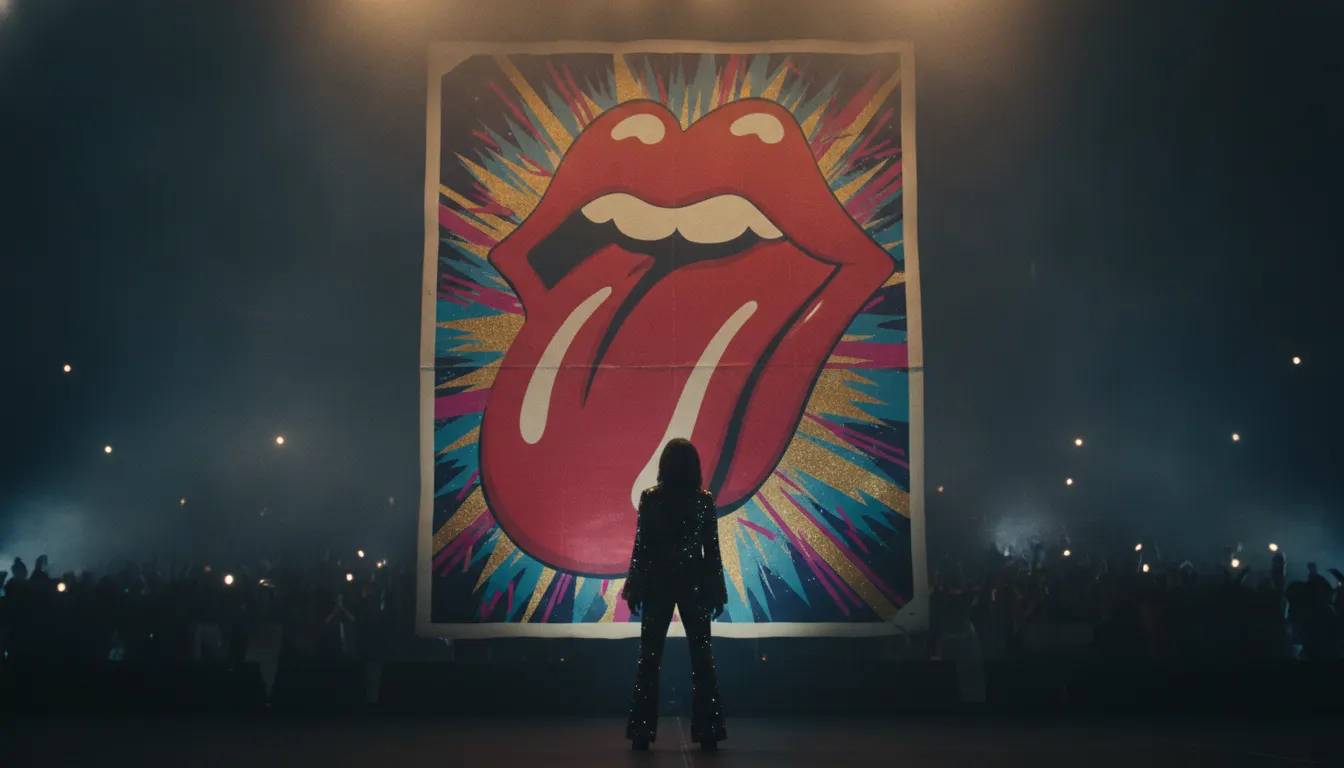
John Pasche, original tongue-and-lips design -- purchased by V&A for £92,500 in 2008
1971
Rolling Stones John Pasche tongue and lips logo era poster. Glossy red lips, protruding tongue, glam-rock 70s tour poster, iconic band branding.
The moves a human crew would use to get here. Cue applies them for you, and knowing their names is how you ask for a change.
colour (red and white/black) graphic design with no tonal modulation, gradients, or shadow
the image works at 1 centimetre (guitar pick) and at 10 metres (stage backdrop) equally
- slightly asymmetric, anatomically suggestive but stylised
of-centre for dynamism
contrast colour: saturated red on white, or white on black, with no mid-tones
The tongue-and-lips logo designed by John Pasche in 1971 for the Rolling Stones is arguably the most iconic rock band identity ever created -- a single mark that encapsulates rebellion, sexuality, and rock music so efficiently that it has operated as an autonomous cultural symbol for over five decades.
John Pasche was a Royal College of Art graduate student in 1970 when Mick Jagger commissioned him to design a poster for the Stones' 1971 UK tour. Jagger wanted a logo that would also work as a standalone image. Pasche was paid £50 for the original design. He later received a further £200 when it was licensed. The Victoria & Albert Museum purchased the original artwork in 2008 for £92,500.
Pasche has described the influences as Mick Jagger's own lips and mouth, which are physically distinctive, and the Hindu goddess Kali, who is traditionally depicted with an extended tongue -- a symbol of power, defiance, and transgression. The logo first appeared officially on the Sticky Fingers album (1971, designed by Andy Warhol -- though the tongue does not appear on the Warhol cover, only on the tour programme).
The logo is a masterpiece of reductive graphic design: the thick red tongue, extended from between two outlined red lips, against white, in flat colour with no shading or gradient. The outline is confident and slightly irregular -- human, not mechanical. The lip-lines are bold enough to be legible at small scale on a guitar pick or at 10 metres on a stage backdrop. Red and white (sometimes red and black) are the only colours. The mouth is slightly open, slightly confrontational, slightly absurd.
The logo has appeared on every major Stones tour since 1972, on hundreds of licensed products, and has been reworked for specific tours: the Steel Wheels tongue (1989), the Voodoo Lounge tongue (1994), and the No Filter tongue (2017). It has been referenced, parodied, and homaged across popular culture so extensively that it constitutes its own design vocabulary.
1971
1972
1989
1994
1971
A Look is not a filter. It is a set of stored decisions the pipeline reads before it makes a single frame, so two videos in the same Look actually match.