POP AND STREET ART · 1960S · USA
Pop Art Lichtenstein Halftone
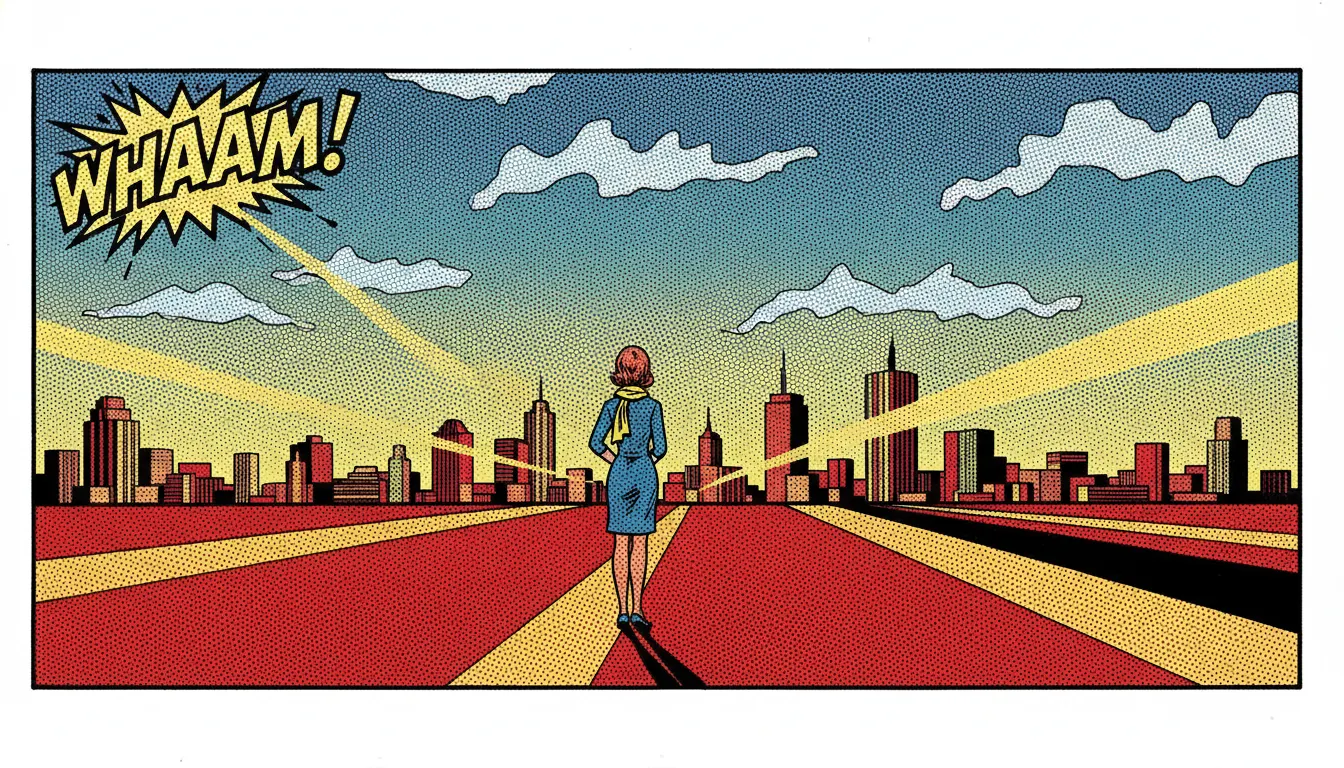
Roy Lichtenstein Pop Art comic panel. Ben-Day dot halftone, thick black outline, speech bubble Whaam, primary-color romance comic.
pop-artcomichalftoneiconic
WHEN TO USE
- Pop culture, entertainment, or gaming content that wants a bold, comic-book energy with fine-art credibility
- Action sequences, conflict, or dramatic moments where the speech-bubble and halftone lexicon reinforces the beat
- Brand campaigns referencing nostalgia for mid-century American mass culture
- Retro-themed events, album artwork, or merchandise where graphic boldness and recognisability are key
- Social media content designed to stop the scroll with flat colour and high contrast
WHEN NOT TO USE
- Serious, sensitive, or nuanced subject matter where the comic-book register trivialises the content
- Luxury or premium brand campaigns where the mass-culture associations undercut exclusivity
- Natural, organic, or wellness brands where the hard graphic edges conflict with softness values
- Content aimed at very young children where comic-book violence iconography is inappropriate
SIGNATURE TECHNIQUES
How the look is made.
The moves a human crew would use to get here. Cue applies them for you, and knowing their names is how you ask for a change.
- 01Ben
Day dot fields -- evenly spaced circular dots in primary or secondary colours -- simulating halftone printing
- 02Bold, uniform black outlines around all forms, regardless of distance or atmospheric perspective
- 03Flat, unmodulated primary colour fills (red, yellow, blue, green) with no tonal variation
- 04Comic
book speech bubbles and thought clouds with hand-lettered or stencilled ALL-CAPS text
- 05Deliberately simplified and cleaned
up source imagery: fewer lines, more decisive shapes than the original comic panel
- 06High
key, white backgrounds with minimal atmospheric depth
- 07Occasional use of diagonal line hatching (as in printing screens) alongside or instead of dots
HISTORY & CONTEXT
Where it comes from.
Pop Art: Lichtenstein Halftone
Roy Lichtenstein (1923-1997) is the most technically specific of the American Pop artists. Where Andy Warhol appropriated mass-media imagery through silkscreen, Lichtenstein zeroed in on the mechanical reproduction process itself -- specifically the Ben-Day dot, the cheap halftone printing technique used in 1950s and 1960s comic books -- and enlarged it to monumental scale.
The Ben-Day Dot System
Ben-Day dots (named for illustrator Benjamin Henry Day Jr.) are small, evenly spaced coloured dots used in cheap offset printing to simulate tones and gradients. In a printed comic book, a character's yellow skin is a field of yellow dots; a blue sky is blue dots on white. Lichtenstein projected comic panels onto canvas and manually rendered these mechanical dots by hand, using a metal stencil to achieve the characteristic even spacing. At the 5-foot scale of Whaam! or Drowning Girl, dots that should be invisible become the subject.
Key Works
Look Mickey (1961) -- derived from a Little Golden Book page -- is considered his first Pop canvas. Whaam! (1963, Tate Modern) is a diptych 13 feet wide, depicting a jet firing a missile, derived from an All-American Men of War panel (artist Irv Novick). Drowning Girl (1963, MoMA) -- adapted from a DC Comics romance panel by Tony Abruzzo -- shows a woman in choppy waves, a speech bubble reading "I DON'T CARE! I'D RATHER SINK THAN CALL BRAD FOR HELP!" In both, Lichtenstein simplified the source: fewer lines, cleaner areas of flat colour, the dots made uniform and deliberate.
Influence
Lichtenstein's lexicon -- bold black outline, primary colours (red, yellow, blue) plus black and white, speech bubbles, Ben-Day field -- has been absorbed into graphic design, advertising, and digital illustration to the point of cliché. His later work applied the same system to Picasso, Monet, and Abstract Expressionism, producing meta-commentaries on art history.
NOTABLE WORKS
Where you have seen it.
Drowning Girl (1963, MoMA) -- DC romance comics source, iconic speech bubble
Whaam! (1963, Tate Modern) -- 13-foot diptych, All-American Men of War source
Hopeless (1963, Kunstmuseum Basel) -- weeping woman with speech bubble
Girl with Ball (1961, MoMA) -- sourced from Pocono Mountains resort ad
I Know... Brad (1963, Museum of Contemporary Art Chicago)
THE RECIPE
The exact knobs
the renderer turns.
A Look is not a filter. It is a set of stored decisions the pipeline reads before it makes a single frame, so two videos in the same Look actually match.
SettingValue
TransitionHow one shot becomes the next
hard cuts · 160ms · linearKen BurnsCamera move applied to stills
Slow push · 0.02 · centerTypographyDisplay / body / mono pairing
Bangers · Inter · JetBrains MonoMusic moodWhat the bed under the voice sounds like
surf-rock · 60s-popPrompt suffixAppended to every shot prompt in this Look
Roy Lichtenstein Pop Art comic panel, Ben-Day dot halftone, thick black outline, speech bubble Whaam, primary color romance comicPALETTE
Primary
#D62828
Secondary
#1A3A8E
Accent
#F5C144
Text/Light
#0A0A0A
Text/Dark
#FFFFFF
BG 900
#0A0A0A
BG 800
#1A1A1A
RELATED LOOKS
Next to it on the shelf.


Your first cut
is on us.
+ New videoFree plan · no card · 1080p export