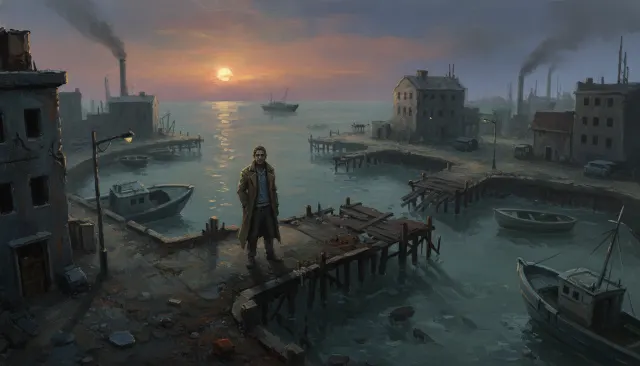
Red Dead Redemption (Rockstar San Diego, 2010)
the foundational western game aesthetic
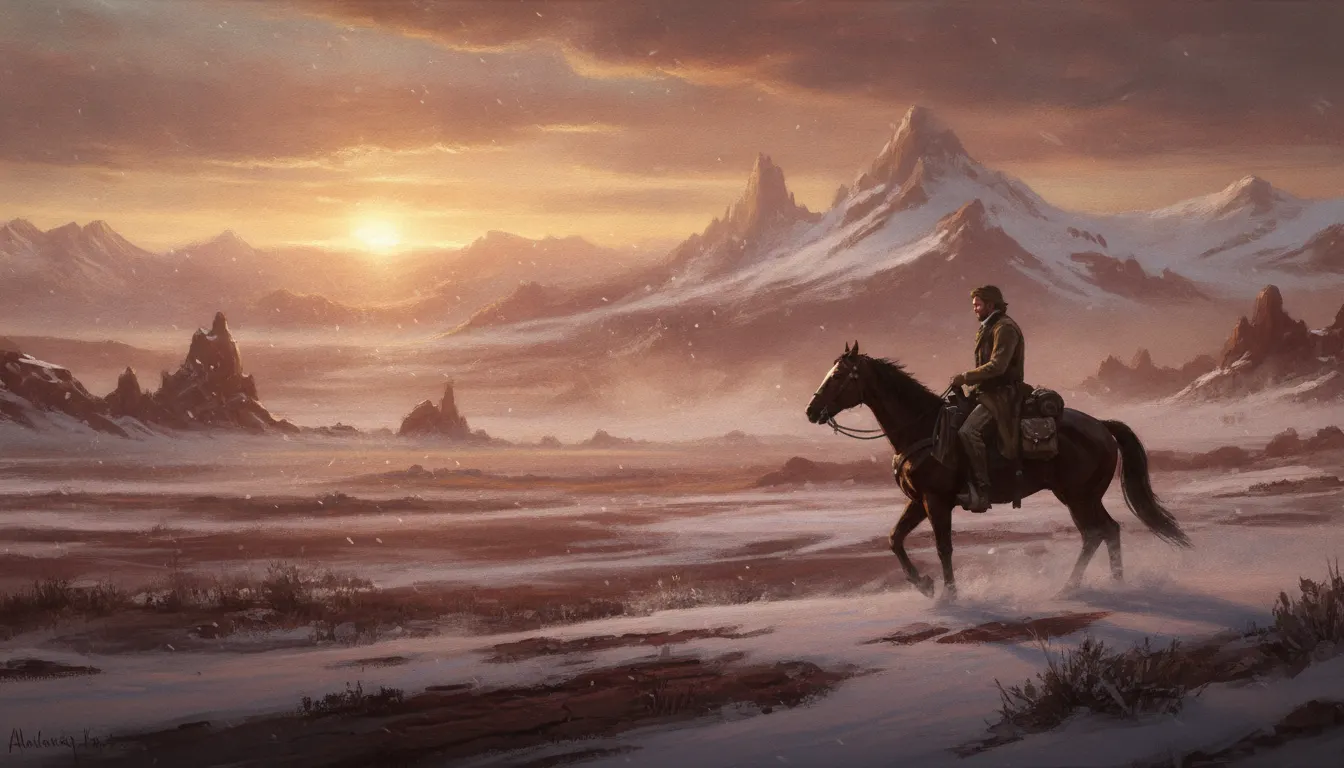
Red Dead Redemption 2 Rockstar painterly-western aesthetic. Bierstadt-inspired vistas, Arthur Morgan saddle-side cinematography, dust-and-snow biome variety.
The moves a human crew would use to get here. Cue applies them for you, and knowing their names is how you ask for a change.
hour light: warm 2800-3200K directional light with long shadow stretching
to-land ratios with a third or more of the frame occupied by cloud formations
purple scattering
15% opacity for photochemical texture
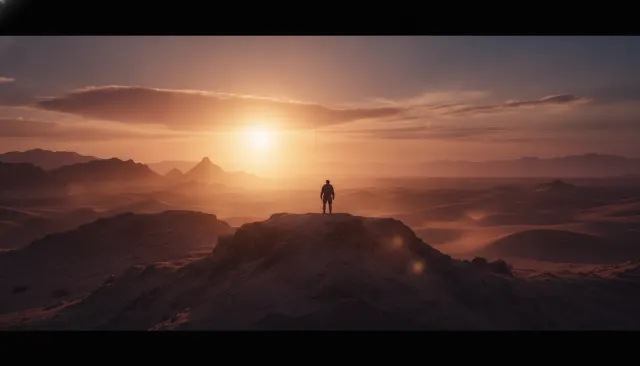
figures dark against luminous horizon skies
Red Dead Redemption (Rockstar San Diego, 2010) and its sequel Red Dead Redemption 2 (Rockstar Studios, 2018) represent the most ambitious attempt to render the American frontier as living painterly spectacle. Both games draw from a rich tradition - Frederic Remington's action paintings, Charles Russell's warmly-lit plains landscapes, Sergio Leone's widescreen spaghetti westerns, and Terrence Malick's light-worshipping cinematography - to create a visual register that transcends the western genre and enters the territory of fine art.
Frederic Remington (1861-1909) and Charles M. Russell (1864-1926) defined the visual mythology of the American West through oil paintings characterized by golden-hour light, vast sky-to-land ratios, and figures rendered in silhouette against luminous horizons. RDR2's art team explicitly studied this tradition. The Heartlands in RDR2 - golden grasses bending in wind, storm clouds building on the horizon, campfire smoke drifting into a purpling dusk sky - are essentially Remington compositions rendered in real time.
RDR2 employs one of the most sophisticated time-of-day and weather systems in gaming. The directional light color temperature shifts from a cold 7000K blue-white at midday to a warm 2800K amber at golden hour, with atmospheric scattering that deepens shadows and hazes distant terrain in purple-blue. Volumetric clouds cast moving shadows across the landscape. Rain darkens everything by 30-40% in perceived brightness and adds specular highlights to every surface.
The film grain overlay - heavier than most contemporary games - deliberately pushes the image toward a photochemical aesthetic. Combined with a slight chromatic aberration at frame edges and the vignette, the result is an image that reads as photographed rather than rendered.
Both RDR games reward stillness with compositional payoff. The camera frequently catches Arthur Morgan (RDR2) or John Marston (RDR1) as a small figure against enormous landscapes - a compositional strategy directly borrowed from Hudson River School painting and western photography. Wide-angle vistas pull the horizon low, maximizing sky. The painterly west look is inseparable from this ratio: vast negative space occupied by atmosphere, weather, and light.
the foundational western game aesthetic
the painterly West at its technical peak
primary art historical source
warmly lit plains companion tradition
widescreen cinematic western ancestor
golden-hour photography as spiritual practice
contemporary painterly west cinematography
A Look is not a filter. It is a set of stored decisions the pipeline reads before it makes a single frame, so two videos in the same Look actually match.