Bob Dylan Poster
Milton Glaser / Push Pin Studios · 1966
Psychedelic Art Nouveau silhouette included with Bob Dylan's Greatest Hits album - one of the most reproduced posters in history
Push Pin Studios eclectic illustration design. Milton Glaser and Seymour Chwast, decorative historical revival, flat shapes with line, 60s NYC.
The moves a human crew would use to get here. Cue applies them for you, and knowing their names is how you ask for a change.
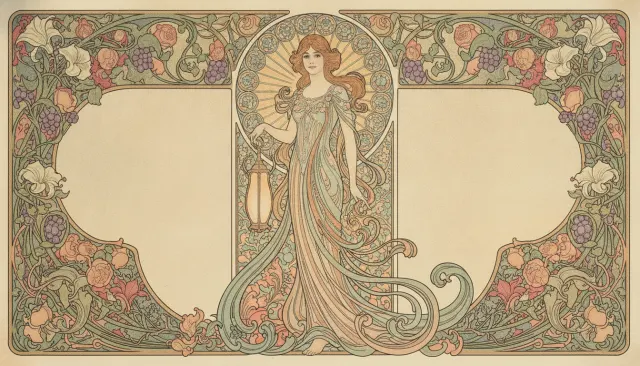
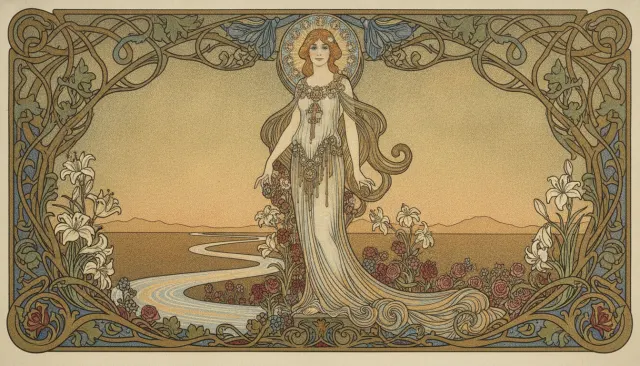
Deliberate borrowing from Art Nouveau, Victorian chromolithography, or 1930s pulp illustration combined with contemporary color and sensibility.
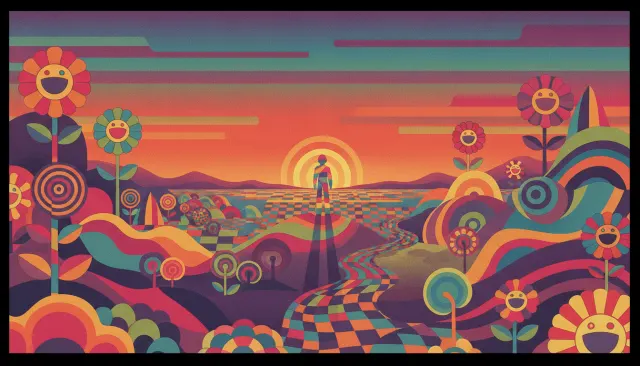
Non-primary warm hues - ochre, dusty rose, sage green, terracotta - applied as flat unmodulated fills rather than rendered volumes.
Type designed as part of the illustration composition; fonts drawn in period-referencing styles rather than set from digital catalogs.
Figures defined by hard outer silhouette with decorative pattern or color field filling the interior - the Dylan poster technique.
Images designed to carry an ironic or narrative subtext beyond their surface subject, rewarding the viewer who looks twice.
Victorian or Art Nouveau-derived borders, scrollwork, and decorative frames used to give images a collected or archival quality.
Push Pin Studios, founded in New York City in 1954 by Milton Glaser, Seymour Chwast, Reynolds Ruffins, and Edward Sorel, became the most influential American illustration and graphic design collective of the second half of the twentieth century. Working against the clean International Style that dominated corporate design, Push Pin revived historical ornamental traditions - Art Nouveau, Victorian chromolithography, Art Deco, 1930s pulp illustration - and recombined them with Pop Art color and vernacular American imagery to produce a style that was simultaneously nostalgic and radically contemporary.
The Push Pin Monthly Graphic, a self-published promotional publication begun in 1957, was the studio's primary vehicle for experimentation. Each issue was an art object in its own right, exploring a different historical style or visual problem. Through this publication, Push Pin's approach reached designers across Europe and Japan, directly influencing the designers who would later be called the New Wave.
Milton Glaser (1929-2020) produced the most recognized single image of the Push Pin era: the Bob Dylan poster (1966), included with the Bob Dylan's Greatest Hits album. The silhouette profile with psychedelic hair streams drawn in flat colors against a black background combined Art Nouveau decorative logic with Pop Art color in a way that read simultaneously as poster art, album packaging, and cultural manifesto. His I♥NY logo (1977), commissioned for a New York State tourism campaign and designed on a paper bag fragment in a taxi, became one of the most reproduced graphic symbols in history.
Seymour Chwast (b. 1931) brought a rougher, more vernacular sensibility - Victorian wood-type letterforms, 1890s broadside aesthetics, chunky outline illustration that owed more to children's book art than to European modernism. His work had a warm, wry quality that balanced Glaser's more elegant decorative instincts.
Push Pin work is identifiable by its historicist eclecticism: the willingness to borrow from any graphic era and recombine the elements with contemporary irony or warmth. Flat color predominates, but the color choices are not the primaries of Bauhaus rationalism - they are warmer, more complex, often unexpected. Letterforms are frequently hand-drawn, decorative, and integral to the composition. The imagery is illustrative rather than photographic, favoring character and wit over documentary precision.
Push Pin's impact on American graphic design was profound enough that the 1970 Paris exhibition Push Pin Style at the Musée des Arts Décoratifs introduced the approach to European audiences. Designers including Paul Davis, James McMullan, and later designers such as Chip Kidd have cited Push Pin as foundational.
Milton Glaser / Push Pin Studios · 1966
Psychedelic Art Nouveau silhouette included with Bob Dylan's Greatest Hits album - one of the most reproduced posters in history
Milton Glaser · 1977
Tourism campaign symbol designed on a paper bag in a taxi, now the most recognized heart-symbol logo globally
Push Pin Studios collective · 1957-1980
Self-published design publication that functioned as the studio's laboratory and international calling card
Milton Glaser · 1968
Magazine launch design for Clay Felker's New York, establishing the modern city magazine visual template
Seymour Chwast · 1967
Political poster using Victorian-style soldier portrait with acid-house color to protest the Vietnam War
Push Pin Studios · 1970
Musée des Arts Décoratifs Paris retrospective that introduced the American studio's approach to European design culture
Seymour Chwast · 1960s-70s
Series of covers and posters using wood-type broadside aesthetics and chunky vernacular American illustration
A Look is not a filter. It is a set of stored decisions the pipeline reads before it makes a single frame, so two videos in the same Look actually match.