Peter Callesen
*A4 white paper sculptures* series (2000s–present), including *Half Way Through*
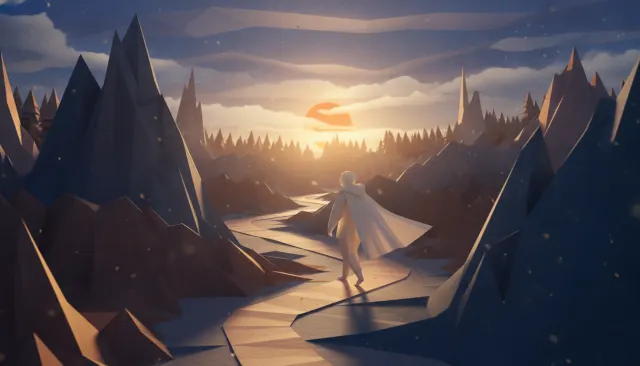
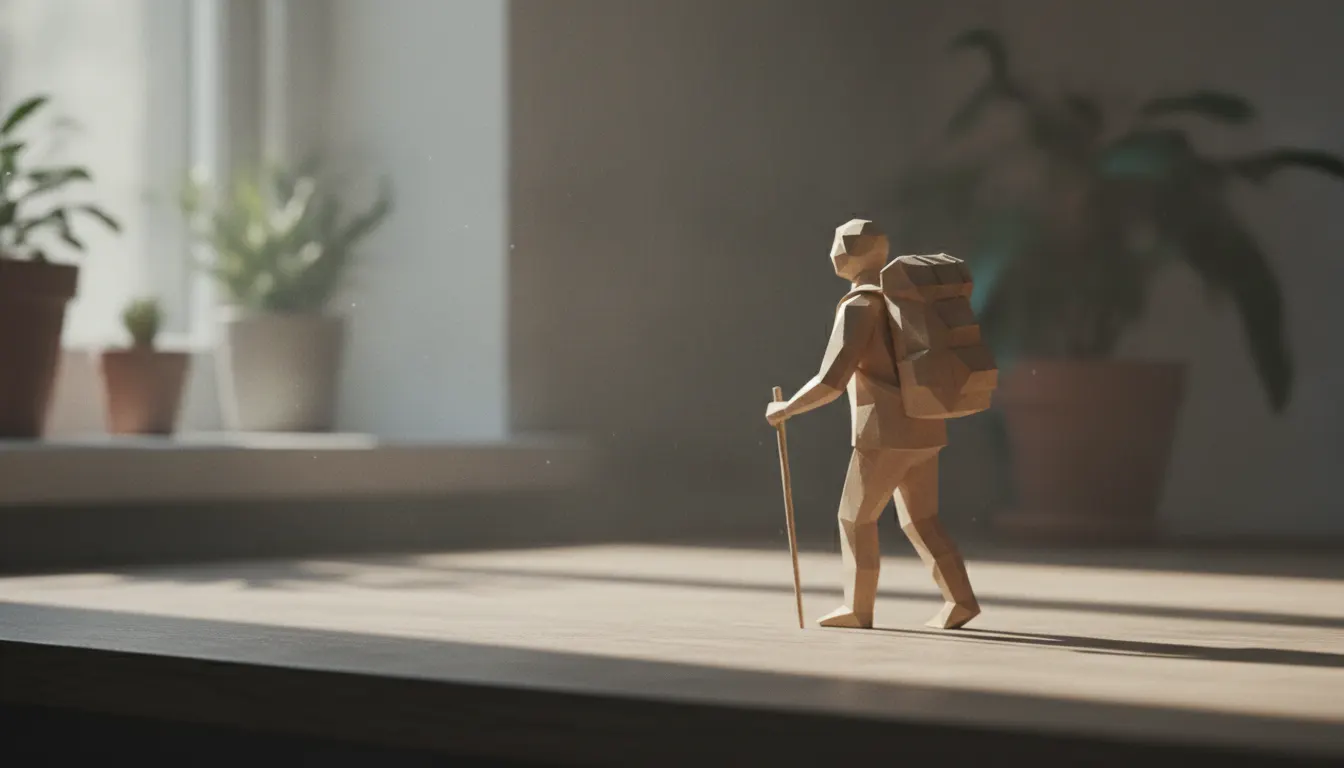
Hand-crafted low-poly paper figurine on a tabletop. Faceted folded-paper planes, visible creases and fiber texture, soft natural desk light, miniature scale.
The moves a human crew would use to get here. Cue applies them for you, and knowing their names is how you ask for a change.
sheet construction: the flat origin and the raised form coexist in the same composition
folding to achieve organic curves and organic volumes
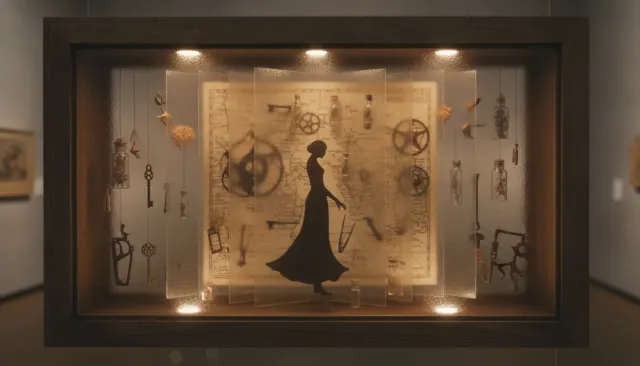
foreground cuts at full depth, midground at half, background flat
crisp valley and mountain folds at exact angles
thin connecting membranes left deliberately slender
monumental form achieved from familiar A4 or letter-size sheet
Paper sculpture is the art of transforming flat sheets into three-dimensional form through cutting, scoring, folding, and gluing without recourse to additional materials. It spans a vast range from the precise mathematical geometry of origami masters to the fragile narrative dioramas cut from the pages of books. The look in commercial and fine art contexts is defined by the material's paradox: paper implies fragility and impermanence, but paper sculpture can achieve extraordinary structural complexity and longevity.
Origami's modern lineage crystallized in the work of Akira Yoshizawa (1911–2005), who developed wet-folding in the 1950s – dampening paper to allow sculptural curves impossible with dry folding – and published Origami Dokuhon (1957). Yoshizawa's work influenced every subsequent origami artist, including Robert Lang (Caltech physicist, author of Origami Design Secrets, 2003) whose TreeMaker algorithm enabled geometric forms of unprecedented complexity.
Parallel to origami, the tradition of paper cutting (Scherenschnitte in German, Jiǎnzhǐ in Chinese) has roots across cultures. Hans Christian Andersen created intricate paper cuts as gifts. Contemporary artist Peter Callesen (Danish, active 2000s–present) creates works where a single A4 sheet is partially cut and raised to form a three-dimensional scene: a skeleton climbing from its own silhouette, a swan rising from the paper it was printed on. The flat sheet and its three-dimensional emergence are always present together.
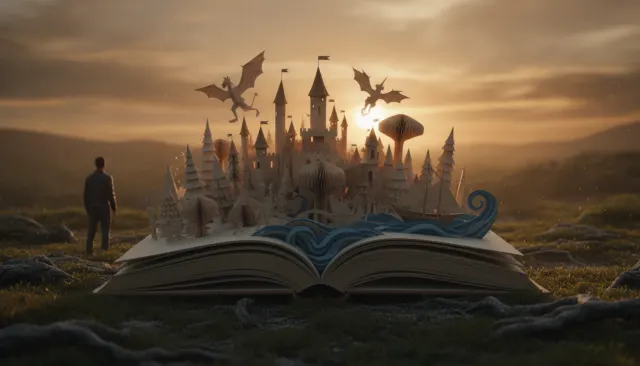
Su Blackwell's book sculptures inhabit a related space: she cuts and constructs directly from existing book pages, so the text of the original novel becomes the material of the illustration. Her 2007 commission for The Snow Child and subsequent Tolkien work brought this technique to luxury publishing and editorial photography.
Nike, Google, and numerous editorial publications have commissioned paper sculptors for photography sets. The look – controlled, white, tactile, artisanal – photographs particularly well against clean backgrounds under directional lighting that picks up fold shadows. For video, time-lapses of paper sculpture assembly have become a genre of crafts content. Directors use miniature paper sets as an alternative to CGI for establishing shots.
The choice of paper as sculptural material carries specific connotations: ephemeral, democratic, domestic, renewable. Against these values, the ambition of the work creates productive tension. When Peter Callesen builds a life-size skeleton from a single sheet of A4 paper, the contrast between the profound (mortality, full-body presence) and the trivial (an office supply) is the conceptual engine. This tension is available to any director or art director who understands what the material is saying.
The surface quality of different paper stocks changes the sculptural character entirely: smooth hot-press cartridge paper produces clean, architectural work with sharp edges and even shadow; rough cold-press watercolor paper creates organic, textile-feeling forms; Japanese kozo fiber paper folds with organic resistance and semi-translucency that reads differently in raking light. Choosing paper stock for paper sculpture is equivalent to choosing film stock for photography – it is a meaningful decision that shapes the entire expressive register of the work.
*A4 white paper sculptures* series (2000s–present), including *Half Way Through*
*Snow Child* and Tolkien book sculptures (2007–2015)
wet-folded animal sculptures (1950s–1990s, Origami Dokuhon 1957)
mathematical origami sculptures including *Black Forest Cuckoo Clock* (TreeMaker, 2003)
relief paper portraits published in *Paper Art* (Firefly Books, 2009)
tunnel book and layered paper sculptures, Neon exhibition (2007–present)
geometric paper sculpture, exhibited at Tate Modern shop (2010s)
A Look is not a filter. It is a set of stored decisions the pipeline reads before it makes a single frame, so two videos in the same Look actually match.