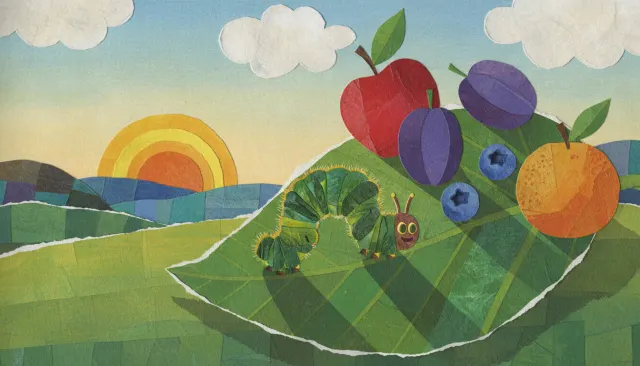
Robert Sabuda and Matthew Reinhart
*Encyclopedia Prehistorica: Dinosaurs* (2005, Candlewick)
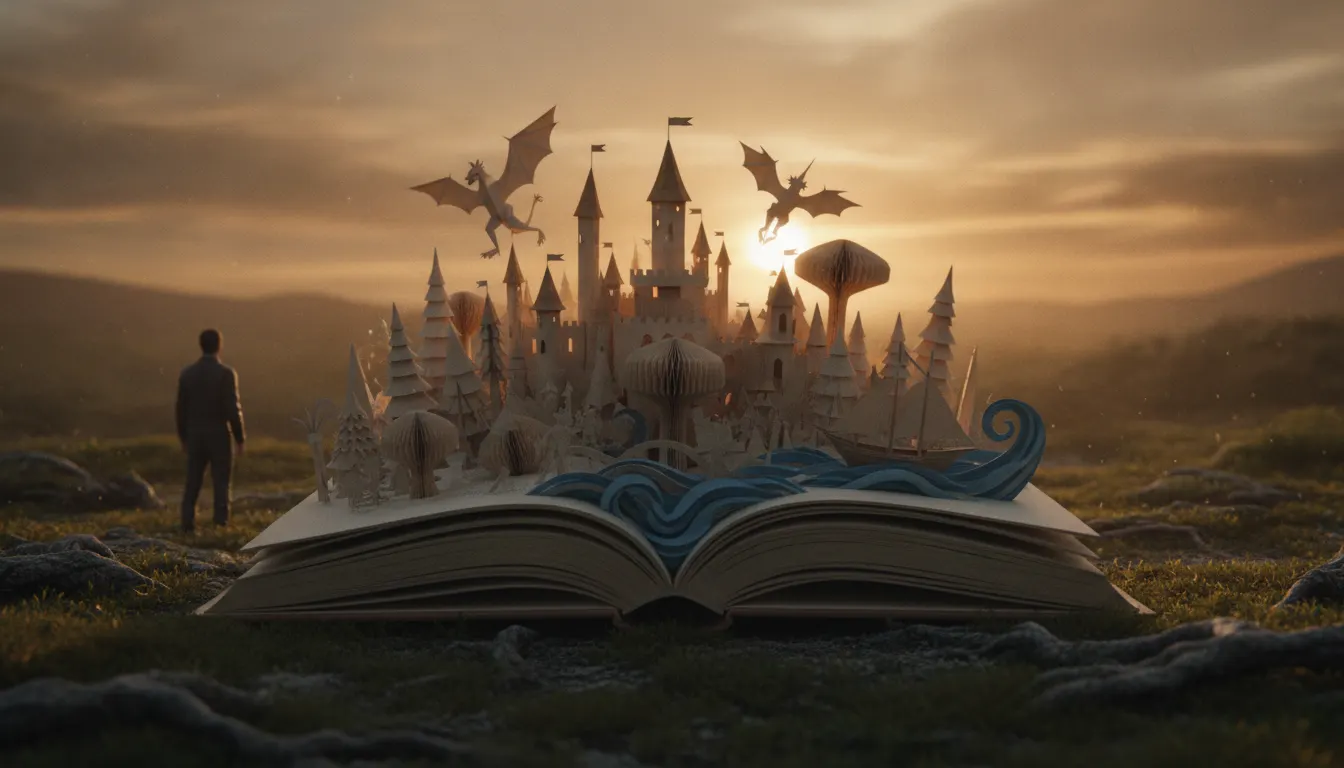
Pop-up paper book sculptural spread. Folded and cut paper figures springing up from book spread on opening, intricate paper engineering, storybook scene jumps off the page.
The moves a human crew would use to get here. Cue applies them for you, and knowing their names is how you ask for a change.
fold tabs distributing image content across rising planes
cut silhouettes with clean edges that read as paper cuts against the base surface
foreground, midground, and background planes at 1-3cm separations
photograph on one, illustration or pattern on another
reveal to create dynamic in-between images
The paper pop-up 3D mix applies the mechanical ingenuity of pop-up book engineering to photography, illustration, and video. Content – portraits, landscapes, or graphic elements – is distributed across multiple paper planes that rise from a flat surface when opened, creating genuine physical depth rather than simulated perspective. The look celebrates the reveal: the moment a flat surface becomes spatial.
Pop-up book art reached a technical and aesthetic apex in the work of Robert Sabuda and Matthew Reinhart. Sabuda's Encyclopedia Prehistorica: Dinosaurs (2005, with Reinhart) achieved unprecedented sculptural complexity within a commercial binding – a Spinosaurus that spans a full spread on a two-foot wingspan built from 14 interlocking components. David A. Carter's 600 Black Spots (2007) pushed pop-up into conceptual art territory, treating each page as a minimalist sculpture.
The Vojtěch Kubašta pop-up books produced in Czechoslovakia from the 1950s through the 1980s reached global distribution and established a mid-century graphic vocabulary: flat-color illustration on die-cut tabs with clean vector shapes. Jan Pienkowski's 1979 Haunted House (Walker Books) applied pop-up to gothic silhouette illustration.
In the fine art sphere, Su Blackwell (British, active 2000s–present) sculpts directly from book pages, cutting characters and landscapes that emerge from the bound spine in three-dimensional dioramas, photographed before a dark background. Her work for Tolkien and fairy-tale commissions brought book-sculpture into luxury editorial and commercial photography.
Contemporary mixed-media artists and directors place photographic content on pop-up planes – a face on a foreground tab, an environment on mid-ground, sky on the backdrop – creating a layered-flat-paper aesthetic distinct from both conventional collage and 3D CGI. The visible paper edges, fold lines, and tab mechanics are part of the image rather than flaws to conceal.
Stop-motion directors use literal paper pop-up sets. Michel Gondry's music video work incorporates paper mechanics. Web and motion graphics adopt simulated paper-fold transitions.
The structural mechanics of pop-up engineering follow three basic principles: V-folds (two planes joined at an angle that rises when the book opens), box folds (four-sided constructions that rise perpendicular from the page), and pivoting attachments (elements connected by a pivot point so they swing into position on opening). Paul Jackson's The Pop-Up Book (1993, Holt) and David Carter and James Diaz's The Elements of Pop-Up (1999, Little Simon) codified these mechanics for artists. The visible sophistication of the mechanics – the paper engineering as spectacle in itself – is a key element of the aesthetic. Unlike CGI depth, which simulates space invisibly, pop-up mechanics make the process of creating depth visible and legible. The shadow each plane casts on the one behind it is real, not rendered. This physical authenticity is what the aesthetic communicates even when simulated in 2D photography of pop-up sets.
*Encyclopedia Prehistorica: Dinosaurs* (2005, Candlewick)
*600 Black Spots* (2007, Little Simon)
Czech pop-up book series (ARTIA Prague, 1950s–1980s)
*Haunted House* (1979, Walker Books)
book-sculpture series including Tolkien commissions (2006–present)
*Blue to Blue* and visual book series (One Stroke, 1990s–2000s)
*Star Wars: A Pop-Up Guide to the Galaxy* (2007, Orchard Books)
A Look is not a filter. It is a set of stored decisions the pipeline reads before it makes a single frame, so two videos in the same Look actually match.