Asteroids arcade cabinet
Atari (Ed Logg, Lyle Rains) · 1979
Definitive vector game visual, with thrust trails, explosion vectors, and wraparound geometry that defined the aesthetic for a generation
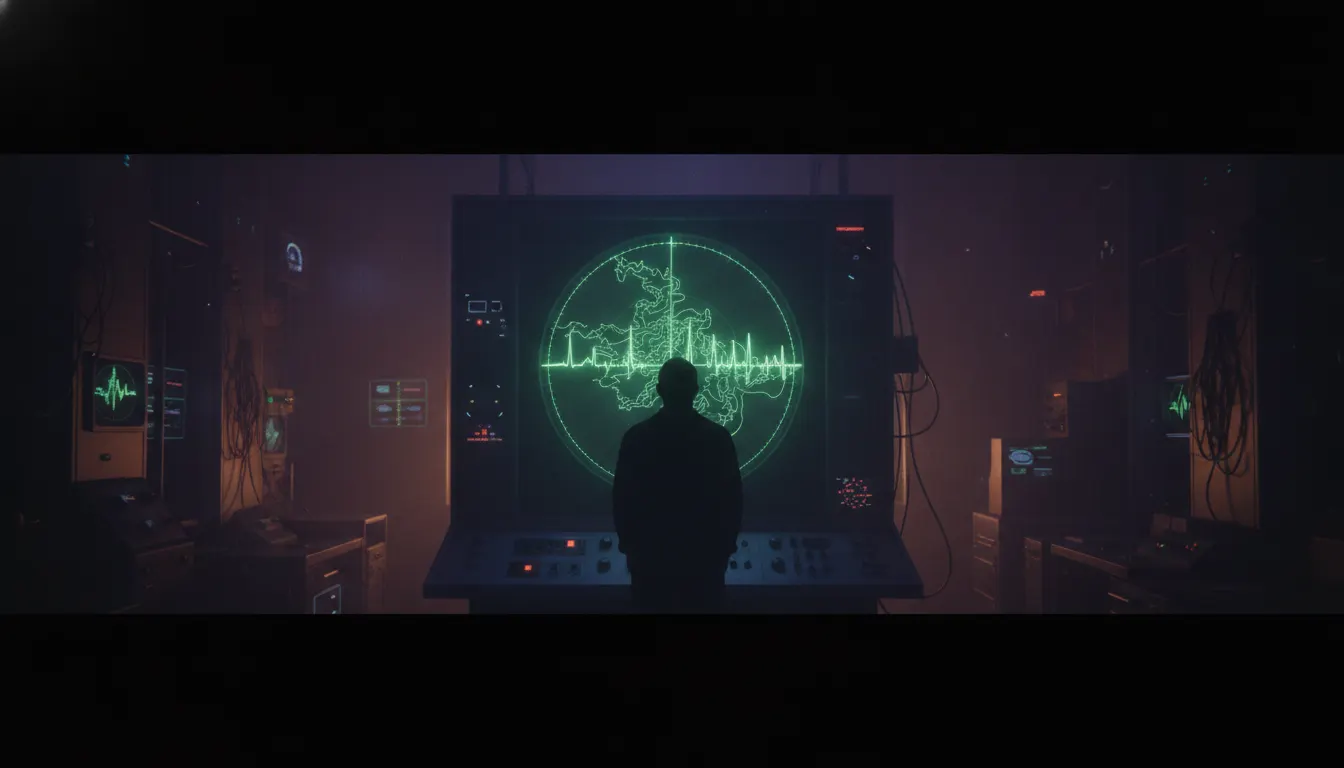
Oscilloscope phosphor vector display. Single-trace green line drawing shapes via X-Y deflection, Vectrex and lab-scope aesthetic, persistence-of-vision glow.
The moves a human crew would use to get here. Cue applies them for you, and knowing their names is how you ask for a change.
P31 phosphor green (~525nm) on a pure black field, with no background texture - the essential oscilloscope palette.
Brief glow decay behind moving vector elements, simulating the physical persistence of CRT phosphor after the electron beam moves on.
Mathematically generated X/Y parametric curves that sweep continuously, creating looping figures-of-eight, circles, and complex harmonic patterns.
Sinusoidal, sawtooth, or square-wave traces drawn as continuous bright lines, referencing audio signal monitoring on oscilloscope displays.
Slightly brighter, bloomed points at vertices and direction changes, simulating the electron beam dwelling longer at each corner.
No anti-aliasing, no sub-pixel blending - hard geometric lines that reference the mathematical precision of vector CRT rendering.
Lines drawn at varying thickness by modulating simulated beam velocity - faster sweeps produce thinner, dimmer lines; slower sweeps leave brighter traces.
The oscilloscope vector aesthetic draws directly from cathode-ray tube (CRT) technology developed for scientific instrumentation in the 1930s. Unlike raster-scan displays that build images line by line, vector CRTs steer an electron beam in any direction to draw geometrically precise shapes - the resulting images are razor-sharp, infinitely scalable within the display, and always rendered in the characteristic green or amber phosphor glow of the CRT coating.
Vector CRT displays powered some of the most iconic video games ever made. Atari's Asteroids (1979), Battlezone (1980), Tempest (1981), and Star Wars (1983) all used Cinematronics or Wells-Gardner vector hardware, producing gameplay visuals with an angular precision that raster systems could not replicate at the time. The phosphor persistence of these displays - the brief glow trails left behind as the beam swept lines - was an artifact of the technology that became an aesthetic signature.
Scientific oscilloscopes such as the Tektronix 400 and 500 series produced Lissajous figures, audio waveforms, and signal traces that have been used as visual art since the 1950s. Electronic musician Benjamin Lakin Flickinger and later Norman McLaren used oscilloscope output as a drawing tool for abstract film. The Critter & Guitari Oscilloscope synthesizer (2010s) brought dedicated oscilloscope-as-instrument to contemporary experimental musicians.
Jerobeam Fenderson's Oscilloscope Music (2015-present) is the most prominent contemporary practice in this space: audio encoded stereo to draw specific shapes on the oscilloscope X/Y display in real time, making the instrument a visual canvas that responds to the composition. His Doom E1M1 oscilloscope render went viral in 2016 and defined modern expectations for the aesthetic.
Audio visualization software like Winamp's classic visualizer (1997-2003), Milkdrop (Ryan Geiss, 2001), and contemporary tools like Resolume process audio frequency data to produce waveforms, Lissajous patterns, and vector-style traces that directly reference oscilloscope display characteristics.
The green phosphor color is typically P31 phosphor at approximately 525nm wavelength, common in Tektronix and Hewlett-Packard oscilloscopes of the 1960s-1980s. P1 phosphor produced a cooler yellow-green; P39 produced the long-persistence green used in radar displays. The aesthetic consistently uses pure black backgrounds, no anti-aliasing, and bright central lines that bloom slightly at vertices where the beam dwells longer.
Atari (Ed Logg, Lyle Rains) · 1979
Definitive vector game visual, with thrust trails, explosion vectors, and wraparound geometry that defined the aesthetic for a generation
Atari · 1983
Color vector display trench run sequence, demonstrating full-color phosphor vector rendering at its commercial peak
Jerobeam Fenderson · 2015-present
Stereo audio encoded to draw geometric forms on oscilloscope X/Y display in real time; viral Doom music render helped define modern oscilloscope art
Ryan Geiss / Nullsoft · 2001
Generative music visualization system that used waveform and frequency data to produce oscilloscope-adjacent abstract forms
Critter & Guitari · 2010s
Dedicated hardware oscilloscope instrument for live performance visual synthesis, widely used in experimental music communities
Nam June Paik · 1960s-70s
Early video art using oscilloscope signal manipulation as primary visual medium
A Look is not a filter. It is a set of stored decisions the pipeline reads before it makes a single frame, so two videos in the same Look actually match.