Monument Valley
ustwo games, 2014 (iOS/Android)
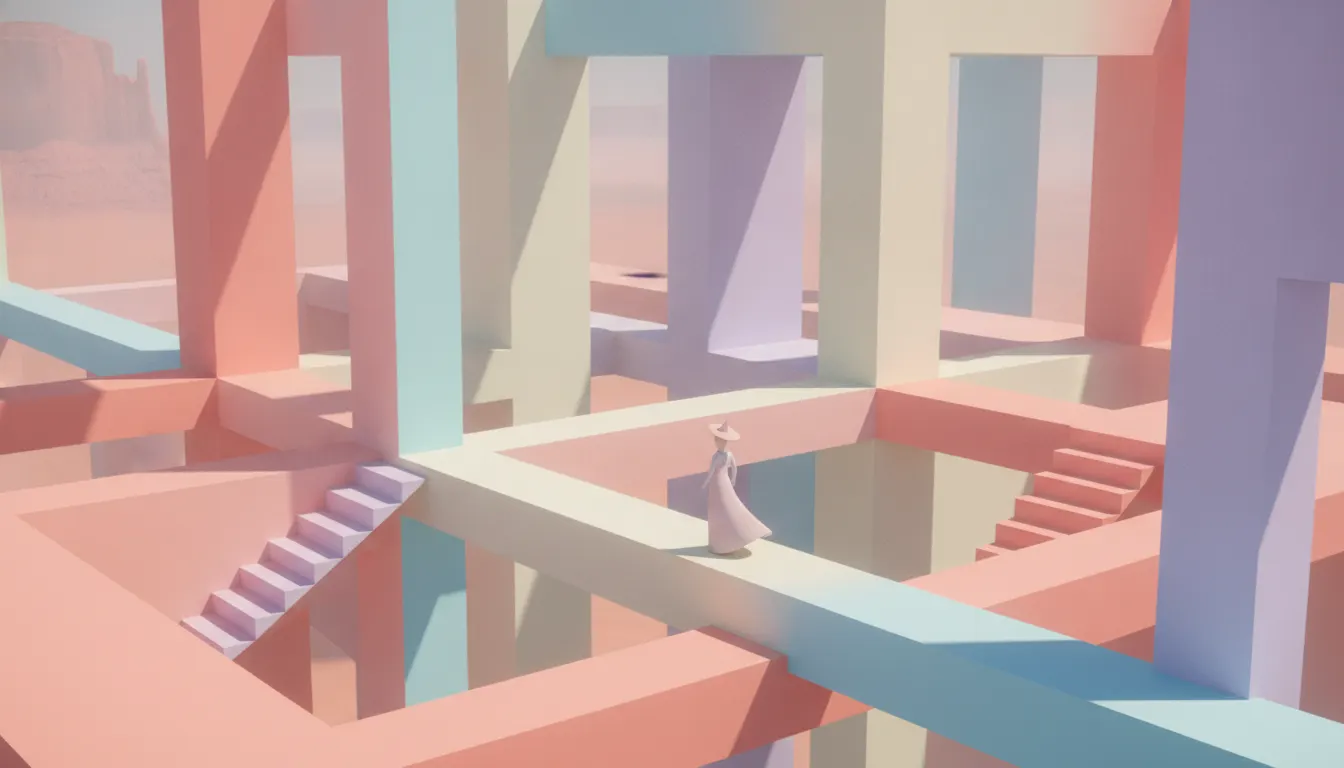
Monument Valley ustwo isometric Escher-illusion aesthetic. Pastel architectural geometry, impossible-perspective puzzle staging, minimal Princess Ida figure.
The moves a human crew would use to get here. Cue applies them for you, and knowing their names is how you ask for a change.
isometric perspective exploited so visual connections supersede physical ones
impossible bridges created by turning architectural elements
controlled palettes: dusty pink, sage green, terracotta, lavender - never fully saturated
robed protagonist Ida as pure compositional focal point against complex architectural environments
stepwells, Islamic tilework, Mesoamerican temples, Modernist abstraction
no dialogue, minimal UI, musical score that breathes with puzzle discovery
touch interaction design: swipe to rotate, tap to walk - maximum gameplay from minimum gesture vocabulary
Monument Valley (ustwo games, 2014), designed and art directed by Ken Wong, is the most commercially successful art-game on the App Store and a defining entry in the museum of mobile visual design. With over 35 million downloads across both titles and a cameo in the Netflix series House of Cards, it became a cultural touchstone for 'games as aesthetic experience.'
The fundamental visual source is M.C. Escher's impossible architecture: Ascending and Descending (1960), Relativity (1953), and Waterfall (1961) provided the spatial logic for Monument Valley's puzzles. In the game, paths that visually appear to connect actually do connect, even when Euclidean geometry forbids it. Pillars rotate to create impossible bridges. Staircases fold back on themselves. The isometric projection is exploited to create a world that functions on the logic of the eye rather than the logic of physics.
Wong's color direction is muted and deliberate: dusty pinks, sage greens, terracotta oranges, and pale lavenders - never garish, never sharp. Each chapter has its own tightly controlled palette that shifts mood from warmth to mystery to melancholy. The silent protagonist Ida - a white-robed princess navigating these impossible structures - creates a compositional center of maximum simplicity: a small pure-white figure against architecturally complex environments.
The environments reference South Asian stepwell architecture (vav), Islamic geometric tilework, Mesoamerican temple forms, and Modernist abstract sculpture without being literal representations of any single tradition. This multicultural synthesis creates a world that feels ancient and impossible simultaneously - like discovering ruins of a civilization that never existed.
Every interaction is designed for a single finger on a phone screen. Rotating pillars via clockwise swipe; tapping endpoints to send Ida walking. The interaction simplicity mirrors the visual simplicity - both are the result of disciplined subtraction.
ustwo games, 2014 (iOS/Android)
ustwo games, 2017 - mother and child journey expanding the visual grammar
ustwo games, 2024 - Netflix-exclusive continuation
Buried Signal / Jason Roberts, 2017 - comic-panel impossible visual puzzle peer
Snowman, 2015 - ustwo peer in meditative mobile minimalism
Simogo, 2013 - Swedish minimal atmosphere in parallel mobile art-game tradition
Fireproof Games, 2012+ - mobile puzzle art-direction peer with different aesthetic vocabulary
A Look is not a filter. It is a set of stored decisions the pipeline reads before it makes a single frame, so two videos in the same Look actually match.