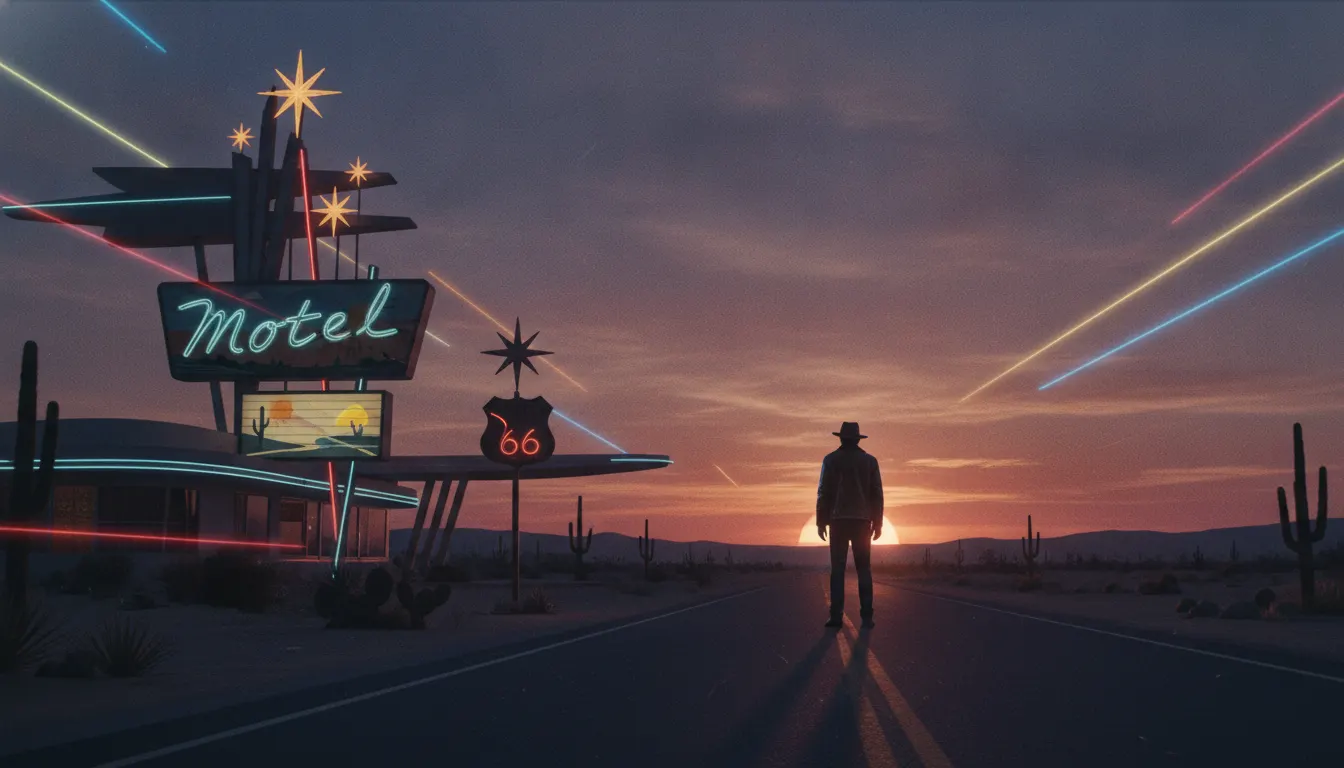
SIGNAGE WAYFINDING · 1950S · USA
Mid-Century Roadside Americana Signage
Mid-century roadside Americana signage. Las Vegas neon, googie architecture, atomic starbursts, painted motel marquees, Route 66 hand-letter.
americananeongoogieroadside
LUT roadside-neon-googie
WHEN TO USE
- American food, restaurant, or hospitality brand content evoking nostalgia, authenticity, and mid-century Americana
- Road trip, travel, or Route 66 / highway culture content
- Music video or entertainment content set in or referencing mid-20th century American culture
- Retro brand identity work for diners, motels, drive-ins, gas stations, or similar category businesses
- Event signage, festival branding, or pop-up installations wanting a hand-painted vernacular quality
- Documentary or editorial content about American commercial culture, urban sprawl, or 20th-century consumer society
WHEN NOT TO USE
- International brand content where the visual references are specific to American cultural geography
- Premium or luxury positioning where the vernacular roughness reads as budget
- Technology or professional services where the 1950s reference conflicts with modernity expectations
SIGNATURE TECHNIQUES
How the look is made.
The moves a human crew would use to get here. Cue applies them for you, and knowing their names is how you ask for a change.
- 01Pole signs at height
large-faced signs on tall poles with neon or painted panels
- 02Bold italic display letterforms with painted drop shadows and highlights suggesting three-dimensionality
- 03Neon tube signs
channel letters and script forms with warm orange, red, and turquoise glow
- 04Period
correct color combinations: red-and-yellow, turquoise-and-white, orange-and-black
- 05Star
burst and atomic-age motifs: boomerang shapes, arrows, and mid-century space-age decorative elements
- 06Changeable marquee letterboards with period block letters
- 07Hand
painted sign technique: visible brush strokes, letter spacing improvised to fill the available field
HISTORY & CONTEXT
Where it comes from.
Mid-Century Roadside Americana Signage
Mid-century roadside Americana signage is the visual culture of the American highway strip from the late 1940s through the early 1970s - a period when the automobile transformed American commercial geography and generated a new vernacular architecture and sign language designed to capture attention at 60 miles per hour from a moving car.
Historical Context
The interstate highway system, authorized by the Federal-Aid Highway Act of 1956 under Eisenhower, accelerated a commercial strip development pattern already underway along US routes since the 1940s. Motels, diners, drive-ins, gas stations, and roadside attractions competed for visibility along strips where every building and every sign was fighting the same visual battle against speed, distance, and competing messages. The result was an exuberant, unregulated visual environment that architect Robert Venturi and Denise Scott Brown celebrated and analyzed in Learning from Las Vegas (1972).
Sign Typologies
Roadside signage developed several characteristic forms. The pole sign (a large face mounted on a tall pole, often with a flashing or rotating component) was designed to be visible from a quarter mile. The marquee sign (a changeable letterboard beneath a permanent illuminated header) allowed daily updates. Neon tube signs were used extensively from the 1940s through the early 1960s for their readability in daylight and luminosity at night. The Googie architecture movement (1950s-1960s) extended the roadside aesthetic into building form itself - boomerang canopies, starburst motifs, and exaggerated angles designed to read as futuristic from a moving vehicle.
Typographic Character
Roadside type was typically painted or formed in channel letters by sign painters using proprietary techniques and commercially available lettering guides. The dominant letterforms were bold italics suggesting forward motion, scripts suggesting warmth and welcome, and blocky display faces for maximum readability at distance. Hand-painted shadows and highlights gave dimensional quality. Colors were determined by what was visible and memorable: red-and-yellow, turquoise-and-white, orange-and-black combinations dominate the period.
Contemporary Reference
The aesthetic has been continuously referenced in American brand design: In-N-Out Burger (founded 1948, identity unchanged), Cracker Barrel, the Route 66 nostalgia industry, and dozens of contemporary restaurant brands that deploy the period's visual cues as signals of Americana authenticity. Designers like House Industries have built extensive typeface libraries from the period's letterforms.
NOTABLE WORKS
Where you have seen it.
Las Vegas strip pole sign typology documented in Venturi and Scott Brown's Learning from Las Vegas
1972
Googie architecture
Norm's Restaurant Los Angeles (Armet and Davis, 1956)
Route 66 roadside documentation
1963
Ed Ruscha's Twentysix Gasoline Stations
Jack in the Box original clown-head sign (1951, Harold Butler)
Howard Johnson's orange roof and signage system (1925-1970s peak)
THE RECIPE
The exact knobs
the renderer turns.
A Look is not a filter. It is a set of stored decisions the pipeline reads before it makes a single frame, so two videos in the same Look actually match.
SettingValue
GradeColour LUT applied to every frame
roadside-neon-googieTransitionHow one shot becomes the next
soft cuts · 280ms · ease-in-outKen BurnsCamera move applied to stills
Slow push · 0.04 · rule-of-thirdsTypographyDisplay / body / mono pairing
Cooper Hewitt · Lora · CourierMusic moodWhat the bed under the voice sounds like
surf-rock · lounge-exoticaPrompt suffixAppended to every shot prompt in this Look
Mid-century roadside Americana signage, Las Vegas neon, googie architecture, atomic starburst, painted motel marquee, Route 66 hand-letterPALETTE
Primary
#FF6F1A
Secondary
#1A2A4A
Accent
#26F0F1
Text/Light
#1A0808
Text/Dark
#FFE8D0
BG 900
#0F1424
BG 800
#1A2A4A
RELATED LOOKS
Next to it on the shelf.


Your first cut
is on us.
+ New videoFree plan · no card · 1080p export