The Lord of the Rings: The Two Towers
Peter Jackson / Weta Digital / Jim Rygiel / Andrew Lesnie · 2002
Helm's Deep sequence debuting MASSIVE at production scale; Academy Award Best Visual Effects
Peter Jackson Lord of the Rings massive-battle VFX. Weta Digital MASSIVE crowd simulation, Helms Deep ten thousand Uruk-hai, Gollum mocap breakthrough.
The moves a human crew would use to get here. Cue applies them for you, and knowing their names is how you ask for a change.
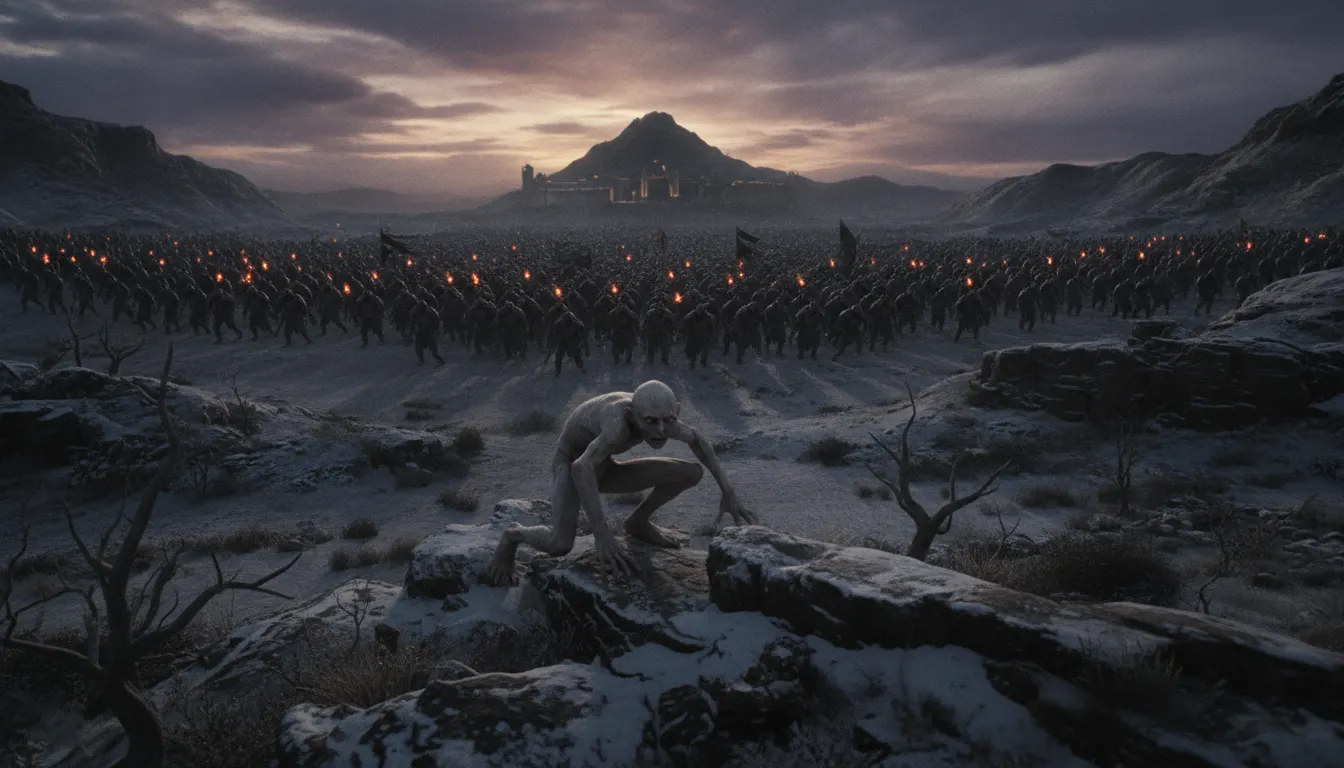
Regelous's behavioral AI system giving each soldier independent perception, decision-making, and combat behavior -- up to 200,000 simultaneous agents in Pelennor Fields
Andrew Lesnie and Peter Jackson's aerial camera moves flying through battle at participant height, making scale a felt experience rather than a distant statistic
Full-fidelity foreground agents grading to simplified mid-field agents to LOD background agents, maintaining visual coherence across population densities without render budget overrun
New Zealand South Island practical locations extended via photogrammetry geometry and painted depth cards into fantasy-scale environments at impossible scales
Deep volumetric fog layers separating environmental planes and creating the specific atmospheric depth of Peter Jackson's Middle-earth aesthetic
Large creatures (Mûmakil, fell beasts) requiring full-fidelity close-up rigs that degrade gracefully to far-field level-of-detail within the same mass-battle simulation frame
Peter Jackson's Lord of the Rings trilogy (2001-2003, VFX studio Weta Digital, VFX supervisor Jim Rygiel, CG supervisor Christian Rivers) defined the battle-sequence VFX aesthetic for a generation through two breakthroughs: the development of the MASSIVE autonomous agent software (Stephen Regelous, 1996-2001) and the establishment of Weta Digital's digital matte painting and environment pipeline. The Helm's Deep, Pelennor Fields, and Minas Tirith sequences each pushed these systems further, creating battle scenes of unprecedented scale and coherence.
Stephen Regelous's MASSIVE software (Multiple Agent Simulation System In Virtual Environment), developed specifically for Lord of the Rings starting in 1996, enabled each soldier in a battle to make independent AI-driven decisions about movement, combat target selection, and collision avoidance. Rather than animating thousands of characters individually or repeating motion cycles, MASSIVE agents perceive their environment through simulated sensor inputs (visual, audio, tactical) and select from a behavior library in real time. The Pelennor Fields sequence in The Return of the King (2003) featured 200,000 simultaneous AI agents.
Jackson and DP Andrew Lesnie used the camera as a participant in the battle rather than an observer -- the famous swooping aerial shot that begins the Rohirrim charge at Pelennor Fields required the camera to apparently fly at speed through hundreds of thousands of soldiers, revealing the scale of the engagement as a felt experience rather than a statistic. This required Weta to render massive foreground environments at full fidelity while using level-of-detail systems that reduced far-field agent complexity without visible seam.
New Zealand's South Island locations provided the geological foundations for Middle-earth's environments. Weta's digital matte painting team extended these practical locations into fantasy-scale environments: Minas Tirith emerging from the White Mountains; Mordor's volcanic plains extending to impossible distances; the Dead Marshes' corpse-light fog. These environment extensions used photogrammetry-derived geometry layered with painted depth cards and volumetric fog.
Oliphaunts (Mûmakil), fell beasts, and the Witch-king's mount all required creature animation at scale within the battle environments, combining single-character close-up fidelity with mass-battle far-field level-of-detail management.
Each MASSIVE agent contains a simplified brain: a set of fuzzy-logic rules that evaluate environmental inputs (proximity of enemies, presence of allies, current health state) and select from an animation behavior library. When an agent 'sees' an enemy within attack range, it transitions from a march behavior to a combat behavior, selecting an appropriate attack animation from the library. The emergent behavior of thousands of these individual decisions produced realistic-looking crowd behavior that animators could not have authored manually -- including the organic clustering, routing, and routing-avoidance patterns of a real battle.
The physical New Zealand locations used as practical plates for Helm's Deep (Queenstown area), the Pelennor Fields (Twizel, Canterbury), and Minas Tirith exteriors (Wellington area) created a consistent geological vocabulary that unified Weta's digital extensions. New Zealand's South Island's specific rock strata -- schist and greywacke with their grey-blue coloring and angular fracture patterns -- became the material palette of Middle-earth. This geological specificity means that New Zealand tourism experienced a significant post-LOTR boost, as viewers sought the real-world locations behind the fantasy environments.
Peter Jackson / Weta Digital / Jim Rygiel / Andrew Lesnie · 2002
Helm's Deep sequence debuting MASSIVE at production scale; Academy Award Best Visual Effects
Peter Jackson / Weta Digital · 2003
Pelennor Fields battle with 200,000 AI agents; siege of Minas Tirith as the definitive MASSIVE showcase
Peter Jackson / Weta Digital · 2001
Prologue Battle of Dagorlad establishing the mass-battle visual grammar the subsequent films expanded
Ridley Scott / Double Negative / Weta Digital · 2005
Historical epic using MASSIVE-influenced crowd simulation for Crusades-era Jerusalem siege sequences
Peter Jackson / Weta Digital · 2012
Return to Middle-earth with evolved MASSIVE systems and expanded creature battle integration
Amazon Studios / Weta Digital · 2022
TV-scale return to MASSIVE-enabled Middle-earth battle sequences with third-generation Weta pipeline
A Look is not a filter. It is a set of stored decisions the pipeline reads before it makes a single frame, so two videos in the same Look actually match.