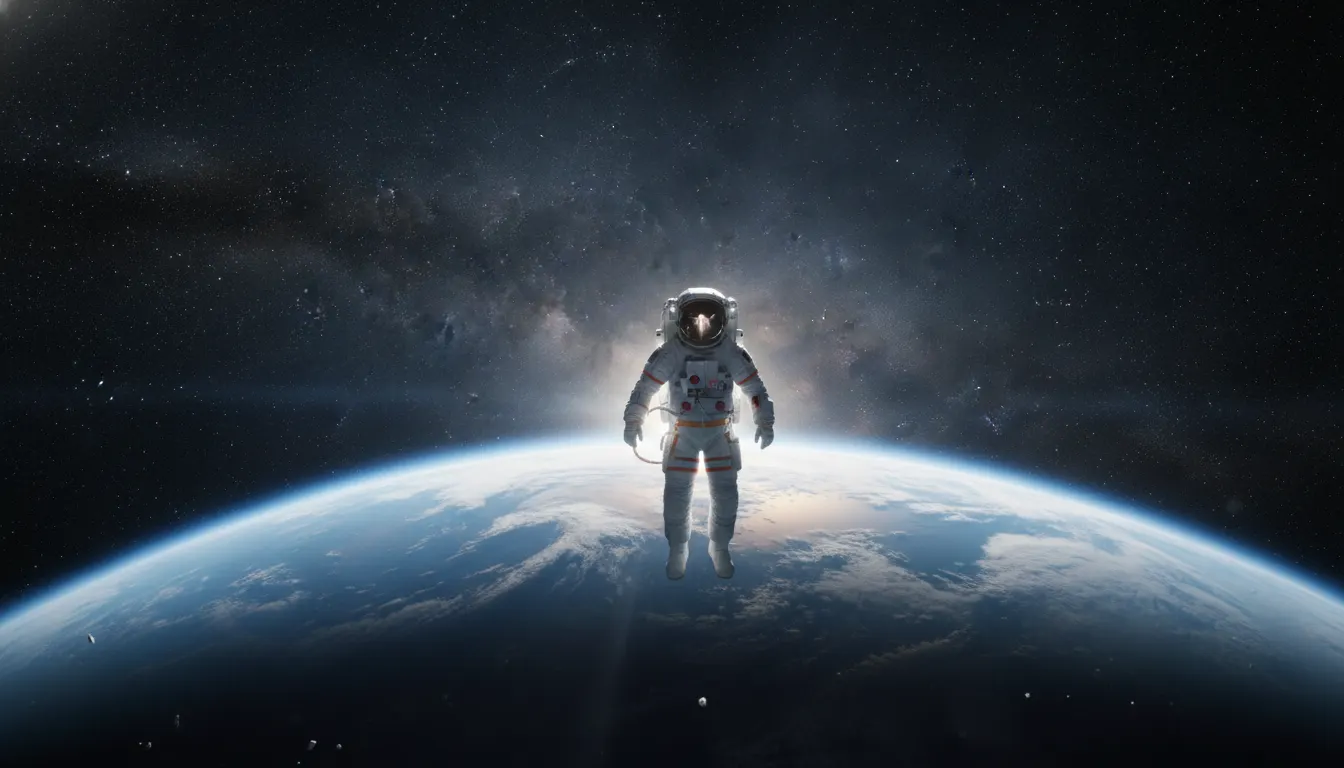
Gravity
Alfonso Cuaron / Framestore / Tim Webber · 2013
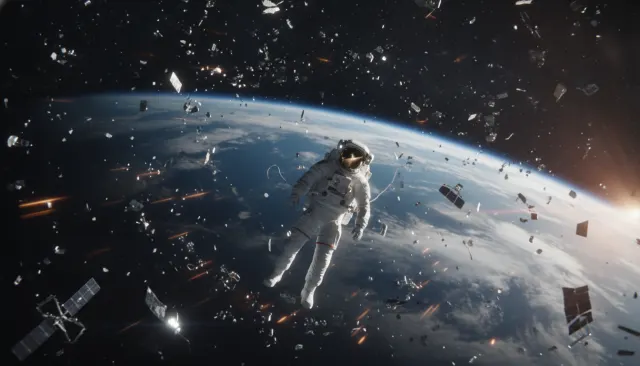
2.5 million debris objects, purpose-built vacuum dynamics, and four years of pre-production simulation development
Gravity Cuaron zero-G VFX. Long-take spacewalk simulation, Lubezki cinematography, photoreal Earth backdrop, weightless choreography.
The moves a human crew would use to get here. Cue applies them for you, and knowing their names is how you ask for a change.
Combustion front expanding uniformly without convective direction, producing orange globes instead of standard teardrop flames
Physically accurate orbital trajectories for each debris piece, including rotational inertia and light-glint variation across the field
Dynamics simulation without a gravity vector, required for tethers, cables, and suit material in freefall
Art-directed particle density calibrated to narrative tension: sparse for dread, dense and overwhelming for crisis peak
POV shots through gold-tinted visors that reflect the debris field, placing viewers inside the suit's perspective
Extended unbroken VFX shots that foreground the duration of real orbital events, contrasting human experience against the scale of space
The zero-gravity VFX aesthetic is distinct from its photoreal sibling in that it foregrounds the craft and spectacle of weightlessness simulation rather than invisible integration. Where photoreal zero-g strives for seamless believability, zero-g VFX showcases the kinetic drama of floating debris fields, orbital fire propagation, and bodies in unconstrained motion -- the visceral language of space disaster rather than space documentary.
Framestore's work on Gravity (Alfonso Cuaron, 2013) remains the canonical reference: the opening debris field sequence required rendering 2.5 million individual debris objects, each with physically accurate orbital trajectories. Supervisor Tim Webber's team spent four years in pre-production developing new simulation pipelines for cloth in vacuum, fire without convection, and the optical behavior of shattered glass in weightlessness.
Fire in vacuum or microgravity is spherical rather than teardrop-shaped -- without convective air currents, the combustion front expands uniformly. Framestore's vacuum fire simulations for Gravity departed entirely from standard fire rigs, using custom spherical advection solvers. This counterintuitive visual (round orange globes rather than flickering flames) became a signature of high-fidelity zero-g VFX.
Large-scale debris sequences require art direction at the particle simulation level: choosing which objects tumble slowly vs. spin rapidly, what catches glint light, what passes in foreground vs. background. The aesthetic uses debris density as an emotional barometer -- sparse debris for tension, dense fields for overwhelm.
Spacesuit tethers, loose cables, and hair within helmets are among the most technically complex VFX elements because audiences have strong unconscious expectations for how these materials move. Framestore's cloth solver for Gravity was purpose-built, as standard dynamics rigs assumed a gravity vector.
Modern zero-g VFX productions calibrate how much the weightlessness is 'shown' vs. felt. Gravity shows it constantly; The Martian (Ridley Scott, 2015) uses it more sparingly for emotional punctuation. Both approaches share the underlying simulation vocabulary.
Shattered glass in zero-g presents a distinct simulation challenge: shards do not fall, but drift in all directions from the fracture point with the specific momentum distribution of the impact event. Framestore developed a structural failure simulation for the ISS and shuttle windows that tracked each fragment's size, velocity vector, and tumble rate individually. The visual result -- a slowly expanding cloud of tumbling glass catching light from different angles simultaneously -- became one of the Gravity debris sequences' most striking elements and a template for subsequent space disaster productions.
The four years of Gravity pre-production spent on simulation tool development was itself an industry anomaly. Most VFX productions develop tools during production, under schedule pressure. Framestore's decision to build and test the vacuum fire, cloth, and debris systems before the main photography allowed the simulation tools to reach a quality level that would have been impossible under standard production timelines. The resulting pipeline was patented and informed the studio's subsequent zero-g work for over a decade.
Alfonso Cuaron / Framestore / Tim Webber · 2013
2.5 million debris objects, purpose-built vacuum dynamics, and four years of pre-production simulation development
Christopher Nolan / Double Negative / Paul Franklin · 2014
Wormhole and black hole VFX with Kip Thorne consultation producing scientifically accurate light-bending simulations
Sebastian Cordero / Look Effects · 2013
Found-footage approach to zero-g VFX prioritizing constraint and realism over spectacle
Daniel Espinosa / Framestore · 2017
ISS-set survival horror using zero-g VFX to make a contained space terrifying through weightless creature movement
Morten Tyldum / Method Studios · 2016
Zero-gravity pool sequence as character-defining VFX set piece, using water behavior in freefall
Apple TV+ / Dneg · 2021
TV-scale zero-g VFX across multiple planetary environments, demonstrating the aesthetic at series-production volume
A Look is not a filter. It is a set of stored decisions the pipeline reads before it makes a single frame, so two videos in the same Look actually match.