Gravity
Alfonso Cuaron / Framestore / Emmanuel Lubezki · 2013
Benchmark photoreal zero-g production with 17-minute unbroken CG-composite takes and LED Light Box practical lighting
Alfonso Cuaron Gravity zero-G photoreal VFX. Long-take orbital debris choreography, LED-volume lighting precursor, near-fully-CGI astronaut wide shots.
The moves a human crew would use to get here. Cue applies them for you, and knowing their names is how you ask for a change.
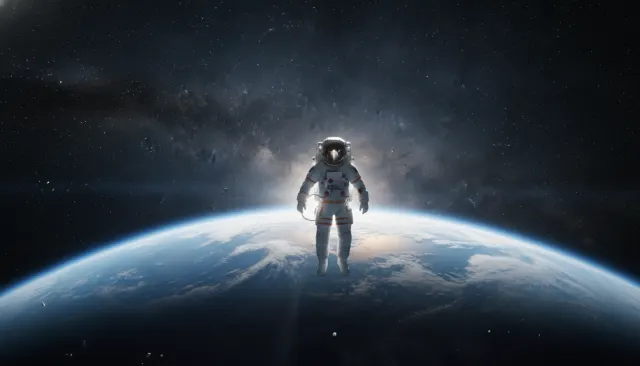
No atmospheric fill in vacuum means shadow sides of objects fall to near-black, creating hard terminator lines with infinite contrast ratio
Framestore / Gravity approach of matching practical set lighting to CG environment via LED panels, eliminating post-composite lighting mismatch
Compositions built around object floating in void with minimal ground-plane anchoring, using the black of space as dominant compositional mass
Blue-white-brown Earth visible below serves as the warm-cool color anchor against which suit whites and visor golds are calibrated
Extended single-take sequences referencing actual EVA timing to place viewers in the duration of orbital events
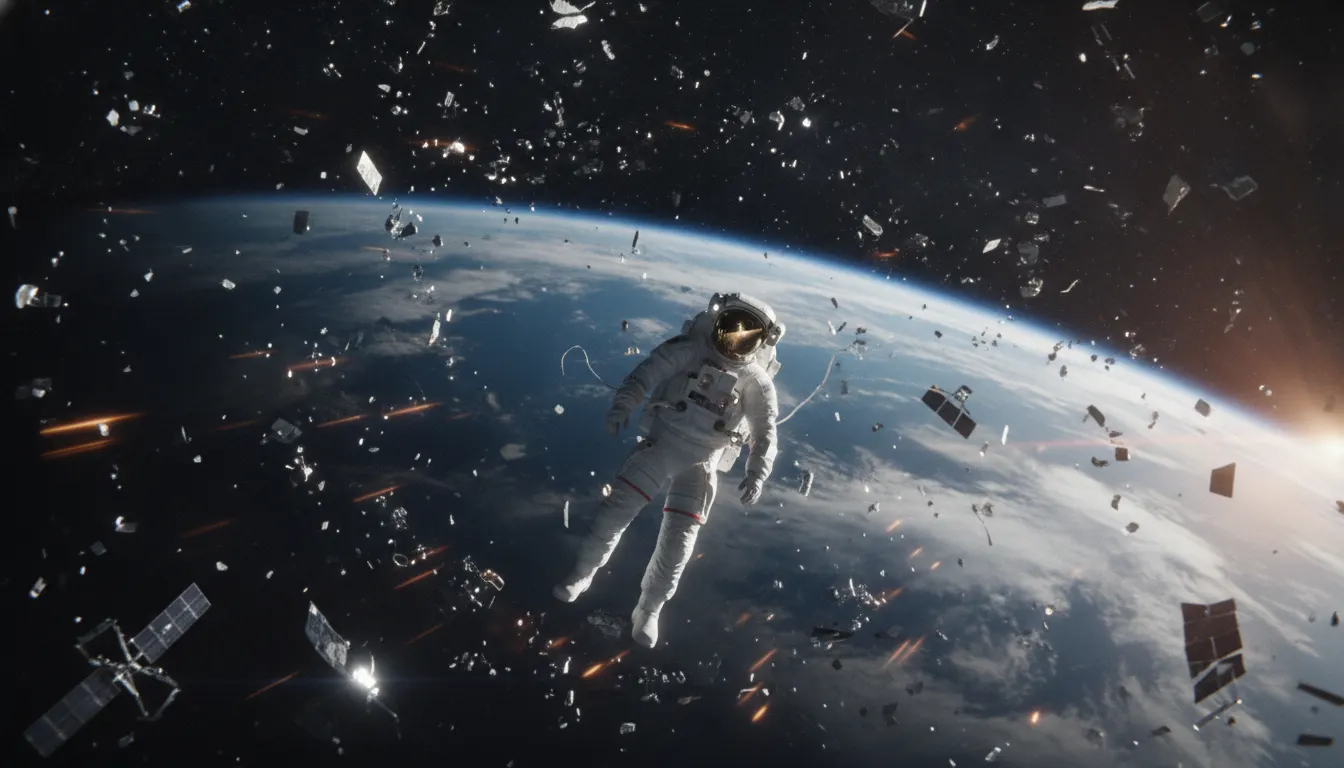
Photoreal pitting, scratches, and frost deposits on suit surfaces establishing operational history and resisting the 'too clean' look
The zero-gravity photoreal aesthetic draws from a lineage of space productions where physical accuracy and tactile detail coexist with the visual silence of vacuum. Alfonso Cuaron's Gravity (2013, VFX by Framestore, DP Emmanuel Lubezki) set the modern benchmark: 17-minute unbroken takes, 98% visual effects composited with practical light panels, and the deliberate removal of atmospheric diffusion that makes space scenes feel uniquely crisp and airless.
In vacuum environments, there is no atmospheric haze, no depth-of-field softening from particulate, and no ambient light scatter. Shadows are absolute -- the difference between the sunlit side of an object and its shadow side is essentially infinite contrast. DP Lubezki's lighting rig on Gravity used a 40-foot LED cube (the 'Light Box') to project location-accurate Earth reflections onto the actors' suits, allowing real-time interactive lighting that matched the CG environment precisely.
Authentic zero-g motion eliminates the constant micro-corrections humans make against gravity. Objects released float; hair spreads in all directions; loose equipment drifts in slow arcs. The visual language of weightlessness depends on negative space -- objects exist in a void with no ground-plane anchor. The Martian (Ridley Scott, 2015), Interstellar (Christopher Nolan / Hoyte van Hoytema, 2014), and First Man (Damien Chazelle / Linus Sandgren, 2018) each employed this grammar with different emotional registers.
Spacesuit materials in photoreal zero-g productions are rendered with meticulous subsurface and reflectance data: PTFE fabric weave, gold-coated visors, pressure-seam stitching. Scratches, outgassing frost, and micro-meteorite pitting are added to establish age and authenticity. The contrast between the suit's human-made precision and the infinite void it operates within is central to the aesthetic's emotional power.
The Earth below in space scenes serves as the primary color reference: blue ocean, white cloud, brown continent. Production designers use this as a color key -- suits are white or orange to contrast, equipment racks are grey, alert lights are red. The absence of warm ambient fill means skin tones in visor-cracked frames appear unusually saturated by comparison.
Gravity's LED Light Box was a 40-foot cube of individually programmable LED panels built at Shepperton Studios, conceived by Framestore and production designer Andy Nicholson. Each LED could be programmed to match any point in the pre-rendered CG environment surrounding the actors at any given frame. This made the Light Box the direct conceptual ancestor of the ILM StageCraft LED volume used in The Mandalorian (2019) and the entire virtual production movement. Gravity's production, in retrospect, invented the pipeline that transformed Hollywood physical production a decade later.
Director Cuaron made the deliberate decision to suppress most sound design in exterior vacuum sequences, honoring the physical reality that sound does not travel in space. This visual-minus-sound grammar reinforces the aesthetic's isolation register: events happen without the emotional cushioning of sonic impact. Combined with the absolute shadow contrast and negative-space void compositions, the silence creates a sensory experience unlike any other genre of filmmaking.
Alfonso Cuaron / Framestore / Emmanuel Lubezki · 2013
Benchmark photoreal zero-g production with 17-minute unbroken CG-composite takes and LED Light Box practical lighting
Christopher Nolan / Hoyte van Hoytema / Double Negative · 2014
Wormhole and black hole sequences with scientifically accurate gravitational lensing rendered in consultation with Kip Thorne
Ridley Scott / Framestore · 2015
Mars surface and orbital photoreal work emphasizing isolation and human-made object precision against alien landscape
Damien Chazelle / Linus Sandgren / UPP · 2018
Apollo-era space sequences using 16mm grain and IMAX intercuts to ground historical photoreal zero-g in analog texture
James Gray / Hoyte van Hoytema · 2019
Near-future commercial space travel aesthetic with muted corporate interiors contrasting against void exteriors
Netflix / DNEG · 2020
TV-budget photoreal zero-g demonstrating how the aesthetic can be achieved at streaming production scale
A Look is not a filter. It is a set of stored decisions the pipeline reads before it makes a single frame, so two videos in the same Look actually match.