Edward Johnston
1916
Underground Sans typeface
London Underground Johnston typeface tube signage aesthetic. Edward Johnston 1916 typeface, red roundel + blue bar, Henry Beck tube map influence, TfL wayfinding system.
The moves a human crew would use to get here. Cue applies them for you, and knowing their names is how you ask for a change.
geometric sans-serif with circular O, diamond i-dot, and perfect proportional stroke weights
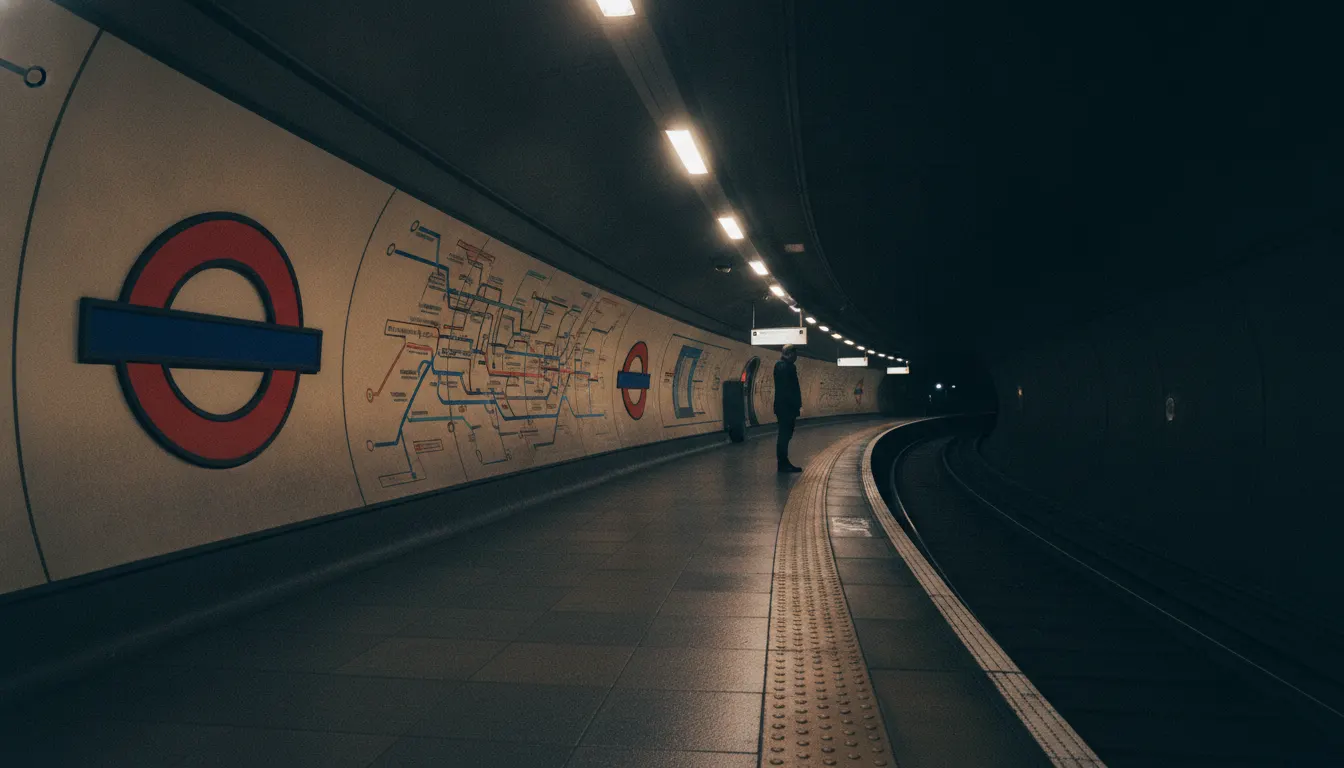
red circle intersected by horizontal blue bar with reversed-out white type
degree and 90-degree angles only - no diagonal approximations
each Underground line assigned a distinct hue applied consistently to maps and signage
the only geographic reference preserved
The London Underground's visual identity is one of the most complete and enduring examples of systematic design ever created. Its two foundational elements - Edward Johnston's typeface (1916) and Harry Beck's diagram map (1933) - have remained essentially unchanged for over a century, continuing to serve one of the world's busiest transit networks.
In 1913, Frank Pick, commercial manager of the Underground Electric Railways Company of London, commissioned calligrapher and lettering artist Edward Johnston to create a typeface exclusively for the Underground. Johnston (1872-1944) delivered the typeface in 1916. Johnston Sans, as it became known, was a geometric sans-serif of exceptional clarity, with proportions based on classical Roman inscriptions but stripped of serifs and historicist ornament. Its defining features are: a capital O that is a perfect circle, a lower-case l with a hooked tail to prevent confusion with the numeral 1, and a dot above the lower-case i that is a perfect diamond, tilted 45 degrees. The typeface preceded Gill Sans (1928) by a decade and directly influenced it - Eric Gill had been Johnston's student.
Harry Beck (1902-1974) was an Underground technical draughtsman who, in 1933, proposed a radical redesign of the route map. Previous maps had attempted geographical accuracy, making the central London section cramped and illegible. Beck realized that for underground travel, exact geography was irrelevant - passengers needed to know which line to take, where to change, and in which direction. His solution was a schematic diagram: straight lines at 45-degree and 90-degree angles, station spacing equalized regardless of real-world distance, and the Thames as the only geographical reference retained, simplified to a single blue curve. The Underground management initially rejected it as too radical before allowing a trial printing of 750,000 copies in 1933. It was adopted permanently.
The London Underground roundel - a red circle bisected by a horizontal blue bar bearing the station name in white Johnston type - was developed incrementally from 1908 onward, reaching its definitive form in the 1920s. It functions as a universally understood wayfinding mark, identifiable from a distance in any direction.
In 2016, on the centenary of the original typeface, Transport for London commissioned type foundry Monotype to update the typeface for digital use. The result, Johnston100, adds light and hairline weights while preserving the original's geometric DNA.
1916
Underground Sans typeface
London Underground Diagram Map (1933 first edition)
integrated Underground visual identity programme (1913-1940)
1938
London Underground poster : art-directed under Pick
2016
Johnston100 typeface update
continuous use since 1916
A Look is not a filter. It is a set of stored decisions the pipeline reads before it makes a single frame, so two videos in the same Look actually match.