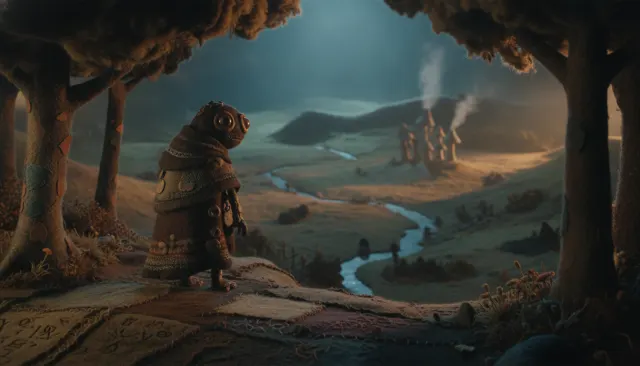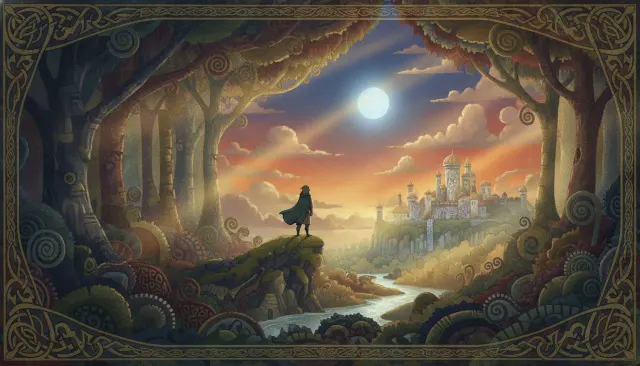
Klaus
Netflix / SPA Studios / Sergio Pablos · 2019
Primary source: character rendering demonstrates the painterly 3D aesthetic at its fullest development in the Klaus and Jesper faces
Klaus Netflix illusion of 2D over 3D. Hand-painted-feel CG, soft Nordic warmth, holiday folk-tale storybook.
The moves a human crew would use to get here. Cue applies them for you, and knowing their names is how you ask for a change.
Macro, mid-level, and micro-detail brushwork normal maps layered on character faces to simulate multiple scales of painted surface simultaneously
Deep eye-socket shadows and warm key-light on forehead and cheekbones referencing Old Master portrait lighting rather than conventional animation fill-light
Palette-knife brushstroke normal maps on wool, fur, and knitted surfaces giving fabric the thick-paint quality of an impasto oil painting
Older characters receiving higher texture complexity (coarser skin, deeper wrinkles) than younger characters, using texture density as age and weathering signifier
Protagonist warm ochre-amber skin palettes contrasting with antagonist grey-blue desaturated skin, encoding moral standing through color temperature
Klaus's white beard rendered as painterly masses of brushstroke marks rather than individual strand simulation, maintaining the hand-drawn feel at macro scale
The Klaus painterly 3D aesthetic, developed by SPA Studios Madrid under Sergio Pablos for the 2019 Netflix feature, describes a specific subset of the studio's non-photorealistic rendering approach focused on character-level paint quality: how individual protagonists and supporting figures are rendered with the brushwork quality of traditional animation cells while existing in a three-dimensionally lit world.
Where the broader Klaus feature aesthetic encompasses environment design and the NPR pipeline's technical framework, the 'painterly 3D' designation specifically describes the character rendering philosophy -- the visible paint strokes on skin, the sculpted-brushwork quality of hair and fur, and the warm impasto texture of fabric surfaces.
Klaus's own face is the film's most demanding rendering challenge: a large-featured, weather-worn face with deep eye-socket shadows, coarse skin texture, and a white beard that must read as both volumetric and hand-drawn simultaneously. SPA's pipeline applies multiple layers of hand-painted normal maps to Klaus's face geometry, each layer representing a different scale of brushwork -- macro rough-skin texture, mid-level wrinkle maps, micro skin-grain detail. The result looks like a painting by Rembrandt or Vermeer animated in three dimensions.
Fabric surfaces in Klaus use what the production team called an 'impasto' approach: thick-paint brushstroke normal maps that make wool sweaters, fur cloaks, and knitted items look as though the paint was applied with a palette knife. This is the opposite of the smooth-surface approach in Disney or Pixar CGI, where fabric folds are smooth and physically simulated. Klaus's fabric reads as painted because it is -- the geometry is standard simulation, but the texture maps layer hand-applied paint quality over the physics.
Jessie's character design uses a warmer, lighter skin palette with less texture complexity than Klaus, reflecting her youth versus his age. Smeerensburg villains use desaturated grey-blue skin tones that reference northern European folk art depictions of hardship. These color-temperature and texture-complexity differentiations create a visual hierarchy that mirrors the narrative's emotional logic without requiring explicit exposition.
SPA Studios' NPR pipeline for Klaus was developed as proprietary in-house technology and has not been fully published in the technical literature -- unusually opaque for a production of its critical profile. The studio has published making-of materials and talked about the system at SIGGRAPH and CTN Animation Expo, but the precise workflow for building the painted normal map stack and integrating it with the 3D lighting pipeline is not publicly documented. This has made the aesthetic genuinely difficult to reverse-engineer, which partly explains why Klaus's specific visual quality has not been directly replicated in the five years since its release.
Fortiche Production's Arcane (Netflix, 2021) achieved a related but distinct painterly 3D aesthetic for League of Legends using a different technical pathway: painted 2D elements composited over 3D animation with extensive post-process paint effects added in Nuke. Where SPA's Klaus system works from the texture map inward (paint on the 3D surface), Fortiche's system works from the rendered image outward (paint applied as post-process). Both achieve painterly results, but Klaus's system produces more tactile material quality while Arcane's produces a more graphic, two-dimensional illustration feel.
Netflix / SPA Studios / Sergio Pablos · 2019
Primary source: character rendering demonstrates the painterly 3D aesthetic at its fullest development in the Klaus and Jesper faces
SPA Studios · 2019
Published concept art and character development documentation showing the painterly normal map pipeline development process
Riot Games / Fortiche Production · 2021
Netflix series using a related NPR character rendering approach -- 3D geometry with hand-painted texture passes -- for darker subject matter
Cartoon Saloon / Tomm Moore · 2020
Contemporaneous hand-drawn animation demonstrating the 2D quality that Klaus's 3D system was designed to match or exceed
Palomar / Stop-motion directors anthology · 2022
Puppet animation anthology using painterly-textured physical surfaces offering a tactile comparison to Klaus's digital painterly approach
DreamWorks / Joel Crawford / Walter Dohrn · 2022
DreamWorks NPR character rendering inspired by Spider-Verse and Klaus offering the broadest studio implementation of the painterly 3D approach
A Look is not a filter. It is a set of stored decisions the pipeline reads before it makes a single frame, so two videos in the same Look actually match.