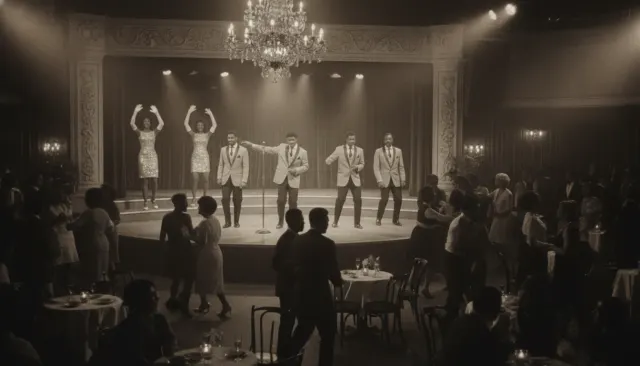
Francis Wolff, Blue Note Records album photography (1939-1966)
Miles Davis, Monk, Coltrane
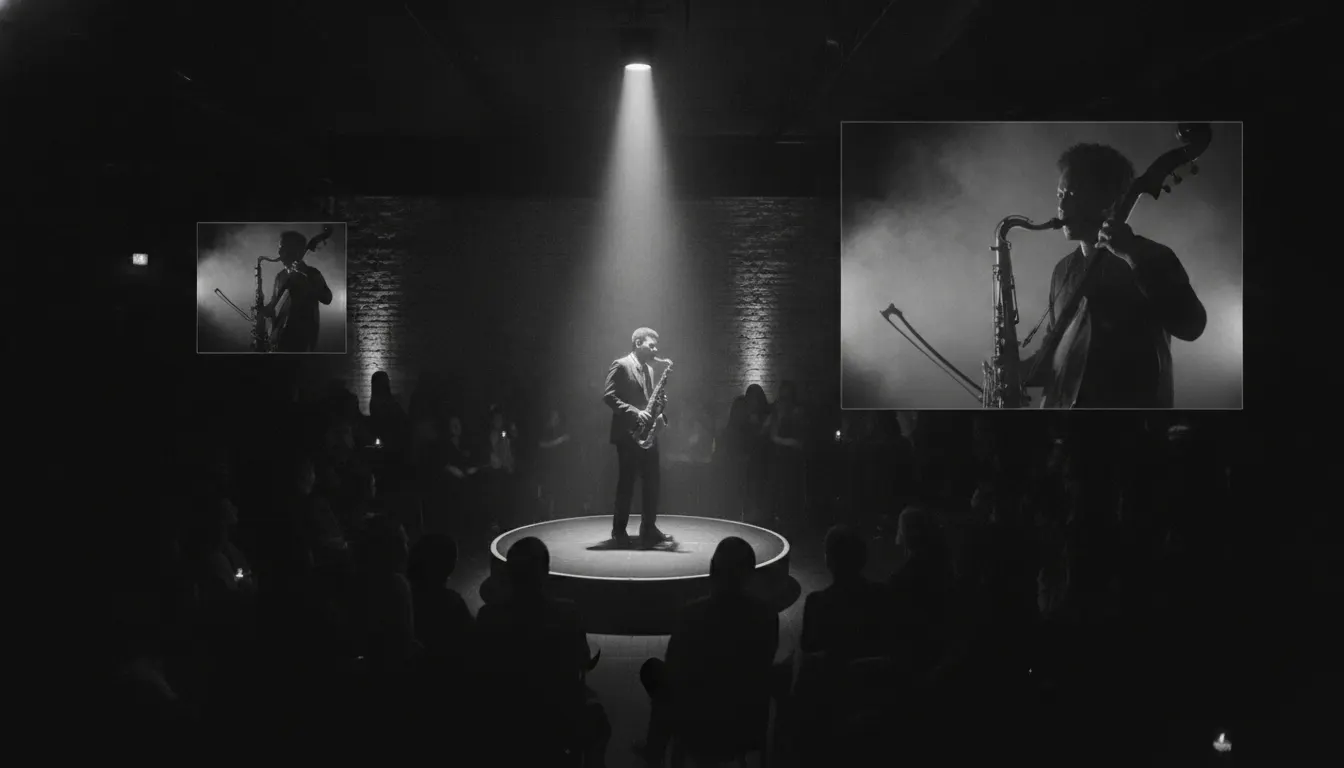
Jazz club BW MV. Blue Note Village Vanguard, single overhead spot, cigarette-smoke haze, sax close-up sweat, bowed bass silhouette.
The moves a human crew would use to get here. Cue applies them for you, and knowing their names is how you ask for a change.
and-white film stock (or digital emulation): Kodak T-MAX 400 or 3200 pushed, visible grain structure
source key light from a hard spotlight - deep shadow on the non-lit side of the face
evidence and light-diffusion tool
spotlights made visible by particulate in the air
up on mouth, hands, or eyes while playing - the instrument as face extension
blocked shadows, bright specular highlights on brass or keys
faces in half-light, smoke-obscured, attentive
of-focus backgrounds rendering the club into a bokeh of warm light points
The visual language of the jazz club is one of the most precisely codified aesthetic systems in music photography and video - a set of conventions developed over decades of album cover photography, documentary film, and live venue documentation that has become culturally inseparable from the music itself.
Blue Note Records, under the art direction of Reid Miles and the photography of Francis Wolff (1939-1967), established the foundational visual language of jazz as a serious, sophisticated, and intimate art form. Wolff's studio photographs of Miles Davis, John Coltrane, Thelonious Monk, Art Blakey, and Herbie Hancock used a consistent approach: black-and-white film pushed to visible grain, single-source key light from one side creating deep shadow on the other half of the face, the cigarette (or trumpet or saxophone) as a prop that extended the expressive line of the body.
The cigarette in jazz club photography is not incidental - it functions as visual punctuation, a held object that gives the hands something to do in the interval between notes, and whose smoke trails provide the only visible evidence of breath in a black-and-white image. The smoke also diffuses light: a room with cigarette smoke in the air scatters single-source light into volumetric shafts, turning a direct spotlight into something approaching chiaroscuro.
William Claxton's photography for Pacific Jazz Records (1950s-1960s) brought a West Coast counterpoint to Blue Note's New York seriousness: a slightly warmer, more relaxed quality that retained the high-contrast black and white but allowed for more casual framing, outdoor sessions (Chet Baker against a California sky), and humor in the composition. Claxton's photographs of Chet Baker, in particular, established the template of the jazz musician as romantic lead - a visual approach that later influenced the representation of pop and rock artists in music video.
Documentary films including Jazz on a Summer's Day (dir. Bert Stern, 1958, Newport Jazz Festival) and Let's Get Lost (dir. Bruce Weber, 1988, Chet Baker documentary) translated the still-photography aesthetic into moving image: high-contrast black and white, smoke-diffused light, performance in intimate venues, and the performer's face in extreme close-up as the primary visual subject.
The jazz club aesthetic was revived in content marketing by streaming platforms (Apple Music Jazz programming, Spotify Jazz sessions), neo-jazz artists (Kamasi Washington's visual direction, Robert Glasper's atmospheric production), and soul/jazz crossover artists (Amy Winehouse's early visual aesthetic borrowed heavily from this tradition, as did Norah Jones' early promotional work).
Miles Davis, Monk, Coltrane
typographic and photographic integration
Chet Baker portraits
1958
Newport Festival documentary
1988
Chet Baker documentary
1959
1964
2006
jazz aesthetic revival
A Look is not a filter. It is a set of stored decisions the pipeline reads before it makes a single frame, so two videos in the same Look actually match.