HARRYHAUSEN DYNAMATION · 1960S · USA
Jason and the Argonauts Skeleton
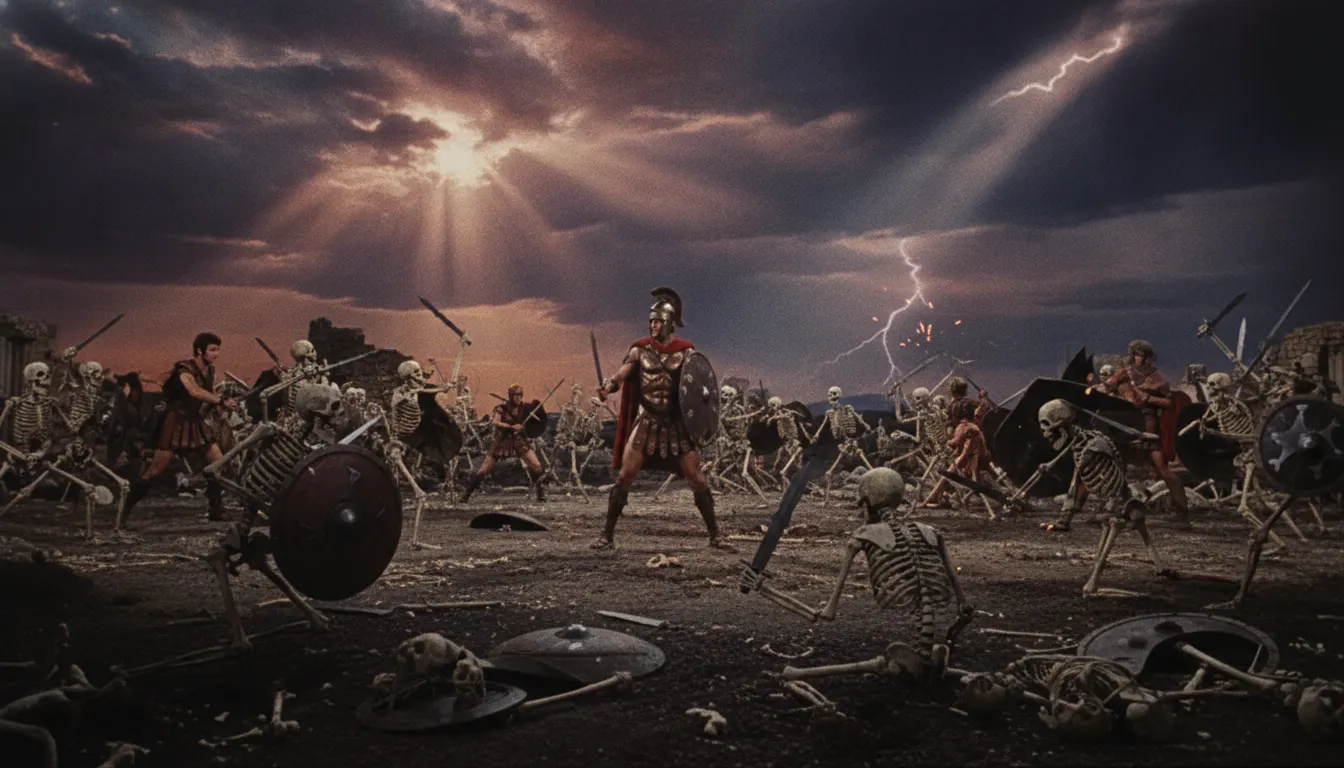
Jason and the Argonauts skeleton-fight stop motion homage. Sword-clashing skeleton army composited against live actors, Harryhausen 1963 spectacle benchmark.
stop-motionskeletonsword-and-sandalclassic
LUT argonauts-sun-baked
WHEN TO USE
- Fantasy, mythology, or ancient world content referencing the visual grammar of sword-and-sandal epic cinema
- Creature effects or monster content where stop-motion's mechanical quality is preferred over CGI smoothness
- Nostalgia or film history content celebrating practical effects and pre-CGI craft
- Horror or supernatural content where slightly jerky, inhuman movement is an asset
- Brand content for games, fantasy products, or entertainment properties referencing classical mythology
- Educational or film studies content about stop-motion technique, compositing, or effects history
WHEN NOT TO USE
- Contemporary action or adventure content where modern audiences expect fluid CGI creature movement
- Comedy or light-hearted content where the supernatural gravitas of Harryhausen's work creates tonal mismatch
- Content requiring fast, high-volume creature animation -- Dynamation was extraordinarily labour-intensive
- Children's content where articulated skeleton warriors may be developmentally inappropriate
SIGNATURE TECHNIQUES
How the look is made.
The moves a human crew would use to get here. Cue applies them for you, and knowing their names is how you ask for a change.
- 01Dynamation compositing
stop-motion models integrated with live-action footage via split-screen and rear projection
- 02Articulated metal armatures covered in latex and fibre glass for creature surfaces
- 03Slight mechanical 'stutter' in movement that distinguishes Harryhausen's work from organic CGI
- 04Physically logical interaction between animated models and live actors: weapons clash, bodies react
- 05Scale models of 15
18 cm animated against live-action environments and actors
- 06Individual creature personalities expressed through movement style and physical logic
- 07Classical mythology visual vocabulary
Greek armour, ancient weapons, architectural backgrounds
HISTORY & CONTEXT
Where it comes from.
Jason and the Argonauts Skeleton Look
Jason and the Argonauts (1963), directed by Don Chaffey and produced by Charles H. Schneer for Columbia Pictures, contains what is almost universally regarded as the greatest sequence in stop-motion film history: the battle of the skeleton warriors, in which Jason and two companions fight seven articulated skeleton soldiers on a clifftop above the sea. The sequence, animated by Ray Harryhausen, took four and a half months to produce and remains a technical and artistic landmark more than sixty years after its creation.
Ray Harryhausen and Dynamation
Ray Harryhausen (1920-2013) was the master of 'Dynamation' -- his proprietary term for the process of compositing stop-motion animated models with live-action footage using a split-screen and rear-projection technique that allowed animated creatures to appear to interact physically with human actors. Harryhausen refined this process across more than 20 films over four decades, and Jason and the Argonauts represents its most accomplished application.
The Skeleton Sequence
Each of the seven skeleton warriors in the battle sequence was a separately constructed articulated armature covered in fibreglass and latex, approximately 15 cm tall. Harryhausen had to track and animate seven separate figures in a coordinated fight with three live actors, maintaining spatial consistency across live-action and animation elements. The sequence is 3 minutes and 18 seconds long and contains approximately 4,750 individual frames.
Visual Characteristics
Harryhausen's skeletons have a specific visual quality that distinguishes them from later CGI or digital skeleton effects: they move with a slightly jerky, mechanical precision that reads as supernatural rather than organic. Their movement has weight and resistance -- shields clatter, swords engage with physical logic -- but the slight stop-motion 'stutter' marks them as beings from another ontological register.
Harryhausen's Broader Legacy
Before Jason and the Argonauts, Harryhausen animated the Medusa in Clash of the Titans (1981), the Cyclops in The 7th Voyage of Sinbad (1958), and the Ymir creature in 20 Million Miles to Earth (1957). His work directly inspired Steven Spielberg, George Lucas, Peter Jackson, and Phil Tippett, and his stop-motion aesthetic is the foundational visual language for creature effects in cinema.
NOTABLE WORKS
Where you have seen it.
Clash of the Titans (1981, dir. Desmond Davis, effects by Ray Harryhausen, MGM)
The 7th Voyage of Sinbad (1958, dir. Nathan Juran, effects by Harryhausen, Columbia)
The Golden Voyage of Sinbad (1973, dir. Gordon Hessler, effects by Harryhausen)
Sinbad and the Eye of the Tiger (1977, dir. Sam Wanamaker, effects by Harryhausen)
20 Million Miles to Earth (1957, dir. Nathan Juran, effects by Harryhausen)
THE RECIPE
The exact knobs
the renderer turns.
A Look is not a filter. It is a set of stored decisions the pipeline reads before it makes a single frame, so two videos in the same Look actually match.
SettingValue
GradeColour LUT applied to every frame
argonauts-sun-bakedTransitionHow one shot becomes the next
hard cuts · 180ms · linearKen BurnsCamera move applied to stills
Slow push · 0.04 · rule-of-thirdsTypographyDisplay / body / mono pairing
Cooper Hewitt · Lora · CourierMusic moodWhat the bed under the voice sounds like
bernard-herrmann-percussion · heroic-brass-stabPrompt suffixAppended to every shot prompt in this Look
Jason and the Argonauts skeleton fight stop motion, sword clashing skeleton army composited against live actors, Harryhausen 1963 spectaclePALETTE
Primary
#E8C09A
Secondary
#7A5A3A
Accent
#7A2A2A
Text/Light
#2A1808
Text/Dark
#FFE8C0
BG 900
#1A0F08
BG 800
#2A1810
RELATED LOOKS
Next to it on the shelf.
Your first cut
is on us.
+ New videoFree plan · no card · 1080p export