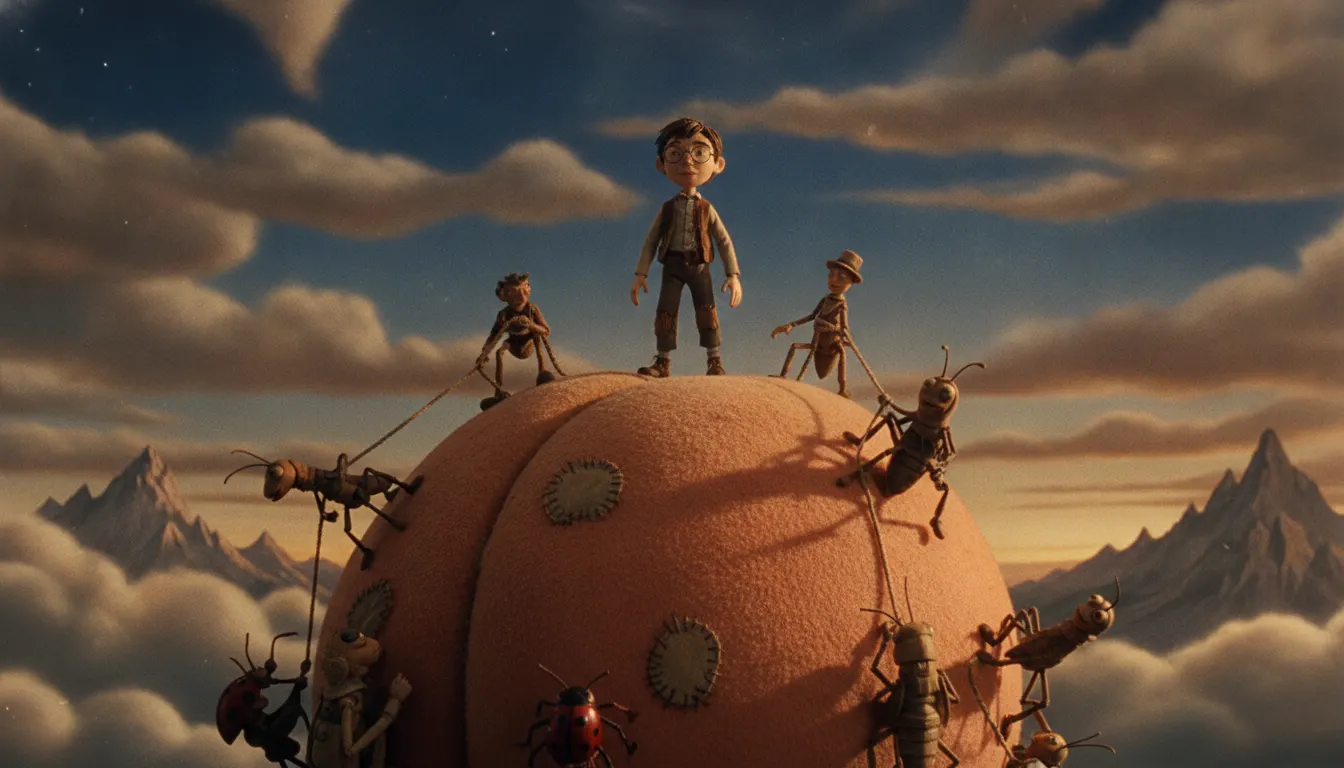
PUPPET STOP MOTION · 1990S · USA
Henry Selick James and the Giant Peach
Henry Selick James and the Giant Peach storybook puppet stop motion. Live-action-to-puppet transition, bug ensemble cast, Atlantic-crossing fairytale set.
stop-motionstorybookwhimsicalfairytale
LUT selick-peach-warm
WHEN TO USE
- Dark children's content in the Roald Dahl tradition: grotesque but warmly characterised
- Literary adaptation content where the source material's strangeness should be amplified rather than softened
- Stop-motion puppet content requiring expressive, slightly unsettling insect or creature characters
- Content blending live-action framing with stop-motion fantasy sequences
- Adventure content with ocean, nautical, or perilous journey aesthetics
- Brand content celebrating craft, books, or childhood imagination in its darker registers
WHEN NOT TO USE
- Content for very young children where the grotesque character design creates fear rather than delight
- Clean, bright, primary-colour children's content -- this look is dark, complex, and textured
- Comedy content requiring broad physical gags -- the Selick register is more melancholy and strange
- Content where the hybrid live-action/stop-motion format creates production complexity without payoff
SIGNATURE TECHNIQUES
How the look is made.
The moves a human crew would use to get here. Cue applies them for you, and knowing their names is how you ask for a change.
- 01Foam latex puppet skins over wire armatures with individual handcrafted character fabrication
- 02Grotesque but warmly characterised creature design in the Roald Dahl / Quentin Blake tradition
- 03Live
action and stop-motion hybrid structure with clear fantasy-departure transition
- 04Dream
sequence colour palette: warm amber, deep teal, and bruised purple for night ocean sequences
- 05Elongated, asymmetric character proportions that exaggerate personality traits into physical form
- 06Mechanised and skeleton puppet designs for villain characters (shark, pirates)
- 07Musical number integration requiring specialised stop
motion performance choreography
HISTORY & CONTEXT
Where it comes from.
Henry Selick James and the Giant Peach Look
James and the Giant Peach (1996) was directed by Henry Selick, produced by Tim Burton and Denise Di Novi through Skellington Productions, and distributed by Walt Disney Pictures. The film adapts Roald Dahl's 1961 novel and represents Selick's most distinctive individual visual statement -- a film that is more grotesque, more psychologically complex, and more visually eccentric than the The Nightmare Before Christmas (1993) that preceded it.
Henry Selick's Visual Identity
Henry Selick (born 1952) is one of the most significant stop-motion directors in film history. While The Nightmare Before Christmas is frequently -- and erroneously -- attributed to Tim Burton (who conceived and produced it), Selick was the director who oversaw every aspect of its production. James and the Giant Peach is his most fully personal feature, allowing him greater creative latitude over character design and visual atmosphere.
Live Action and Stop-Motion Hybrid
The film opens and closes in live-action sequences set in a Roald Dahl-esque English village, then transitions into stop-motion for the peach adventure sequences. This structural hybrid mirrors the novel's own fantasy-departure logic and allows the stop-motion world to carry the weight of the film's emotional and fantastical core.
Character Design: Dahl's Grotesque
The insect characters -- Centipede, Earthworm, Miss Spider, Grasshopper, and Glowworm -- are rendered with the lovable grotesquerie that characterises Dahl's original illustrations by Quentin Blake. Characters are elongated, asymmetric, and slightly unsettling, but warmly characterised. The puppet armatures and foam latex skins required months of individual fabrication.
Atmosphere and Palette
The peach sequences use a dreamlike palette of warm amber, deep teal, and bruised purple for the ocean night sequences. The mechanised shark and skeleton pirates sequences push into darker, more menacing territory, anticipating the visual language Selick would later develop in Coraline (2009, Laika).
NOTABLE WORKS
Where you have seen it.
The Nightmare Before Christmas (1993, dir. Henry Selick, produced by Tim Burton, Disney)
Coraline (2009, dir. Henry Selick, Laika Entertainment)
Wendell and Wild (2022, dir. Henry Selick / Jordan Peele, Netflix)
Monkeybone (2001, dir. Henry Selick, Fox Searchlight, hybrid live-action/stop-motion)
THE RECIPE
The exact knobs
the renderer turns.
A Look is not a filter. It is a set of stored decisions the pipeline reads before it makes a single frame, so two videos in the same Look actually match.
SettingValue
GradeColour LUT applied to every frame
selick-peach-warmTransitionHow one shot becomes the next
soft cuts · 280ms · ease-in-outKen BurnsCamera move applied to stills
Slow push · 0.03 · centerTypographyDisplay / body / mono pairing
Cormorant · Lora · CourierMusic moodWhat the bed under the voice sounds like
randy-newman-show-tune · orchestral-storybookPrompt suffixAppended to every shot prompt in this Look
Henry Selick James and the Giant Peach stop motion, storybook puppet, oversized peach miniature, bug ensemble cast, 1990s Disney whimsyPALETTE
Primary
#E89A4E
Secondary
#7A4A2E
Accent
#3A6A8F
Text/Light
#2A1408
Text/Dark
#FFE8C0
BG 900
#1A0E05
BG 800
#2A1808
RELATED LOOKS
Next to it on the shelf.
Your first cut
is on us.
+ New videoFree plan · no card · 1080p export