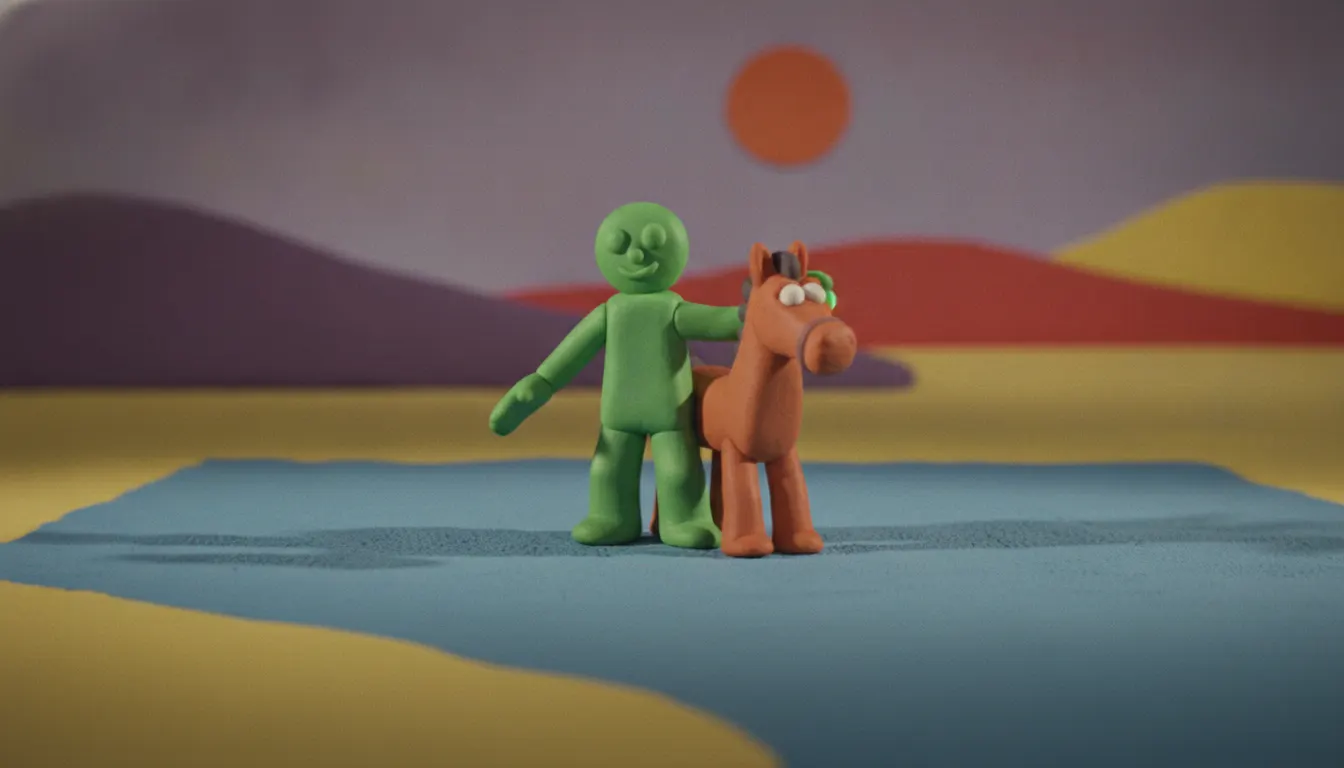
CLAYMATION · 1950S · USA
Gumby Classic Stop Motion
Art Clokey Gumby and Pokey claymation. Flat tabletop sets, primary-color clay, slightly jerky 12fps motion, mid-century childrens-tv simplicity.
claymationretrochildrens-tvprimary-color
LUT gumby-primary-tabletop
WHEN TO USE
- Nostalgia content referencing 1950s-1960s American children's television
- Content celebrating the naive, childlike, or deliberately simple aesthetic as a creative choice
- Surreal or psychedelic content where physical impossibility and body transformation are themes
- Toy, craft, or maker content that wants to invoke foundational stop-motion heritage
- Brand content for audiences who associate Gumby-style animation with warmth and creative freedom
- Comedy content that uses the visual grammar of 1950s children's TV for ironic or affectionate effect
WHEN NOT TO USE
- Sophisticated or prestige content where the deliberately naive aesthetic reads as unpolished
- Dramatic or emotional content where the surreal plasticity undermines sincerity
- Contemporary children's content where modern CGI expectations make the vintage look feel dated
- Brand content where the 1950s American children's TV associations create unintended retro signals
SIGNATURE TECHNIQUES
How the look is made.
The moves a human crew would use to get here. Cue applies them for you, and knowing their names is how you ask for a change.
- 01Simple, rounded clay forms with minimal anatomical detail and exaggerated plasticity
- 02Visible armature wobble and clay surface fingerprints as period-authentic aesthetic features
- 03Primary and bright secondary colour palette with no attempt at naturalistic colour grading
- 04Body transformation and morphing as narrative device
- Gumby stretches, shrinks, and changes shape
- 05Book and portal entry as recurring environmental metaphor (characters entering two-dimensional media)
- 06Simple set design using flat painted backdrops and basic three-dimensional props
- 07Frame rates typical of 1950s television
12-18 fps with occasional jerky movement
HISTORY & CONTEXT
Where it comes from.
Gumby Classic Stop-Motion Look
Gumby, created by Art Clokey, is one of the foundational figures in American stop-motion animation and the character most responsible for establishing clay animation as a viable medium for children's television in the United States. Gumby first appeared in Clokey's experimental short Gumbasia (1953), a clay animation piece set to jazz music, before being developed into the character who debuted on The Howdy Doody Show in 1956 and received his own series The Gumby Show from 1957.
Art Clokey's Visual Philosophy
Art Clokey (1921-2010) developed his approach to clay animation from a combination of experimental film study (he attended USC under Slavko Vorkapich, who was known for montage theory) and a personal spiritual philosophy that valued childlike openness and imaginative freedom. The Gumby aesthetic reflects this: simple forms, bright colours, and a complete disregard for the laws of physics. Gumby can enter books, shrink, stretch, and transform his body shape -- the clay medium's fundamental plasticity is exploited as a narrative device.
Character Design
Gumby's design is almost childlike in its simplicity: a green humanoid shape with a distinctive asymmetric head, articulated at the joints but without detailed anatomy. His horse companion Pokey is rendered with the same basic simplicity. The characters' lack of detailed facial anatomy makes their emotional expressions reliant on body language and context -- an approach that gives the series a slightly alien, hypnotic quality.
Production Aesthetic
The original series was produced on low budgets with visible technical limitations: wobble in the armatures, fingerprints on clay surfaces, slight colour shifts across takes as clay dried, and visible surface textures that betray the handmade quality of every frame. These qualities are now understood as aesthetic features of the Gumby look rather than failures.
Cultural Legacy
Gumby's image was revived in the 1980s through the Eddie Murphy Saturday Night Live parody and a new series in 1988. The character remains an icon of American pop surrealism.
NOTABLE WORKS
Where you have seen it.
The Gumby Show (1957-1967, Art Clokey Productions / ABC/NBC)
Gumby Adventures (1988, Art Clokey Productions, revival series)
The Gumby Movie (1995, dir. Art Clokey, feature film)
Davey and Goliath (1960-1975, Art Clokey / Lutheran Church, companion clay animation series)
THE RECIPE
The exact knobs
the renderer turns.
A Look is not a filter. It is a set of stored decisions the pipeline reads before it makes a single frame, so two videos in the same Look actually match.
SettingValue
GradeColour LUT applied to every frame
gumby-primary-tabletopTransitionHow one shot becomes the next
hard cuts · 240ms · linearKen BurnsCamera move applied to stills
Static framesTypographyDisplay / body / mono pairing
Archivo · Inter · CourierMusic moodWhat the bed under the voice sounds like
cheery-organ · mid-century-kids-tunePrompt suffixAppended to every shot prompt in this Look
Art Clokey Gumby Pokey claymation, flat tabletop set, primary color clay, jerky 12fps motion, mid-century childrens tvPALETTE
Primary
#5BB04C
Secondary
#3A6A1E
Accent
#E8552A
Text/Light
#0F2410
Text/Dark
#F8E8B5
BG 900
#0A1808
BG 800
#1A2A18
RELATED LOOKS
Next to it on the shelf.
Your first cut
is on us.
+ New videoFree plan · no card · 1080p export