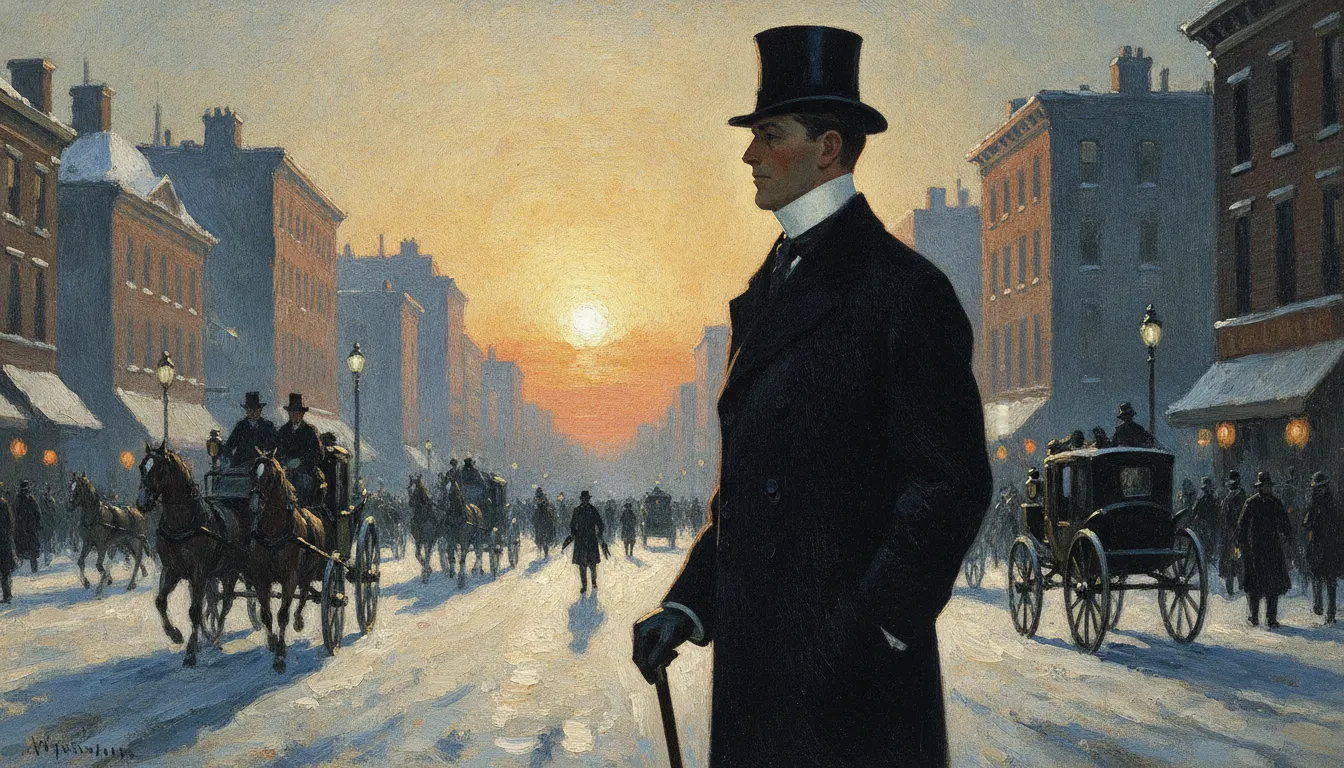
Arrow Collar Man advertising series
J.C. Leyendecker (Cluett, Peabody & Co.) · 1905-1931
The most recognized advertising figure in early 20th-century America; the idealized male figure in faceted brushstroke technique
J.C. Leyendecker Arrow Collar man. Stylised hatched brushstroke, square-jawed gentleman, fashion-plate posture, Saturday Evening Post cover.
The moves a human crew would use to get here. Cue applies them for you, and knowing their names is how you ask for a change.
Forms built from distinct, angled planes of paint rather than smooth gradients - each brush mark describes a specific facet of a surface, creating an architectural quality to faces and figures.
The square jaw, high cheekbone, strong nose bridge, and deep-set eyes rendered as bold geometric planes, abstracting individual features toward a cultural ideal rather than a portrait.
Figures rendered in warm cream, rose, and amber skin tones against deep cobalt, forest green, or dark red backgrounds that amplify the figure's luminosity by contrast.
Border elements, costume details, and compositional organization showing Art Nouveau influence from his Paris training - particularly in the flowing, stylized treatment of fabric and hair.
Figures placed in poses that signal ease, authority, and self-possession - the slight backward lean, the directly returned gaze, the held cigarette or glass - that define aspirational masculinity.
Dress shirts, suits, ties, and collar details rendered with meticulous accuracy, functioning as advertising documentation as well as painterly exercise.
Joseph Christian Leyendecker (1874-1951) was the dominant American magazine cover illustrator of the first half of the 20th century, responsible for 322 covers of The Saturday Evening Post between 1899 and 1943, as well as foundational advertising campaigns for Kuppenheimer Clothes, Kellogg's, Coca-Cola, and most influentially, the Arrow Collar Company. His visual signature - a faceted, angular rendering of male and female beauty that has no direct precedent in American illustration - shaped the cultural ideal of American handsomeness for three decades.
Leyendecker was born in Montabronn, Germany, and his family emigrated to Chicago when he was eight. He trained at the Art Institute of Chicago and then in Paris at the Académie Julian (1896-1900), where he absorbed the academic European figure-painting tradition and the influence of Art Nouveau poster artists including Alphonse Mucha. He returned to the United States in 1900 and rapidly established himself as the leading cover artist for Collier's Weekly and then The Saturday Evening Post.
His technique is unlike that of any direct predecessor or follower. Where most American illustration in this era used smooth graduated tonal rendering (an influence from photography and photomechanical reproduction), Leyendecker built his oil paintings from distinct, faceted brushstrokes that describe form through planes of light and shadow rather than smooth transitions. Faces become architectures: the nose bridge a distinct angled plane, the cheekbone a high-lit triangular surface, the jaw a geometric mass. The effect is simultaneously more artificial and more powerful than photorealism - the figures read as ideals, abstractions of physical type, rather than individuals.
From 1905 to 1931, Leyendecker produced the advertising illustrations for Cluett, Peabody & Co.'s Arrow brand dress shirts. The Arrow Collar Man - tall, square-jawed, impeccably dressed, always in a moment of confident leisure or purposeful activity - became the most recognized advertising figure in America, generating more fan mail than actual celebrities. The model for most of these illustrations was Charles Beach, Leyendecker's longtime companion and business manager.
Leyendecker's invention of the New Year's Baby (the infant figure representing the new year carried over from the old year, shown as an old man) first appeared on the Saturday Evening Post cover in 1907 and became an American visual convention. His Thanksgiving and Christmas covers, featuring idealized family gatherings in warm domestic interiors, similarly became the template for mid-century holiday imagery.
Norman Rockwell was mentored by Leyendecker and his earlier success at the Post directly inspired Rockwell's own ambitions. The two painters were simultaneously rivals and peers, though Rockwell's more sentimental, story-based approach eventually displaced Leyendecker's more formally abstract idealism.
J.C. Leyendecker (Cluett, Peabody & Co.) · 1905-1931
The most recognized advertising figure in early 20th-century America; the idealized male figure in faceted brushstroke technique
J.C. Leyendecker · 1899-1943
322 covers; the defining visual identity of the most widely circulated American magazine of the era
J.C. Leyendecker, Saturday Evening Post · 1907
Invention of the New Year's Baby visual convention; still reproduced annually as an American cultural image
J.C. Leyendecker · 1905-1940s
Idealized domestic holiday gatherings; the visual template for mid-century American Thanksgiving imagery
J.C. Leyendecker · 1910s-1920s
Men's suits advertising; faceted technique applied to full-figure fashion illustration
J.C. Leyendecker · c.1930s
Monumental allegorical figure work; the academic training at large scale
A Look is not a filter. It is a set of stored decisions the pipeline reads before it makes a single frame, so two videos in the same Look actually match.