DISPLAY FORMAT EXTREME · CONTEMPORARY · INTERNATIONAL
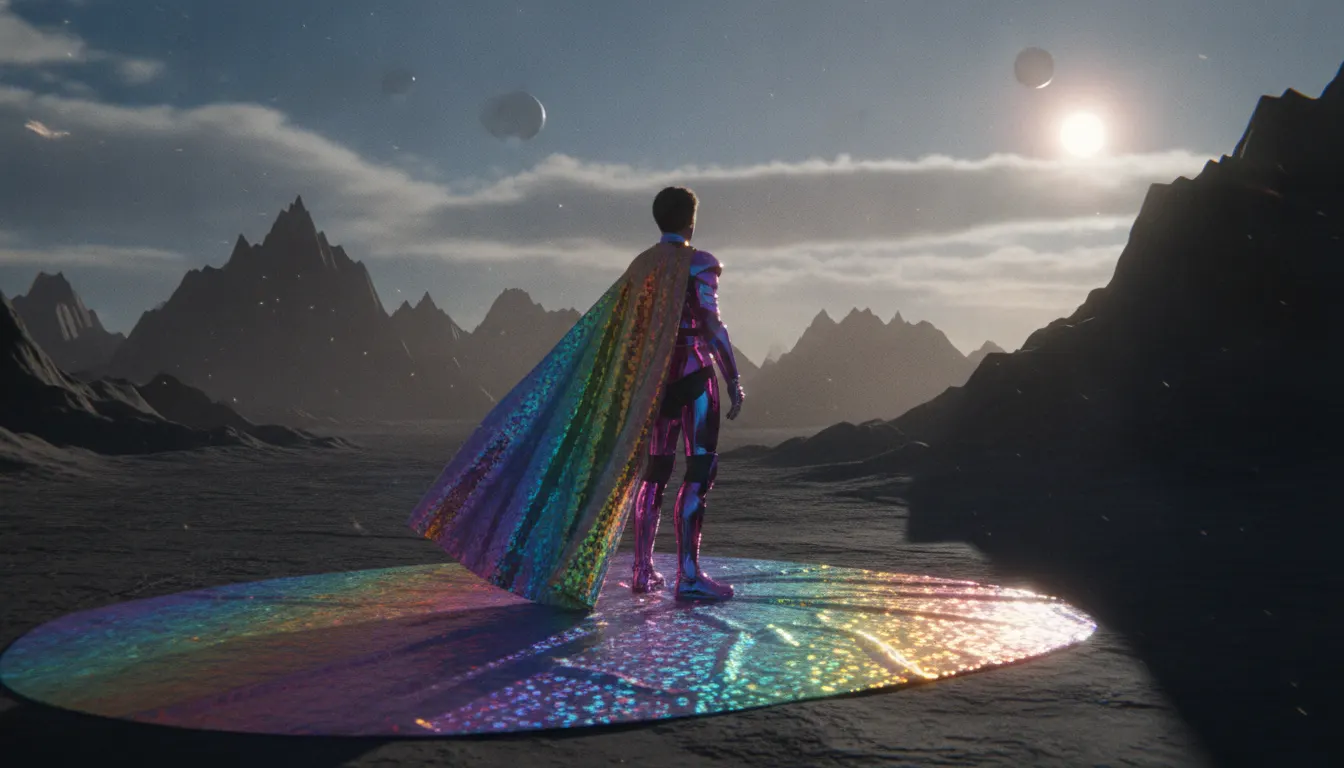
Holographic Iridescent Foil
Holographic iridescent foil surface. Rainbow-shift gradient depending on angle, Y2K trading-card hologram, futuristic chrome-shift fashion aesthetic.
holographiciridescenty2kfuturistic
LUT holo-iridescent
WHEN TO USE
- Y2K, futurism, or cyber-glamour aesthetics in fashion, beauty, or music content
- Product photography for premium cosmetics, tech accessories, or fashion items where prismatic luxury signals high value
- Music video or performance content in the pop, EDM, or K-pop space where visual maximalism is expected
- Event and festival content where the foil aesthetic matches the sensory excess of the experience
- Brand campaigns targeting Gen Z or millennial audiences with nostalgia for late-1990s and early-2000s aesthetics
- Abstract or texture-forward thumbnail art that needs color variety without representational imagery
WHEN NOT TO USE
- Serious editorial, news, or documentary content where iridescent excess undermines authority
- Earthy, natural, or sustainability-positioned brands where synthetic shimmer contradicts brand values
- Minimalist, monochrome, or brutalist design systems where spectral rainbow hues break visual discipline
- Medical, legal, or financial content where the aesthetic reads as frivolous or untrustworthy
SIGNATURE TECHNIQUES
How the look is made.
The moves a human crew would use to get here. Cue applies them for you, and knowing their names is how you ask for a change.
- 01Hue rotation over time
animate Hue/Saturation adjustment across 0-360 degrees on a 2-4 second loop
- 02Rainbow gradient overlay in Hard Light or Color Dodge blend mode at 30-60% opacity across surface
- 03High specular highlight mapping
boosted whites and clipped specular peaks simulate foil reflectivity
- 04Reflection displacement
ripple or warp distortion applied to gradient overlay to simulate fabric movement
- 05Desaturate base to silver
gray before applying spectral color overlay to preserve foil metallic base
- 06Lens flare or anamorphic streak passing through the spectrum peak for punctuation
- 07Gaussian bloom on highlights at 15
25px to replicate the bleeding glow of real foil in direct light
HISTORY & CONTEXT
Where it comes from.
Holographic Iridescent Foil
Holographic iridescent foil is distinguished by shifting rainbow hues that change with viewing angle - a phenomenon called structural color, driven not by pigment but by physics. When light reflects off extremely thin transparent layers (each just hundreds of nanometers thick), wavelengths interfere constructively or destructively depending on the angle and layer thickness, producing the spectral shimmer associated with oil slicks, soap bubbles, butterfly wings, and the metallic Mylar foils that define this aesthetic.
Physics and Material Science
The principle is thin-film interference, described mathematically by the same equations governing anti-reflective lens coatings and AR-coated optics. Dichroic glass (from Greek: two-colored) achieves a similar effect via vacuum-deposited metal oxide layers, and was widely used in architectural installations and theatrical lighting from the 1980s onward. The term "holographic foil" in commercial packaging and fashion refers to embossed diffraction grating film - a surface micro-pattern that diffracts white light into spectral rainbows rather than true holographic wavefront reconstruction.
Fashion Wave
Versace's 1990s collections - particularly under Gianni Versace through his 1997 death and continuing under Donatella - repeatedly incorporated holographic and iridescent lamé fabrics that became signature markers of Milanese luxury excess. Issey Miyake's _Pleats Please_ line (launched 1993) and collaborations with textile engineers pushed iridescent polyester pleat structures that shifted color with movement. Alexander McQueen used holographic mylar inserts in the late 1990s and early 2000s runway pieces. The Y2K moment (1998-2002) made holographic silver and rainbow foil ubiquitous in club fashion and music video wardrobe, appearing in videos by Britney Spears and TLC among many others.
Contemporary Revival
The 2015-2020 Y2K aesthetic revival brought holographic foil back through indie fashion brands, festival wear, and social media content. FKA twigs and Charli XCX video production made heavy use of the look. In product photography, holographic backgrounds became a staple for beauty, tech accessories, and cosmetics brands signaling futurism and luxury simultaneously.
NOTABLE WORKS
Where you have seen it.
Issey Miyake _Pleats Please_ iridescent polyester series (1993-ongoing)
Alexander McQueen holographic mylar inserts, late 1990s runway
TLC
1999
_No Scrubs_ music video holographic wardrobe
FKA twigs
_Two Weeks_ and _Cellophane_ visual treatments with iridescent surfaces (2014, 2019)
Charli XCX
_How I'm Feeling Now_ and _Crash_ era visual campaigns (2020-2022)
THE RECIPE
The exact knobs
the renderer turns.
A Look is not a filter. It is a set of stored decisions the pipeline reads before it makes a single frame, so two videos in the same Look actually match.
SettingValue
GradeColour LUT applied to every frame
holo-iridescentTransitionHow one shot becomes the next
soft cuts · 320ms · ease-in-outKen BurnsCamera move applied to stills
Slow push · 0.04 · centerTypographyDisplay / body / mono pairing
Space Grotesk · Inter · JetBrains MonoMusic moodWhat the bed under the voice sounds like
hyperpop · future-funkPrompt suffixAppended to every shot prompt in this Look
holographic iridescent foil surface, rainbow angle-shift gradient, Y2K trading card hologram, chrome-shift fashion aestheticPALETTE
Primary
#FF3CA0
Secondary
#9D3CFF
Accent
#3CE0FF
Text/Light
#1A0820
Text/Dark
#FFE8F2
BG 900
#0A0418
BG 800
#1A0828
RELATED LOOKS
Next to it on the shelf.


Your first cut
is on us.
+ New videoFree plan · no card · 1080p export