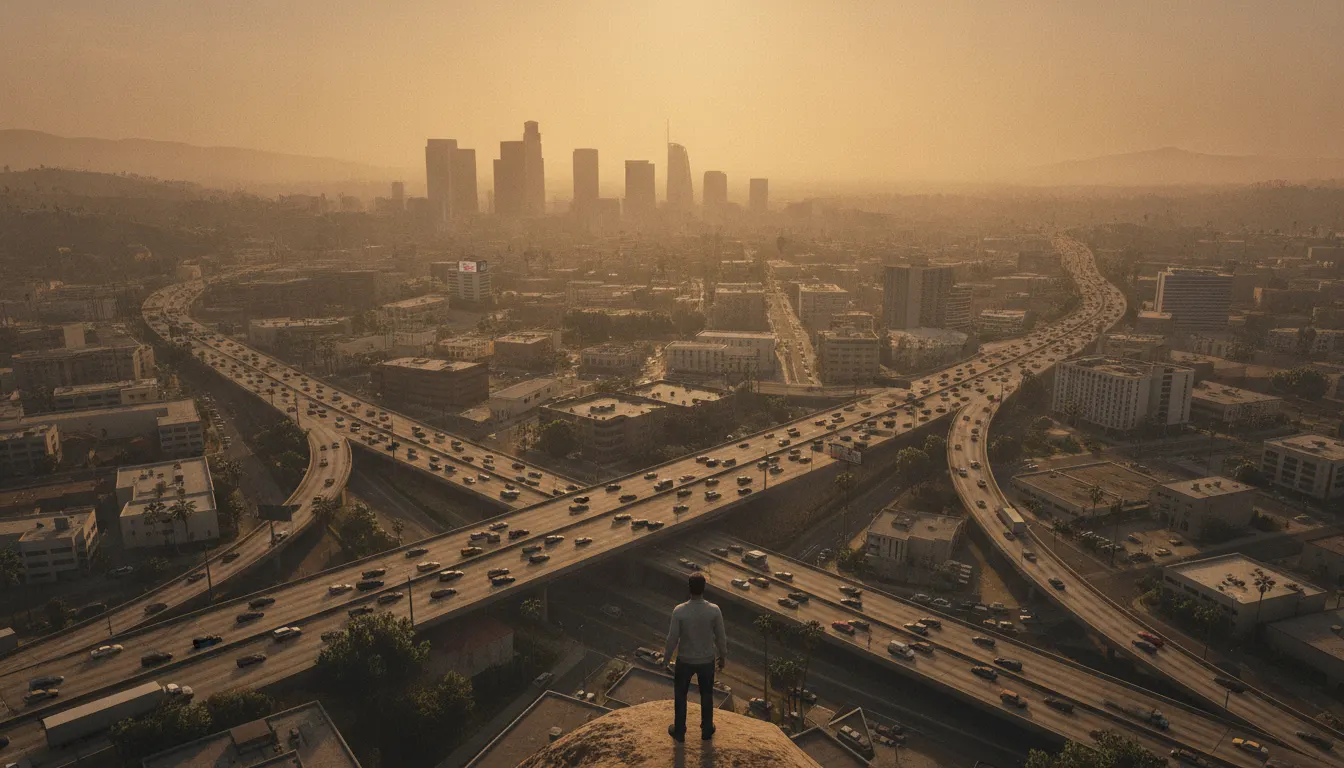
Grand Theft Auto V
Rockstar Games, 2013 (PS3/Xbox 360); re-released 2014 (PS4/Xbox One), 2022 (PS5/Xbox Series X)
Grand Theft Auto V Rockstar photoreal modern aesthetic. Los Santos golden-hour smog, satirical Los Angeles density, vehicular open-world cinematography.
The moves a human crew would use to get here. Cue applies them for you, and knowing their names is how you ask for a change.
shadow / amber-highlight color grade evoking Hollywood blockbuster post-processing
asphalt cracks, rust streaks, glass reflections
1 letterboxing in cinematics and the Rockstar Editor playback
Released in 2013 by Rockstar Games and re-released across three console generations, Grand Theft Auto V established a benchmark for open-world photorealism that content creators still reference a decade later. Set in Los Santos - a sprawling fictional Los Angeles - the game layered physically based rendering with aggressive cinematic post-processing: lens flares, chromatic aberration, film grain, and depth-of-field blur that simulated 35mm cinematography rather than a video game engine.
The core of the GTA V look is golden-hour realism with urban grit. Rockstar's RAGE engine rendered sun-bleached California light at magic hour, giving even mundane highway shots a cinematic warmth. Shadows are deep and saturated; highlights blow out slightly, echoing handheld documentary filmmaking. The color grade leans toward teal shadows and amber midtones - a classic Hollywood blockbuster palette executed at real-time scale.
Texture density is extreme: cracked asphalt, rust-stained concrete, reflective glass towers, and sun-faded paint on low-rider hoods all read as tactile surfaces. Characters cast realistic ambient occlusion and subsurface scattering skin, while environments feature volumetric fog rolling off the Pacific, heat haze over inland highways, and fully dynamic weather that shifts from stark noon bleach to overcast grey within a single mission.
The in-game Rockstar Editor (added in 2015) encouraged players to compose shots with anamorphic letterboxing, rack focus pulls, and color-matched grades. Cinematics use Dutch angles and low tracking shots familiar from Michael Mann crime films. Close-up character shots emphasize stubble, sweat, and creased leather with a near-photographic fidelity that was unprecedented at the game's launch.
Los Santos contains over 3,000 unique assets rendered with a LOD system that maintains believability from helicopter altitude to street level. This multi-scale believability - the city reads as real from both a drone perspective and a first-person sidewalk view - is a hallmark of the look that separates it from smaller-budget open-world titles.
The GTA V aesthetic has become shorthand for gritty modern urban realism in game art direction and has heavily influenced music video production, social content creators using the Rockstar Editor, and even automotive photography aesthetics imported into real-world campaigns.
Rockstar Games, 2013 (PS3/Xbox 360); re-released 2014 (PS4/Xbox One), 2022 (PS5/Xbox Series X)
ongoing live service expansions 2013-present with upgraded photorealism each generation
2012
Rockstar's own photorealistic reveal that set audience expectations
massive GTA Online roleplay scene using the engine's realism as a film backdrop
direct lineage to the GTA V photoreal aesthetic at next-gen fidelity
A Look is not a filter. It is a set of stored decisions the pipeline reads before it makes a single frame, so two videos in the same Look actually match.