Gordon Parks
1942
*American Gothic, Washington, D.C.* , Ella Watson with mop and American flag, FSA
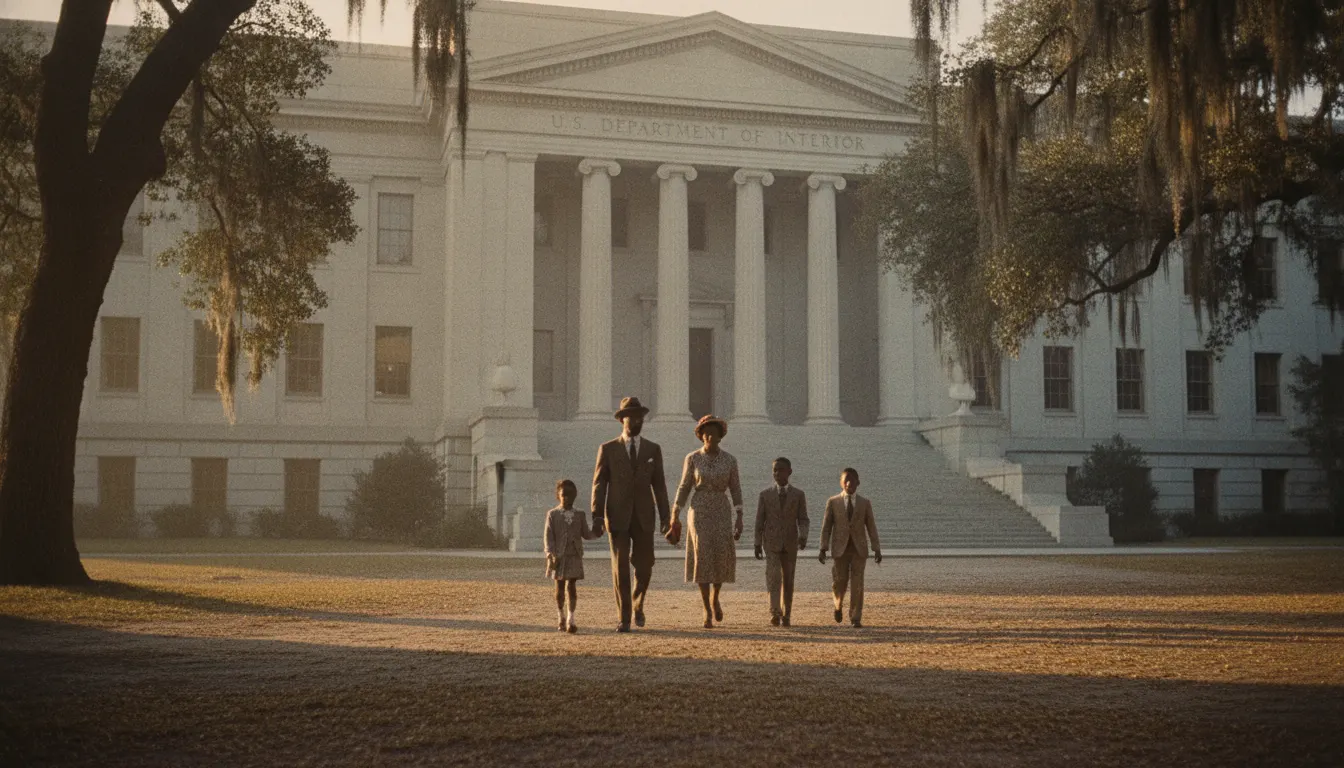
Gordon Parks 1956 Life segregation color. Department of the Interior signage, Alabama family Sunday best, dignified color reportage, Mobile drinking fountain.
The moves a human crew would use to get here. Cue applies them for you, and knowing their names is how you ask for a change.
rich, naturalistic color that resists the aesthetic distance of black-and-white
images designed to carry an argument about social conditions, not merely to document
Parks spent days or weeks with families before photographing, building trust
symbolic objects (flags, mops, church pews) positioned deliberately
American symbols of freedom and democracy set against the reality of their denial
Gordon Parks (1912-2006) was one of the most important and versatile creative figures in 20th-century American culture - a photographer, filmmaker, composer, and writer who used every medium available to him as what he called a 'weapon against poverty and racism.' His photography work spans more than five decades, from his early FSA assignments under Roy Stryker to his Life magazine career to his landmark 1971 film Shaft, which helped define the Blaxploitation era.
Parks's first major statement as a photographer came not as breaking news but as conceptual social critique. American Gothic, Washington, D.C. (1942) shows Ella Watson, a Black government cleaning woman, standing before an American flag, holding a mop and broom - a direct riff on Grant Wood's famous 1930 painting American Gothic. Roy Stryker, head of the FSA photography unit, initially called the image 'too on the nose' but recognized its power. It became one of the defining photographs of systemic racism in America.
In 1948, Parks became Life magazine's first Black staff photographer - a historic appointment at the most influential American picture magazine of the era. Parks used the platform to document stories that had rarely appeared in mainstream American media: his 1956 photo essay 'The Restraints: Open and Hidden,' documenting the life of an Alabama Black family living under legal segregation (later collected as the Segregation Story project), was among the first extended photo essays in a mainstream magazine to give dignity and complexity to Black life under Jim Crow.
Unlike most social documentary photographers of the FSA era who worked in black-and-white, Parks increasingly worked in color - a deliberate choice that humanized his subjects and resisted the aesthetic distance that monochrome could impose. His Life essays used color's emotional directness to make the conditions of segregation and poverty impossible to aestheticize away. The color work gives his subjects flesh tones, environment hues, and the full visual complexity of lived experience.
1942
*American Gothic, Washington, D.C.* , Ella Watson with mop and American flag, FSA
'The Restraints: Open and Hidden' / *Segregation Story* (*Life*, 1956), Alabama segregation essay
Muhammad Ali portraits (*Life*, 1966), Color study of Ali at his peak
1966
*A Choice of Weapons* , autobiography with photographic illustrations
*A Harlem Family* (*Life*, 1968), three-year documentation of a Harlem family in poverty
1971
*Shaft* , debut feature film, directorial career extension of his visual language
New York, established 2006, holds and exhibits the photographic archive
A Look is not a filter. It is a set of stored decisions the pipeline reads before it makes a single frame, so two videos in the same Look actually match.