GeoCities service (1994-2009)
David Bohnett and John Rezner
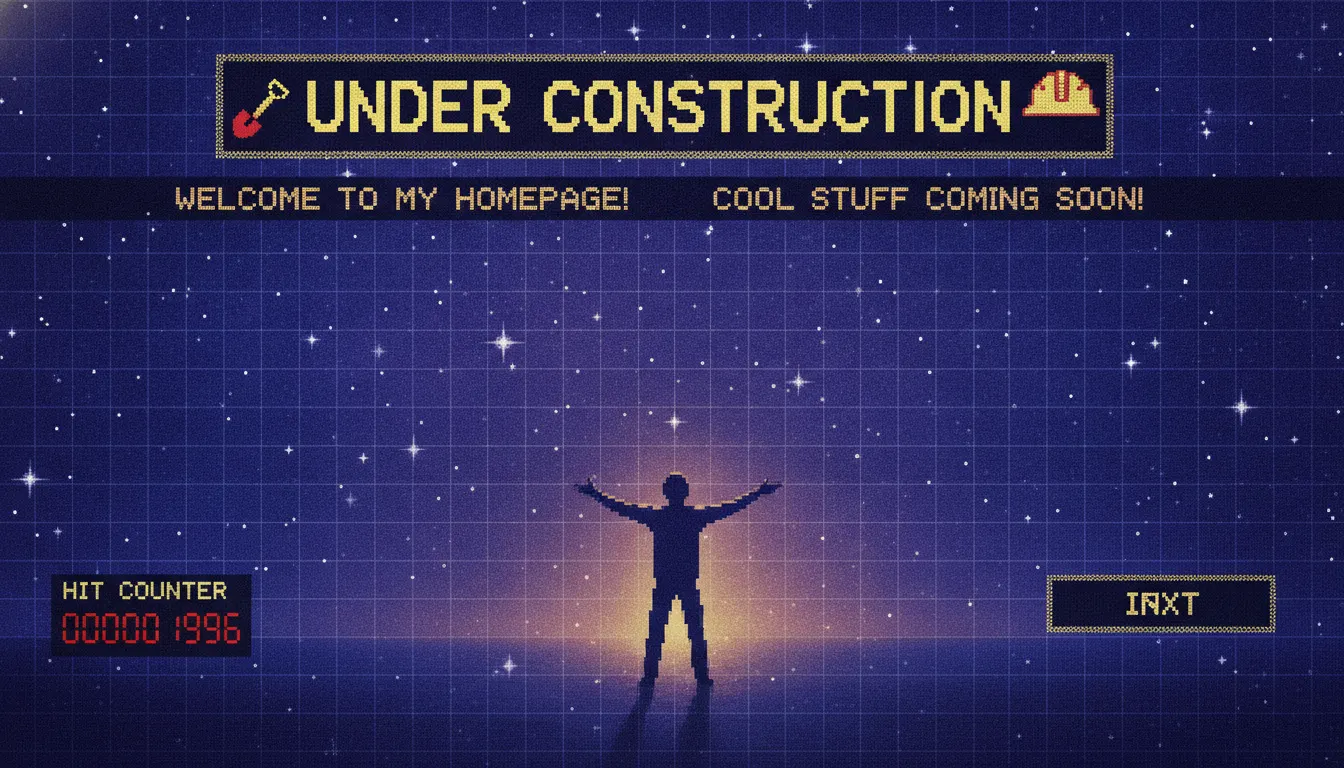
Geocities Web 1.0 amateur homepage. Tiled GIF backgrounds, animated under-construction signs, Comic Sans, marquee scroll, hit counter at bottom.
The moves a human crew would use to get here. Cue applies them for you, and knowing their names is how you ask for a change.
star fields, animated fire, marble textures, or themed tiles
serif typefaces in multiple colors simultaneously
spinning logos, dancing figures, scrolling text
progress indicators
GeoCities was a web hosting service founded in 1994 by David Bohnett and John Rezner, acquired by Yahoo! for $3.57 billion in 1999 (the peak of the dot-com bubble), and shut down in 2009 - at which point the Geocities Archive project preserved over 1.2 million sites. For approximately 15 years, GeoCities hosted millions of personal websites that, taken together, constitute the most complete documentary record of civilian digital creative culture in the 1990s.
GeoCities sites were created by people who had no design training, using tools (Netscape Composer, Microsoft FrontPage, raw HTML editors) that exposed every option simultaneously. The results followed patterns that, in retrospect, constitute a coherent aesthetic vocabulary.
Background patterns - often tiled JPEG or GIF textures sourced from free-graphics sites - covered every surface. Comic Sans, the typeface designed by Vincent Connare in 1994 for Microsoft Bob, was ubiquitous because it was friendly and available. Animated GIFs - dancing babies, spinning logos, flaming text, explicit 'Under Construction' signs with animated excavators - signaled that the site was alive and changing. Visitor counters displayed page views as public proof of audience. Neon text on black backgrounds appeared on millions of music fan and goth-subculture sites.
The 'Under Construction' animated GIF is perhaps the most culturally specific artifact of 1990s web design: an acknowledgment that the web was in constant flux, that pages were works-in-progress, that the medium was new enough that incompleteness needed to be marked rather than hidden. It was a form of honesty that contemporary web design eliminates.
The Archive Team's preservation of GeoCities in 2009 (a 650 GB torrent of approximately 38 million pages) has become both a historical resource and a source of aesthetic inspiration. Cameron's World (cameronsworld.net, 2014) curated and reassembled GeoCities-era graphics into a contemporary scrolling collage that demonstrated the period's visual richness. Y2K aesthetic revival communities on social media from 2018 onward incorporated GeoCities visual elements as markers of early internet authenticity.
David Bohnett and John Rezner
Cameron Askin (cameronsworld.net, 2014)
2009
Archive Team preservation effort
1994
Vincent Connare for Microsoft
1996
Michael Girard and Robert Lurye
tutorial sites teaching early HTML decoration
Deidre LaCarte's GeoCities site (1997, viral benchmark)
A Look is not a filter. It is a set of stored decisions the pipeline reads before it makes a single frame, so two videos in the same Look actually match.