Garry Winogrand
*The Animals* (1969, MOMA), New York City Zoo photographs
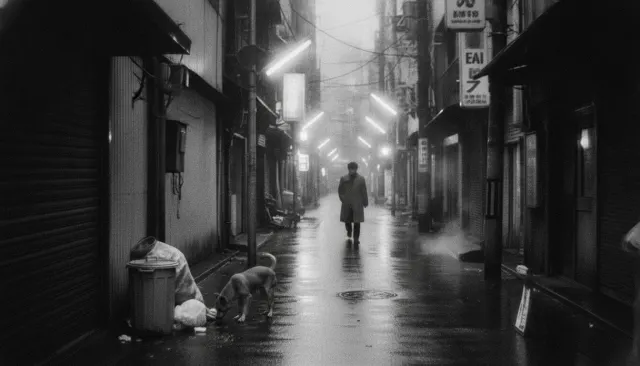
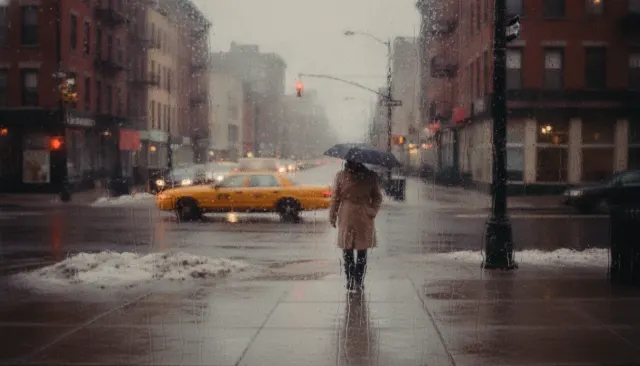
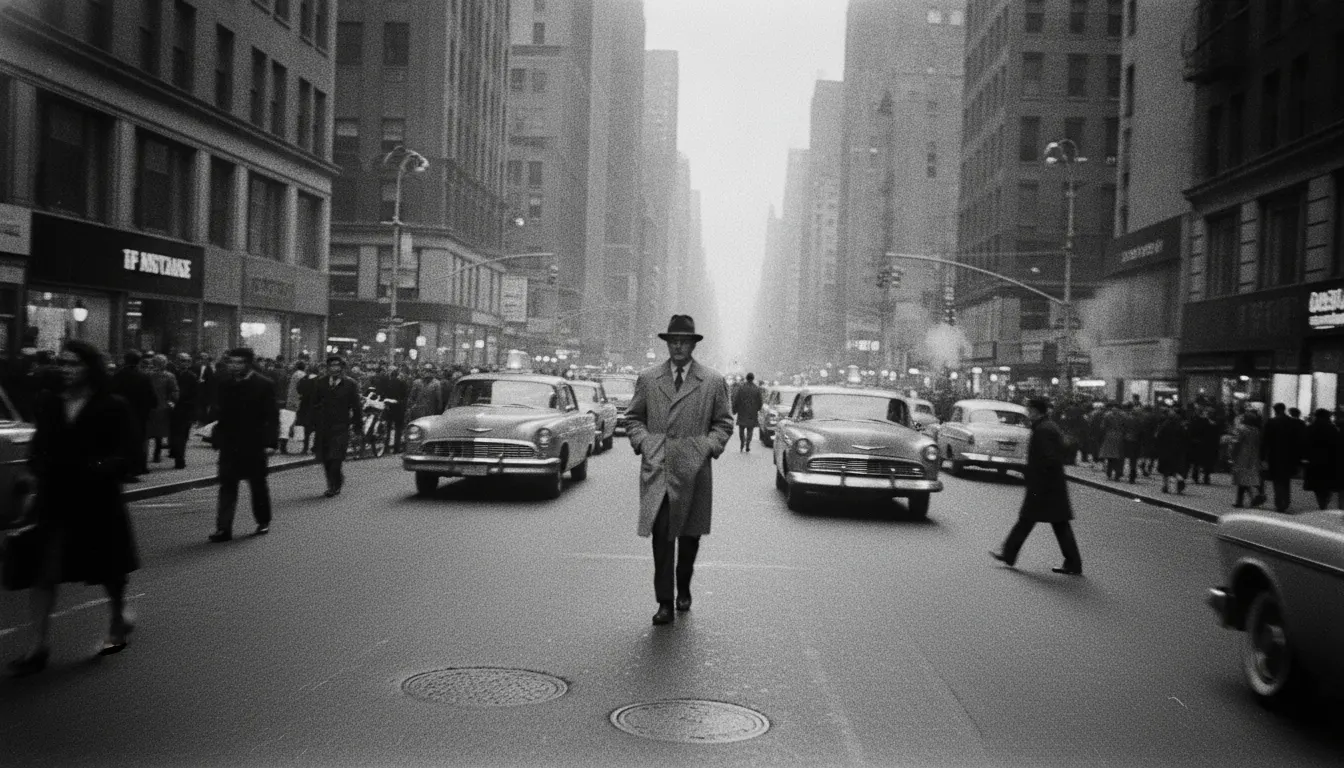
Garry Winogrand 1960s New York. Tilted-horizon kinetic street, women are beautiful era, Fifth Avenue chaos, wide-angle 28mm.
The moves a human crew would use to get here. Cue applies them for you, and knowing their names is how you ask for a change.
angle lens at close physical proximity to subjects for immersive, exaggerated perspective
8 degrees) as a compositional energy signal and personal signature
Winogrand resisted single-subject isolation
Kodak Tri-X at ASA 400, often push-processed for contrast and grain
high-volume working method shooting freely and editing long after
preset focus for the typical shooting distance rather than continuous autofocus
Garry Winogrand (1928-1984) is among the most influential American street photographers of the 20th century and arguably the figure who most expanded the visual vocabulary of the form beyond what Henri Cartier-Bresson's European model allowed. Where Cartier-Bresson's 'decisive moment' philosophy sought a single geometrically perfect and emotionally complete instant, Winogrand's street photography embraced complexity, ambiguity, and the simultaneous energy of multiple events in the frame.
Winogrand was born in the Bronx and was inseparable from New York City. The city was his primary subject throughout the 1960s - the crowded sidewalks of Fifth Avenue, the social theater of Central Park Zoo (The Animals, 1969), the advertising-saturated Times Square, the women of New York (Women Are Beautiful, 1975). His photographs of the 1964 World's Fair in New York, and his ongoing documentation of American prosperity and anxiety during the postwar boom, constitute a sustained social portrait of an era.
Winogrand shot almost exclusively with a Leica fitted with a 28mm wide-angle lens, working at close range to his subjects. The wide angle exaggerated perspective and allowed Winogrand to include a great deal of visual information in a single frame - often too much information, deliberately so. He was famous for a slight diagonal tilt to his horizon, which has come to be seen as his signature: a compositional choice that implied instability, energy, or the subject's world slightly off-kilter.
Winogrand's working method was extraordinary in its volume: at his death in 1984, he left approximately 300,000 unedited frames - rolls of film that had never been developed or printed. The project of editing and printing this archive, undertaken by curator Thomas Szabo and the Fraenkel Gallery, continued for decades after his death. The existence of this archive raised profound questions about the nature of photographic editing and meaning.
*The Animals* (1969, MOMA), New York City Zoo photographs
*Women Are Beautiful* (1975, Farrar Straus & Giroux)
*Public Relations* (1977, MOMA), American political and media event photography
1980
*Stock Photographs: The Fort Worth Fat Stock Show and Rodeo*
1964 World's Fair documentation, retrospectively published
2013
retrospective exhibition at SFMOMA , catalog ed. Leo Rubinfien
A Look is not a filter. It is a set of stored decisions the pipeline reads before it makes a single frame, so two videos in the same Look actually match.