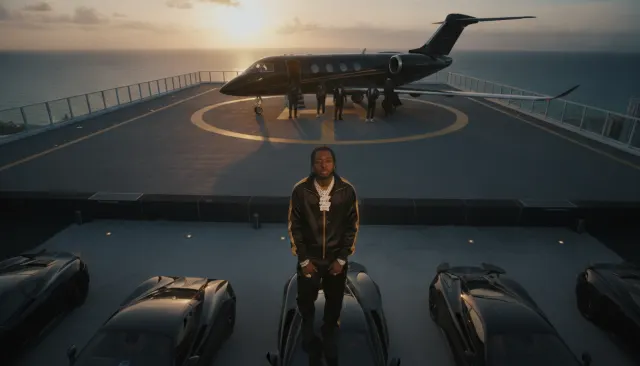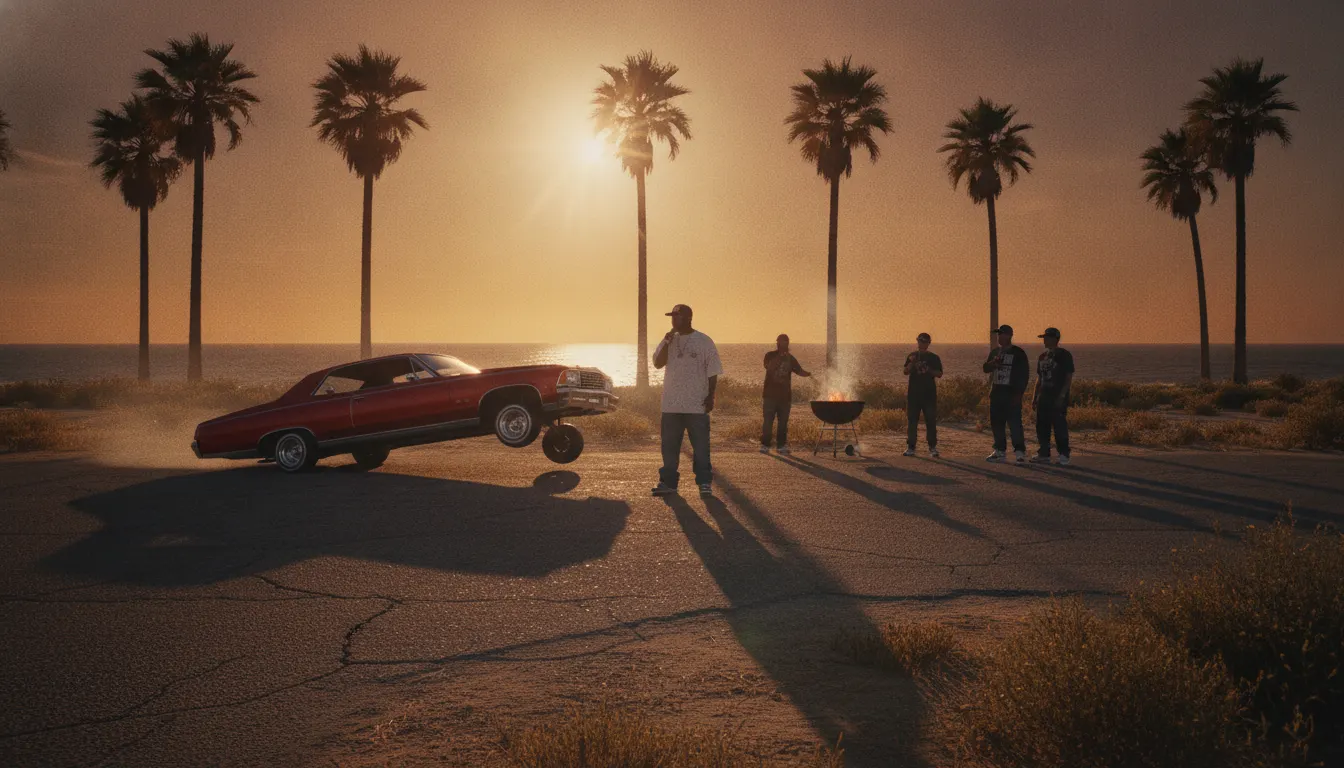
Dr. Dre ft. Snoop Dogg, 'Nuthin' But a G Thang'
1992
Long Beach location, hydraulics
West Coast gangsta rap MV. Dr Dre Chronic era, hydraulic lowrider hopping, palm-tree sunset, BBQ-and-40-oz, bandana posse cypher.
The moves a human crew would use to get here. Cue applies them for you, and knowing their names is how you ask for a change.
flat overcast or harsh midday sun on concrete and stucco
style patience with location - extended neighborhood observation shots
chrome detail on hydraulic switches, steering wheel, candy-paint surface in close-up
en-scene: folding tables, sound systems, community members as non-performers in frame
not crushed to black but rendered as deep brown
angle low-angle lowrider shots emphasizing the chassis height change
the crew or posse as visual subject alongside the lead artist
The West Coast gangsta rap music video aesthetic of 1991-1998 is one of the most precisely defined visual languages in popular music - an immediate, location-specific style built around Compton and Long Beach streets, hydraulic lowriders, sun-bleached summer days, and a tension between neighborhood documentary realism and aspirational display that runs through every frame.
Dr. Dre's The Chronic (1992) and Snoop Dogg's Doggystyle (1993) established the visual template. The promotional videos - "Nuthin' But a G Thang" (dir. Dre and Arnold, 1992) and "Gin and Juice" (dir. Dre, 1993) - were shot on location in Long Beach and Compton, featuring backyard parties, hydraulic-equipped lowrider Impalas and Monte Carlos, and a color palette of Southern California summer: bleached concrete, vivid blues and greens of swimming pools against the washed-out tan of asphalt and stucco.
F. Gary Gray directed some of the era's most significant work: Ice Cube's "Today Was a Good Day" (1993) used a long golden-hour rolling shot through South Central that functioned as a neighborhood portrait as much as a music video. The camera stayed patient, letting the landscape speak.
The defining light quality is California overcast or harsh midday sun - often flat, bleaching highlights and compressing shadow range. When shot on film (16mm or 35mm), the stocks pushed toward warm yellows and desaturated blues. The lowrider itself functions as a chromatic centerpiece: candy-paint finishes in deep burgundy, forest green, or cobalt blue, polished chrome, and white-wall tires against a muted street environment.
Interior lowrider shots with hydraulics springing became a signature insert cut - the chassis lifting and dropping, chrome switches in close-up, the driver's hand on a wheel. These cuts encode both wealth (the custom cost of the build) and neighborhood specificity (the lowrider culture as distinctly West Coast Chicano and Black LA).
Missy Elliott's "The Rain" (1997) and DMX's New York work moved the aesthetic east, while Warren G, Tha Dogg Pound, and Nate Dogg kept the West Coast template intact through the late 1990s. The aesthetic became codified and internationally recognized by 1995-1996, at which point it began to be referenced outside its origin culture - a process that continues in contemporary rap.
The most distinctive tension in the aesthetic is between documentary authenticity (real locations, real community members in the frame, real lowriders from actual car clubs) and the lavish display of Death Row's later videos (Versace wardrobe, multiple lowriders in convoy, choreographed hydraulic exhibitions). Both poles exist within the same visual family.
1992
Long Beach location, hydraulics
1993
backyard party, Compton
1993
golden-hour neighborhood portrait
1994
Long Beach night/day
1995
confrontational lowrider aesthetic
1996
dystopian Mad Max West Coast hybrid
1993
car club visual language
A Look is not a filter. It is a set of stored decisions the pipeline reads before it makes a single frame, so two videos in the same Look actually match.