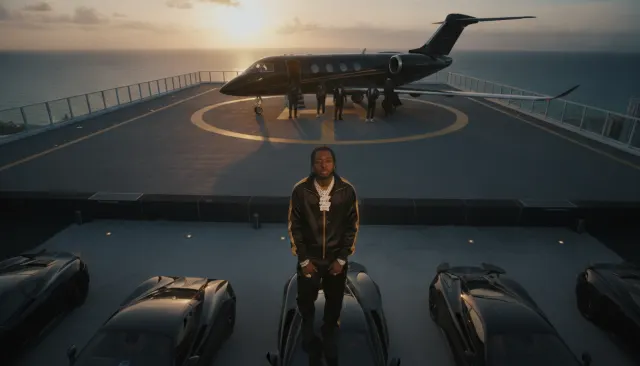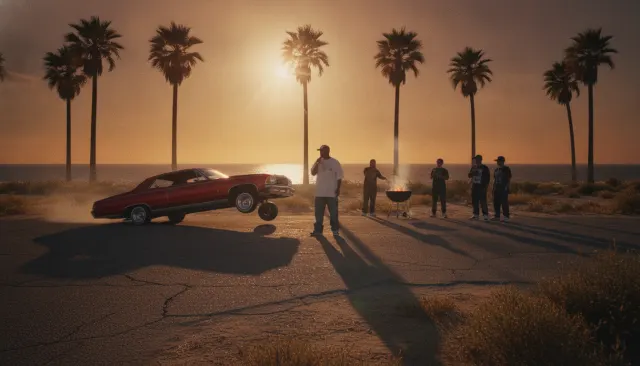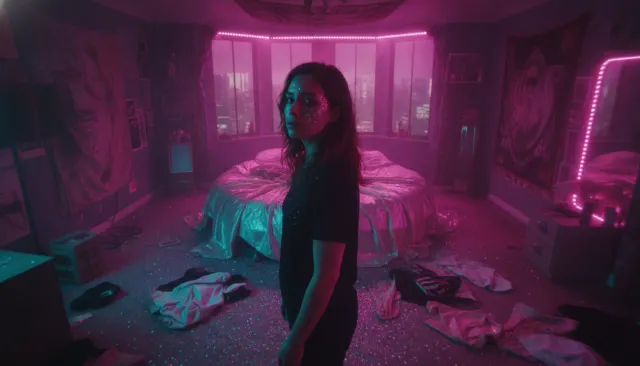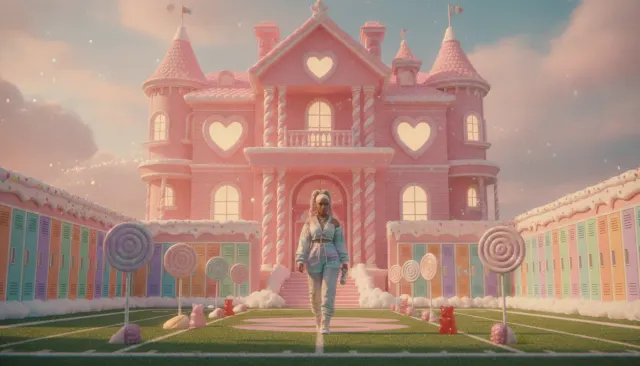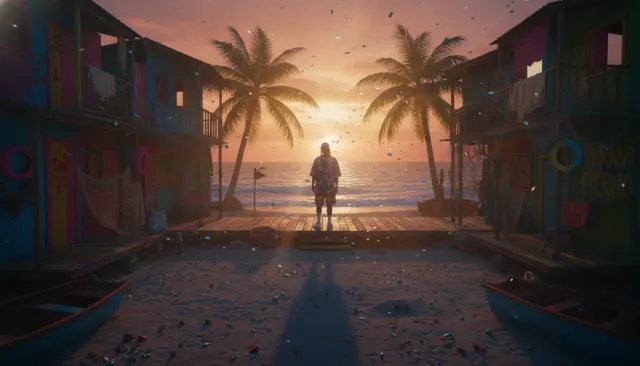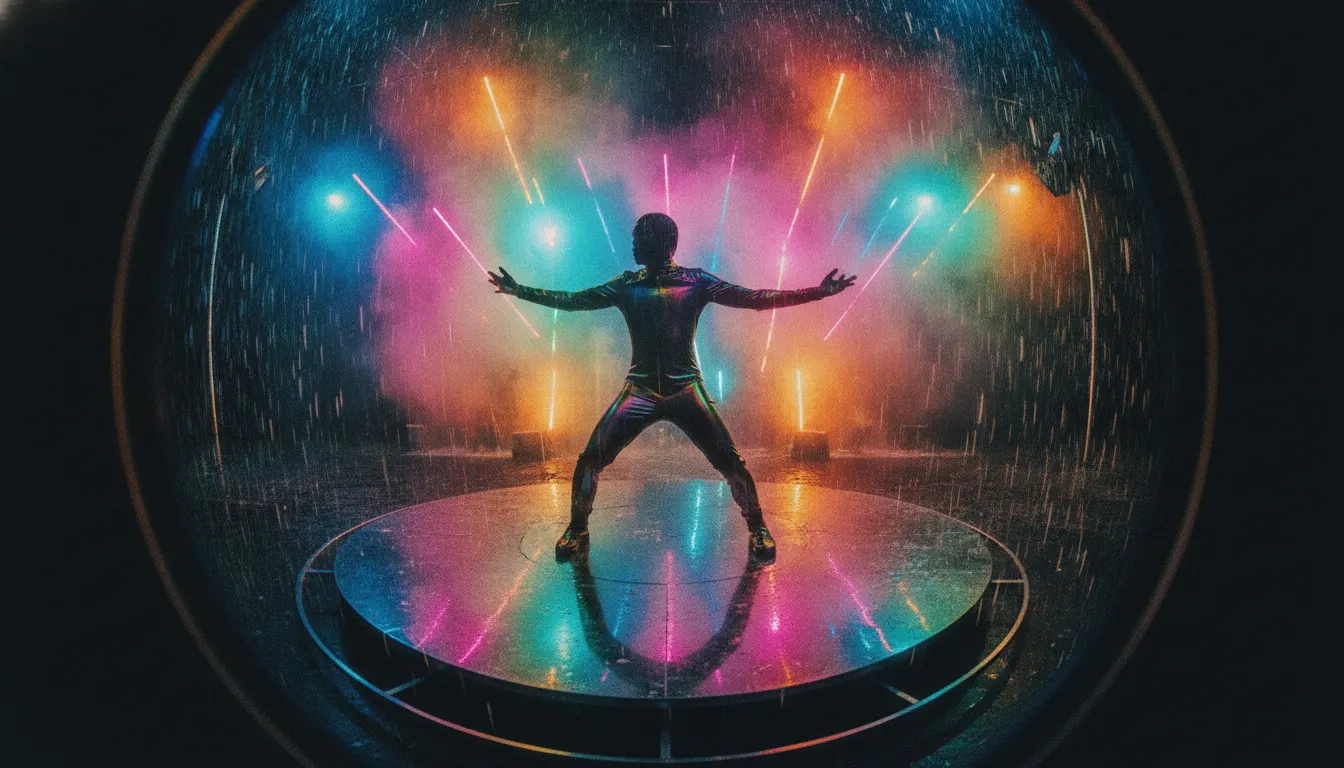
Busta Rhymes, 'Put Your Hands Where My Eyes Could See' dir. Hype Williams
1997
the fisheye apex
Hype Williams late-90s aesthetic. Wide fisheye lens, oil-slick rainbow gloss, latex shiny suits, Belly cinematography, color-blasted hero shots.
The moves a human crew would use to get here. Cue applies them for you, and knowing their names is how you ask for a change.
distortion with subjects bulging from center frame
production saturation - textured grain plus jewel-tone color depth
wet pavement, mylar, chrome, latex, polished floors
tone color palette: deep blue, magenta, emerald, orange-gold skin enhancement
angle low-angle car shots with fisheye compressing the vehicle against a curved sky
Hype Williams is the most influential music video director in the history of hip-hop - and arguably in the medium's entire history. Between 1994 and 2003, Williams directed more than 200 videos that collectively defined the visual language of mainstream hip-hop and R&B. His signature - an extreme fisheye lens distorting architecture and bodies into convex globes, combined with hyper-saturated color, slow motion overflow, and gleaming surfaces - was as distinct as a painter's style.
Williams used the 8mm or 10mm fisheye lens not merely as a stylistic choice but as a world-building device. The distortion - curves bending inward at the periphery, objects in the center bulging forward - created a visual environment that felt simultaneously larger than reality and more concentrated. Busta Rhymes' face looming from center frame in "Put Your Hands Where My Eyes Could See" (1997) was not just a close-up; it was a portrait that distorted the rapper into something elemental, larger than human scale.
Busta Rhymes became Williams' most frequent collaborator and his most committed visual co-author. "Put Your Hands Where My Eyes Could See" (1997), "Dangerous" (1997), and "Turn It Up (Fire It Up)" (1998) built an entire visual mythology around the fisheye: African-wax print costuming against extreme fisheye architecture, bodies moving through spaces that curved at their edges.
Missy Elliott's early visual work with Williams produced some of his most celebrated images. "The Rain (Supa Dupa Fly)" (1997) placed Elliott in an inflatable suit - a visual joke and a political statement about Black female body image simultaneously - inside a fisheye world of neon and wet pavement. "Get Ur Freak On" (2001) used a more restrained but still distortion-heavy visual language, with South Asian-influenced costuming and a dark environment split by vivid colored light.
The other axis of Williams' aesthetic was surface quality: everything gleamed. Chrome, latex, mylar, wet pavement reflecting neon - the world of a Hype Williams video was perpetually damp, reflective, and saturated. The color palette ran to jewel tones: deep blue, magenta, emerald, with orange and gold used for warm skin-tone enhancement. Nothing was flat. The look influenced every subsequent luxury hip-hop video director including Director X and the visual team around Drake.
Williams shot predominantly on 16mm film in his peak period, then pushed the footage through color grading and optical printing processes that enhanced the saturation and contrast beyond what the stock alone would produce. The grain of 16mm combined with post-processed saturation created his characteristic textured-but-vivid quality.
1997
the fisheye apex
1997
inflatable suit, fisheye rain
2001
South Asian-influenced dark palette
1996
Mad Max dystopia, fisheye desert
1997
gloss and wealth
1997
costuming and distortion
2000
yacht luxury fisheye
1999
gladiatorial spectacle
A Look is not a filter. It is a set of stored decisions the pipeline reads before it makes a single frame, so two videos in the same Look actually match.