Chơi Ô Ăn Quan (Playing a Board Game)
Nguyễn Phan Chánh · 1931
The defining work of Vietnamese silk painting; exhibited in Paris; three women and children around a traditional board game
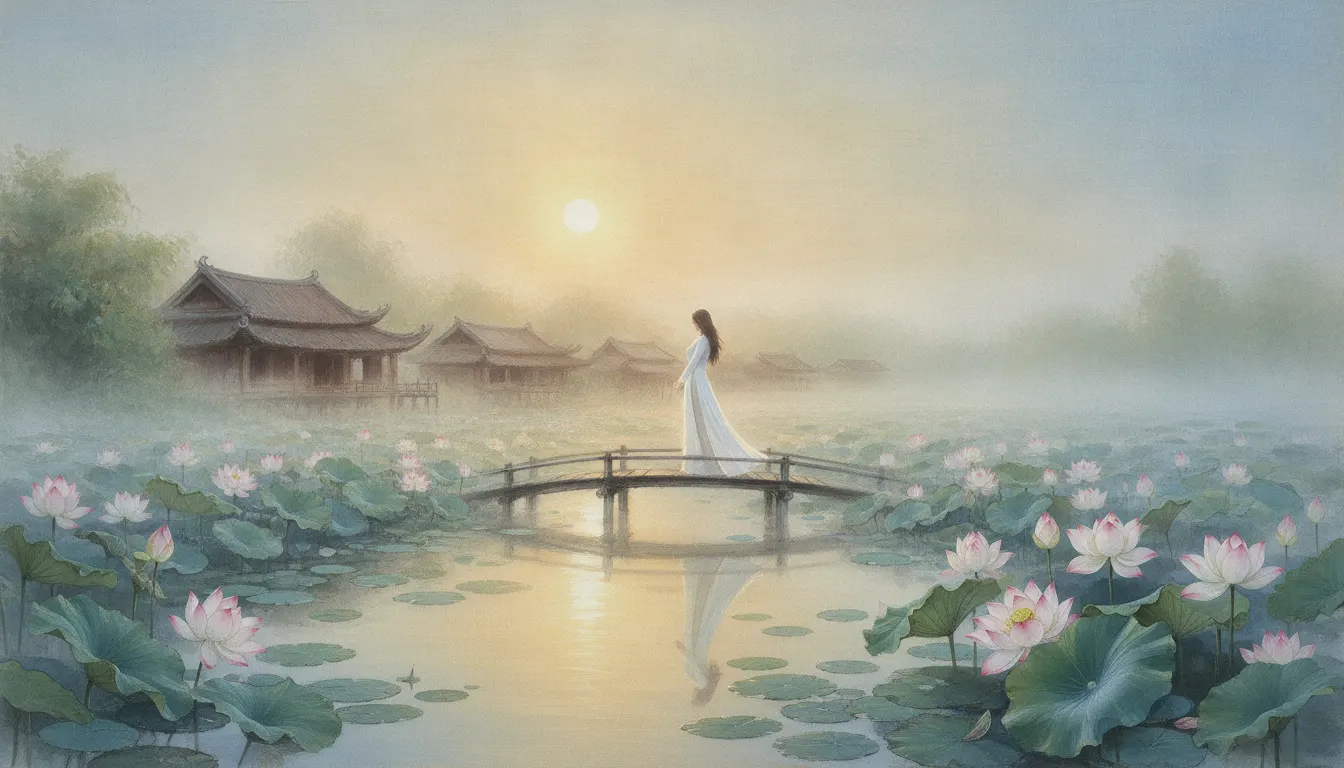
In the tradition of Vietnamese tranh lua silk painting. Translucent water-based pigment soaked into raw silk, soft contour figures of village life, lotus pond, and ao dai elegance.
The moves a human crew would use to get here. Cue applies them for you, and knowing their names is how you ask for a change.
Fine-weave silk stretched and treated with rice-starch water sizing; the sizing controls dye absorption and creates soft edge diffusion.
Multiple thin watercolour or diluted ink washes build tone and colour through transparency; dark areas require many successive layers.
Between dye applications, a brush of clean water softens edges, creating the characteristic blurred-edge quality that defines the medium.
Primary form contours are drawn with ink brush in a soft (not sharp) line; the sized silk absorbs the line slightly, preventing hard edges.
Nguyễn Phan Chánh school uses warm ochres, soft olive greens, and muted browns; colour saturation is always lower than the pigment's natural maximum.
Vietnamese village life, women in áo dài, children at play, and domestic scenes framed with a restraint and warmth derived from Vietnamese folk painting tradition.
Vietnamese silk painting (tranh lụa) is a distinctive fine-art tradition that emerged as a formally recognised genre in the 1930s through the Indochina Fine Arts College (École des Beaux-Arts de l'Indochine, founded 1925 in Hanoi) and the Vietnamese artists trained there. While painting on silk is ancient across East and Southeast Asia, the Vietnamese tradition that developed in this period synthesises French academic training, Chinese ink-wash influence, and indigenous Vietnamese sensibility into a recognisable national style.
The college was established by French colonial authorities partly to document and elevate Vietnamese traditional arts under the direction of Victor Tardieu. Vietnamese faculty members Nam Son and later Tô Ngọc Vân began developing a distinctly Vietnamese approach to silk as a fine-art medium that went beyond Chinese convention.
The defining figures of tranh lụa are Nguyễn Phan Chánh (1892-1984) and Lê Phổ (1907-2001). Nguyễn Phan Chánh's silk paintings of Vietnamese village life - women working, children playing, figures in áo dài by lamplight - use a subtly muted palette of ochres, soft greens, and warm browns with an economy of ink wash line that creates both intimacy and formal restraint. His masterwork Chơi Ô Ăn Quan (Playing a Board Game, 1931) was exhibited in Paris and established Vietnamese silk painting as internationally visible.
Lê Phổ worked in a more richly chromatic vein, influenced by Symbolist and Post-Impressionist colour handling, and later emigrated to Paris (1937) where he worked for the Wildenstein Gallery and developed a hybrid French-Vietnamese aesthetic with prominent floral and female figure subjects.
Silk painting uses a fine-weave silk stretched on a frame, sized with rice starch water, and painted with translucent watercolour or diluted ink washes. Multiple thin layers are applied, with water washing between layers to diffuse edges. The silk's texture creates a characteristic soft blurring at edges that cannot be replicated on paper or canvas. Dark areas are built up through repeated thin washes rather than direct application. Ink-line drawing defines primary forms with a brush that leaves soft rather than hard edges on the sized silk surface.
Nguyễn Phan Chánh · 1931
The defining work of Vietnamese silk painting; exhibited in Paris; three women and children around a traditional board game
Nguyễn Phan Chánh · 1931
Classic Nguyễn Phan Chánh domestic intimacy; soft muted palette
Lê Phổ · 1930s
Richly chromatic floral and figure painting; French-Vietnamese synthesis characteristic of Lê Phổ's mature style
Various · Ongoing
Primary institutional collection of tranh lụa; holds major works by both founding masters
Tô Ngọc Vân · 1939
Major figure in Hanoi school silk painting; bridges silk technique with broader Vietnamese modernist painting
Mai Thu (Vũ Cao Đàm) · 1940s-1970s
Paris-based Vietnamese painter who continued silk tradition in French context; mother-and-child subjects
A Look is not a filter. It is a set of stored decisions the pipeline reads before it makes a single frame, so two videos in the same Look actually match.