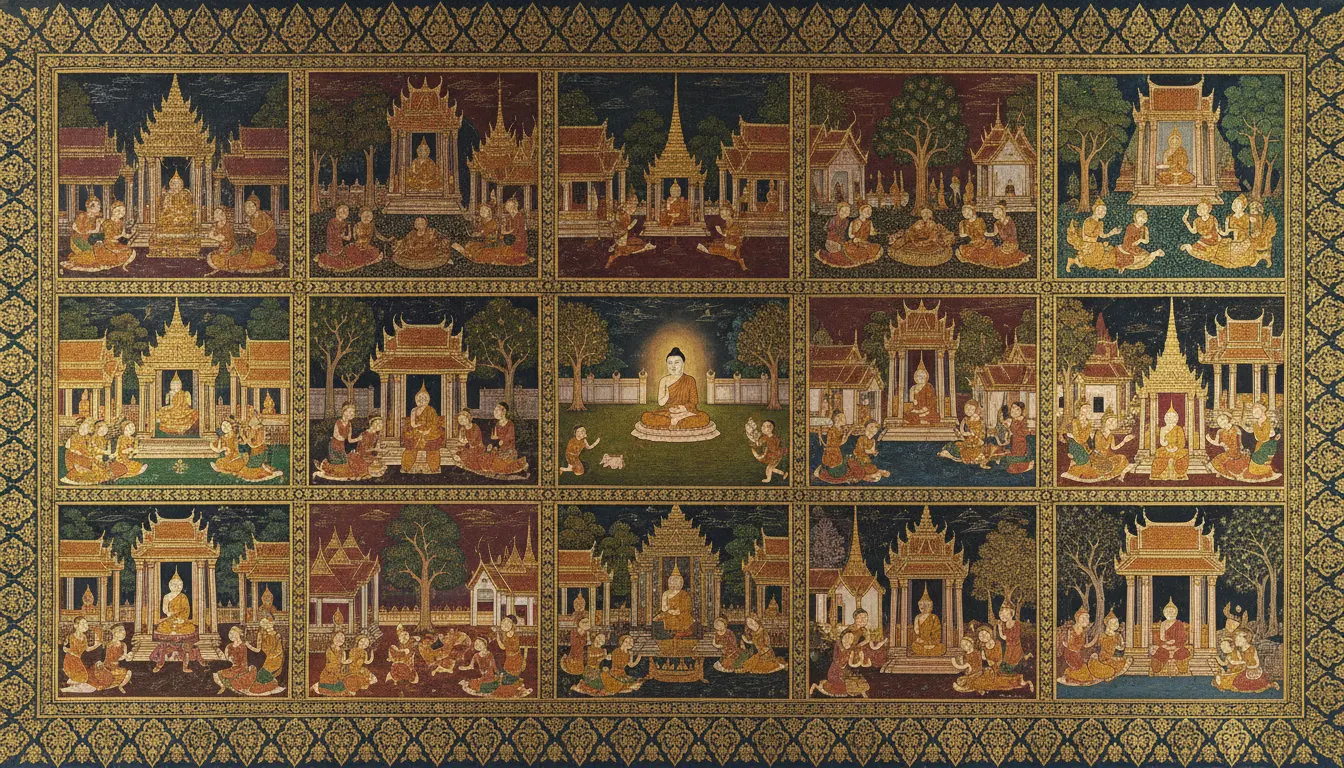
Ramakien mural gallery, Wat Phra Kaew
Royal commissioned painters, Bangkok school · 1782, repeatedly restored to present
178 panels around the outer gallery; the canonical reference for the Rattanakosin mural style
Inspired by Thai Buddhist temple mural tradition (jitrakam fa phanang). Multi-tiered narrative scenes of the Jataka tales in flat jewel color with gold leaf.
The moves a human crew would use to get here. Cue applies them for you, and knowing their names is how you ask for a change.
Celestial and royal figures are rendered in flat golden-yellow with fine black contour; scale hierarchy positions divine beings larger than mortals.
Episodes are arranged in horizontal bands read from bottom to top or around the wall perimeter; no Western linear perspective.
Trees are represented as repeating flame-shaped leaf clusters; water is shown as stylised lotus and wave patterns.
Palace and temple backgrounds use schematic Thai traditional architecture with layered pointed roofs and gilded spires.
Demon figures are coded by colour - green for forest demons, red for war demons, purple or blue for royalty-class demons.
Traditional pigments including cinnabar (red), azurite (blue), orpiment (yellow), and lamp black on a whitewashed lime ground.
Thai Buddhist temple murals (jittrakam faphanang) are large-scale painted narrative programmes that decorate the interior walls, ceilings, and wooden panels of ordination halls (ubosot) and sermon halls (wihan) throughout Thailand. The tradition synthesises Theravada Buddhist cosmology, indigenous Thai visual conventions, and, in later periods, significant Chinese and Western influence, producing some of the most complex and visually dense narrative painting in Southeast Asian art.
The standard mural programme of a Rattanakosin-period (Bangkok, 1782-present) temple depicts the life of the Buddha (especially the Jataka tales of his previous lives), the Traiphum cosmology (three worlds: heaven, earth, and hell), and in Thailand's case often the Ramakien - the Thai adaptation of the Hindu Ramayana epic featuring Rama, Sita, Hanuman, and the demon king Tosarot (Ravana).
Wat Phra Kaew (Temple of the Emerald Buddha, Bangkok, est. 1782) contains the most celebrated mural programme: an unbroken 178-panel Ramakien sequence running around the entire outer gallery wall, regularly restored and still considered the standard of the form. Wat Pho (Bangkok, 1788, major mural restoration 1832) contains extensive Jataka panels. Wat Suthat (Bangkok, early 19th century) has particularly fine ceiling cosmological paintings.
Outside Bangkok, Wat Yai Suwannaram (Phetchaburi, 17th century) preserves some of the oldest surviving murals in Thailand, predating the Bangkok school and showing more naïve, less formalised figure conventions.
Traditional Thai mural technique uses mineral and plant pigments mixed with animal-hide glue on a lime-plaster ground. Figures are drawn in a flat, linear style with fine black contour lines. Bodies of celestial figures (devas, Bodhisattvas) are golden-yellow; demons are green, red, or purple; humans are shown at smaller scale than divine beings. Background architecture - temples, palaces, pavilions - uses schematic Thai traditional forms with multi-tiered roofs and gilded finials. Foliage is represented through stylised flame-shaped tree forms and lotus-blossom patterns. The spatial conventions are non-Western: vertical register stacking, continuous narrative across multiple panels, and mixed scale-hierarchies replace European perspective.
Royal commissioned painters, Bangkok school · 1782, repeatedly restored to present
178 panels around the outer gallery; the canonical reference for the Rattanakosin mural style
Royal commissioned painters · 1788, major restoration 1832
Extensive Jataka life-of-Buddha panels; Bangkok's largest temple complex
Bangkok school painters · Early 19th century
Particularly fine Traiphum three-worlds cosmological programme on ceiling panels
Ayutthaya-period painters, Phetchaburi · 17th century
Among the oldest surviving Thai murals; pre-Bangkok style; more naïve figure conventions
Ayutthaya-period painters · c. 1734
Significant pre-Rattanakosin programme with documented date; regional school variant
Khrua In Khong (monk-painter) · Mid-19th century
Pioneering integration of Western perspective into Thai mural convention; historically pivotal transitional work
A Look is not a filter. It is a set of stored decisions the pipeline reads before it makes a single frame, so two videos in the same Look actually match.