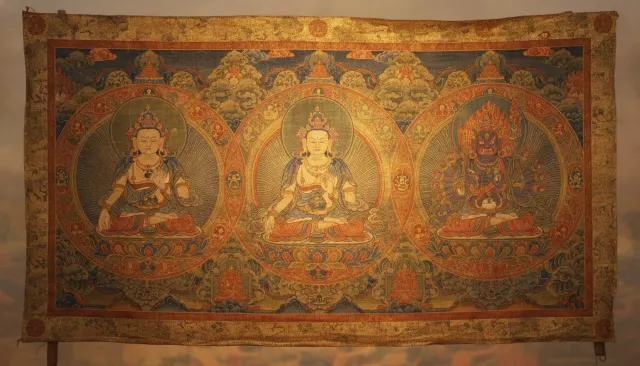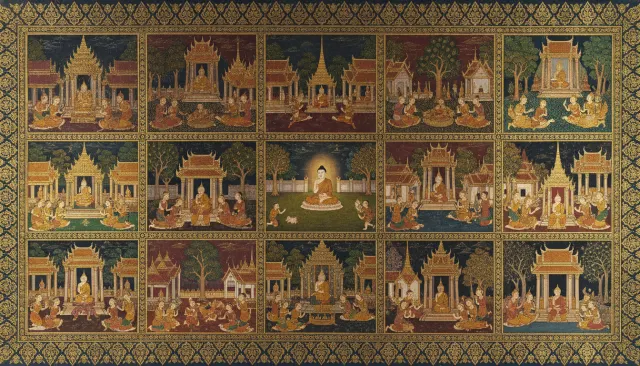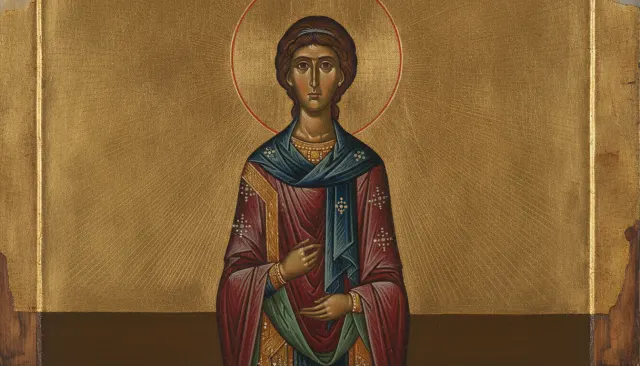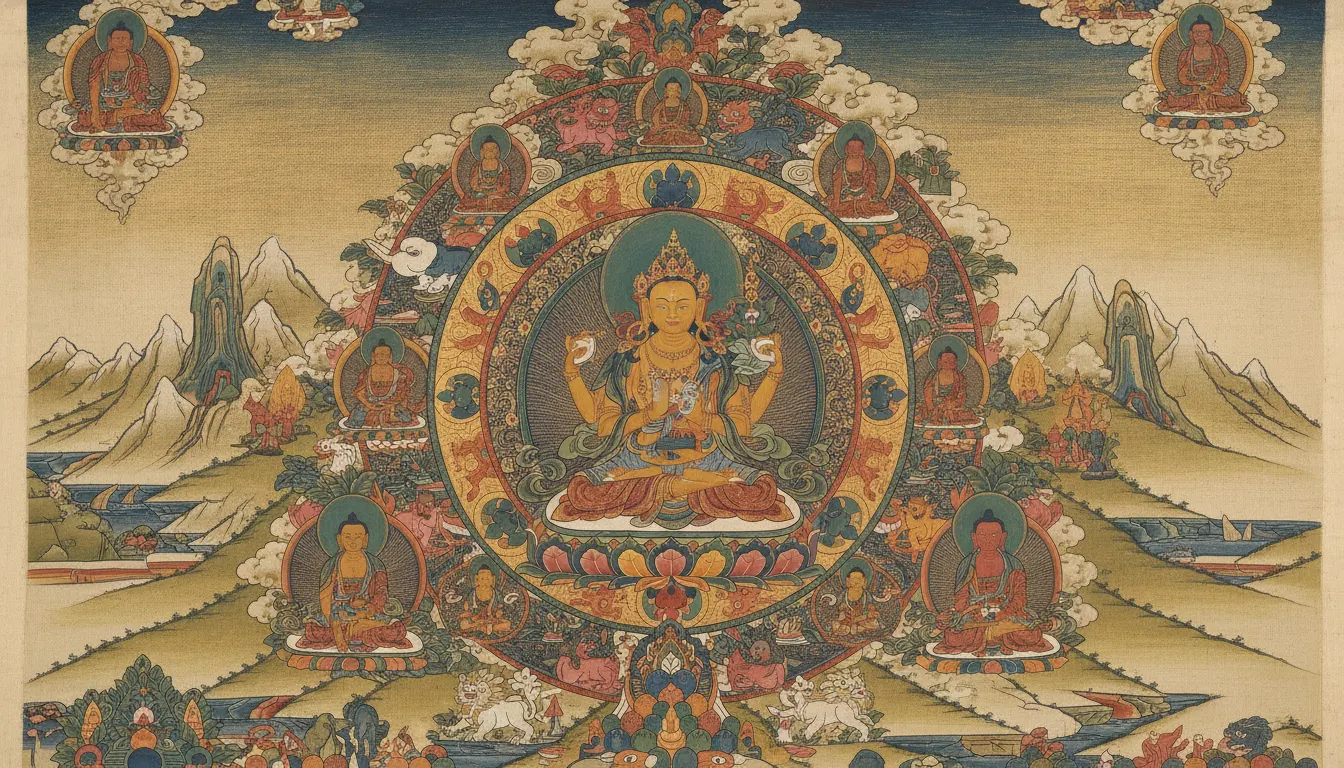
Situ Panchen Chokyi Jungne thangkas, Palpung Monastery collection
Situ Panchen and Palpung atelier · 18th century
Defining works of the mature Karma Gadri school; highest technical standard of the tradition
Inspired by Tibetan Buddhist thangka scroll-painting tradition. Densely composed central deity surrounded by mandala-precise symbolic figures, mineral pigment and gold leaf on cotton.
The moves a human crew would use to get here. Cue applies them for you, and knowing their names is how you ask for a change.
Unlike flat Menri passages, Karma Gadri uses multiple thin colour washes to build subtle tonal modelling in faces, flesh, and landscape elements.
Fine jewellery, ornament detail, and drapery highlights executed in powdered gold mixed with adhesive, then burnished stone-smooth.
Parallel fine brush lines denoting fabric folds, with gold-line highlights on raised fold edges - the signature drapery convention.
Protective deity flame backgrounds graduated from deep orange at the outer edge through yellow to near-white at the body, using multiple layered washes.
The sized cloth ground is burnished to a smooth semi-reflective surface before painting, allowing fine brushwork to sit cleanly.
Atmospheric misty mountains and gnarled pine trees rendered in modified ink-wash convention fill the pictorial space around central figures.
The detailed thangka represents the highest register of Tibetan Buddhist painting craft - works where every centimetre of painted surface carries iconographic, symbolic, and cosmological information executed in fine-brushwork mineral pigments by painters who undergo years of technical and spiritual training. This entry focuses specifically on the formal and technical depth of the most elaborately executed thangka tradition, complementing the broader scroll overview.
The Karma Gadri school (Tibetan: karma sgar bris) was founded in the 17th century under the patronage of the Karmapas (heads of the Kagyu lineage) and is distinguished by a more painterly, landscape-rich aesthetic than the tighter Menri canon. Karma Gadri thangkas use extensive Chinese landscape vocabulary - misty mountains, gnarled pine trees, atmospheric ink-wash effects within the mineral pigment system - to create spatial environments of considerable depth behind the central deity. The school's most celebrated practitioner was Situ Panchen Chokyi Jungne (1700-1774), whose own thangkas and whose patronage of ateliers at Palpung Monastery, Kham, set the standard.
Detailed thangka production follows a codified workflow. The cotton or linen ground is stretched on a frame, sized with hide glue, and polished smooth with a shell or stone. Compositional lines are drawn in charcoal then fixed in ink using the lde'u thig grid as a guide. Colour is built in layered washes from light to dark for shadow modelling (more developed in Karma Gadri than in Menri flat work). Gold is applied last in multiple passages: background areas, halos, and decorative flourishes use leaf gold; detailed ornaments use a finer powdered gold (tso-gur) mixed with adhesive and applied with a pointed brush, then burnished with a hard stone.
Drapery is rendered through a system of fine parallel brush lines (tsib-ma) indicating folds, with gold line highlights on raised edges. Face and hand flesh areas are built up in multiple thin washes of ochre and white, then detailed with fine red-brown contour lines and shaded wet-on-wet.
Detailed thangkas depicting wrathful protective deities (Mahakala, Yamantaka, Palden Lhamo, Chakrasamvara) require specific additional conventions: flame aureoles (prabhamandala) rendered in graduated orange-to-yellow-to-white passages; multi-armed figures with each hand holding a precisely rendered attribute; and elaborate jewellery, bone ornaments, and skull crowns rendered in fine metalwork-style detail.
Situ Panchen and Palpung atelier · 18th century
Defining works of the mature Karma Gadri school; highest technical standard of the tradition
Karma Gadri school painters · 17th-19th century
Wrathful protective deity thangkas exemplifying flame aureole and bone-ornament detail conventions
Central Tibetan workshop · 18th century
Technical tour de force requiring each of 1,000 arms to be individually rendered with precise attributes
Various schools · ongoing
Multiple high-quality detailed thangkas with scholarly documentation; accessible reference collection
Various Tibetan monastic ateliers · 18th-19th century examples
Most geometrically complex mandala type; required proportional precision to the sub-millimetre level
Various · Acquired 19th century onward
Includes several important detailed thangkas with conservation documentation of pigment analysis
A Look is not a filter. It is a set of stored decisions the pipeline reads before it makes a single frame, so two videos in the same Look actually match.