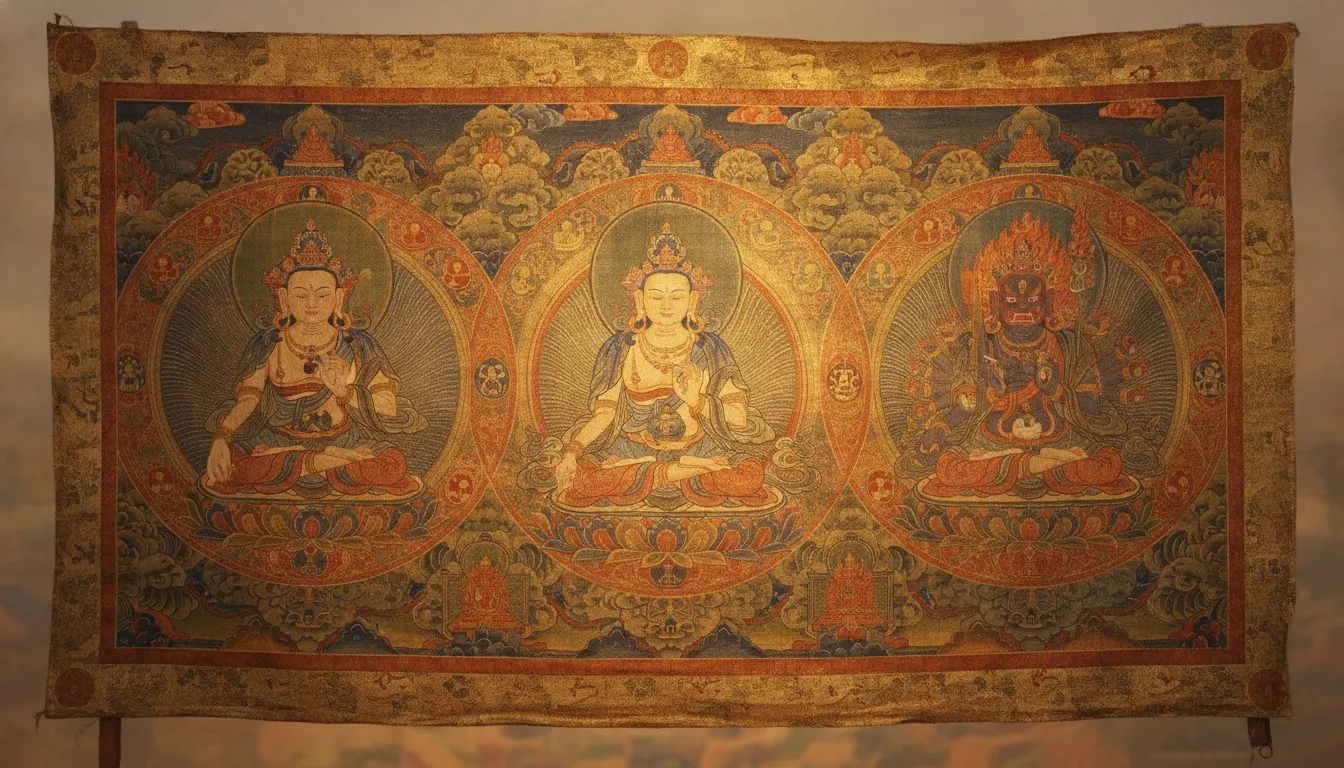
Srongtsen Gampo and Queens thangka
Central Tibetan workshop, Menri school precursor · 13th-14th century
Historical figure thangka; early example of biographical narrative format
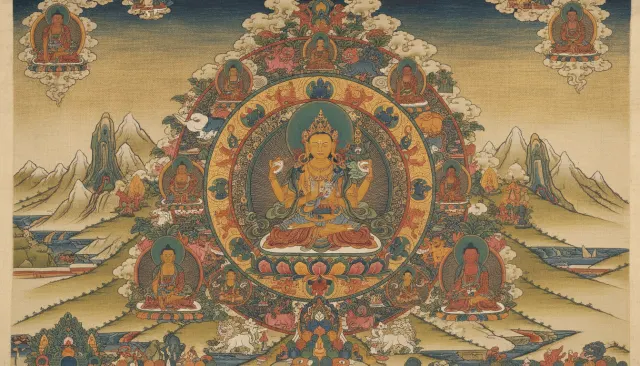
In the tradition of Tibetan thangka Buddhist scroll painting. Symmetrical mandala compositions of bodhisattvas and wrathful deities in mineral pigment and gold.
The moves a human crew would use to get here. Cue applies them for you, and knowing their names is how you ask for a change.
Deity bodies drawn to codified proportional systems specified in Tibetan treatises; every figure measurement is prescribed.
Malachite (green), cinnabar (red), lapis lazuli (blue), orpiment (yellow), and lamp black applied in flat unmodulated colour fields.
Powdered or leaf gold is applied and burnished to high reflectivity for deity halos, thrones, and background celestial zones.
Contour lines defining figure edges and drapery folds are drawn with extremely fine brushes in dark ink or pigment after colour fill.
Central deity is largest; attendants, offering figures, and landscape elements are progressively smaller according to spiritual rank.
Rock formations, clouds, and lotus ponds in the remaining pictorial space use stylised Chinese landscape vocabulary absorbed from the 14th century onward.
A thangka (Tibetan: ཐང་ཀ་, also transliterated as thanka or tanka) is a Tibetan Buddhist painting on cotton, silk, or linen fabric mounted as a scroll for use in religious practice, temple display, and monastic instruction. The tradition spans more than a millennium; the earliest surviving examples date from the 10th-11th centuries CE, though textual references to painted images used in Tantric ritual predate these.
Thangkas serve as objects of meditation (visualisation supports), didactic tools displaying iconographic programmes, and ritual items carried in procession or displayed at festivals. The largest format - the chenthang or giant festival thangka - can span dozens of metres and is unfurled on hillsides at major Tibetan festivals such as Tashilhunpo Monastery's annual thangka display.
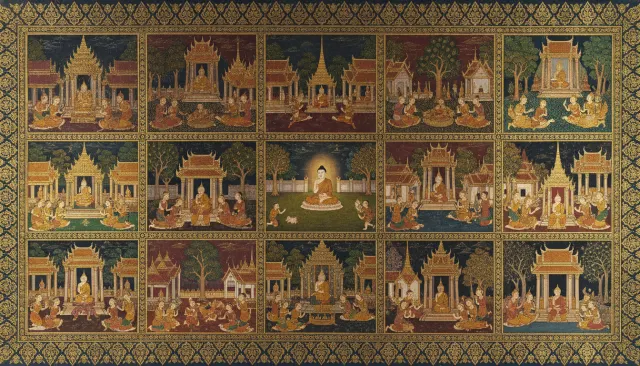
Subjects include: single deity images (Shakyamuni Buddha, Green Tara, Chenrezig/Avalokiteshvara); wrathful protective deities (Mahakala, Palden Lhamo); mandala diagrams (geometric cosmograms used for initiation and meditation); biographical narrative sequences (jataka tales, lives of lineage masters); and cosmological maps (sipa khorlo, Wheel of Life).
The canonical thangka visual system is rigorously codified in lde'u thig (proportional grids) that specify exact measurements for each deity's body proportions, hand gestures (mudra), and attribute positioning. Mineral pigments - cinnabar, malachite, lapis lazuli, gold (both leaf and powdered), and lamp black - are bound in animal-hide glue and applied in flat, unmodulated passages with fine outlining brushwork. Background gold is frequently burnished to a high reflective finish.
The central deity is surrounded by hierarchical attendant figures, each identifiable by attribute, colour coding, and mudra. Landscape elements (rocks, clouds, lotus ponds) fill remaining space in a stylised vocabulary derived from Chinese painting conventions that entered Tibetan art through the 14th-15th centuries. The result is a dense, hierarchically organised field in which every element carries iconographic meaning.
The Menri school (founded by Menthangpa Menla Dhondup, 15th century) established the standard proportional system. The Karma Gadri school (17th century) incorporated more extensive Chinese landscape conventions. The New Menri or Khyenri school emphasised Indian Pala-dynasty influence. Contemporary thangka production continues at Dharamsala, Kathmandu, and several monasteries in Tibet.
Central Tibetan workshop, Menri school precursor · 13th-14th century
Historical figure thangka; early example of biographical narrative format
Various Tibetan monastic workshops · 16th-19th century, multiple examples
Didactic cosmological diagram depicting six realms of existence; most widely reproduced thangka type
Various Tibetan, Nepali, and Bhutanese workshops · ongoing
Most significant Western collection of Himalayan art; reference collection for all major schools
Tashilhunpo monastic ateliers · 19th-20th century
One of the largest thangkas in existence; displayed annually at the Shigatse festival
Central Tibetan royal and monastic commissions · Various centuries
The holiest site in Tibet; houses thangkas of exceptional age and iconographic importance
Various · Acquired 1911-present
One of the first major Western museum Tibetan collections; includes 18th and 19th century Karma Gadri and Menri examples
A Look is not a filter. It is a set of stored decisions the pipeline reads before it makes a single frame, so two videos in the same Look actually match.