Thăng Long Water Puppet Theatre, Hanoi
Vietnamese Ministry of Culture commission · Founded 1969
Premier contemporary venue; daily performances; draws on all major northern Vietnamese village traditions
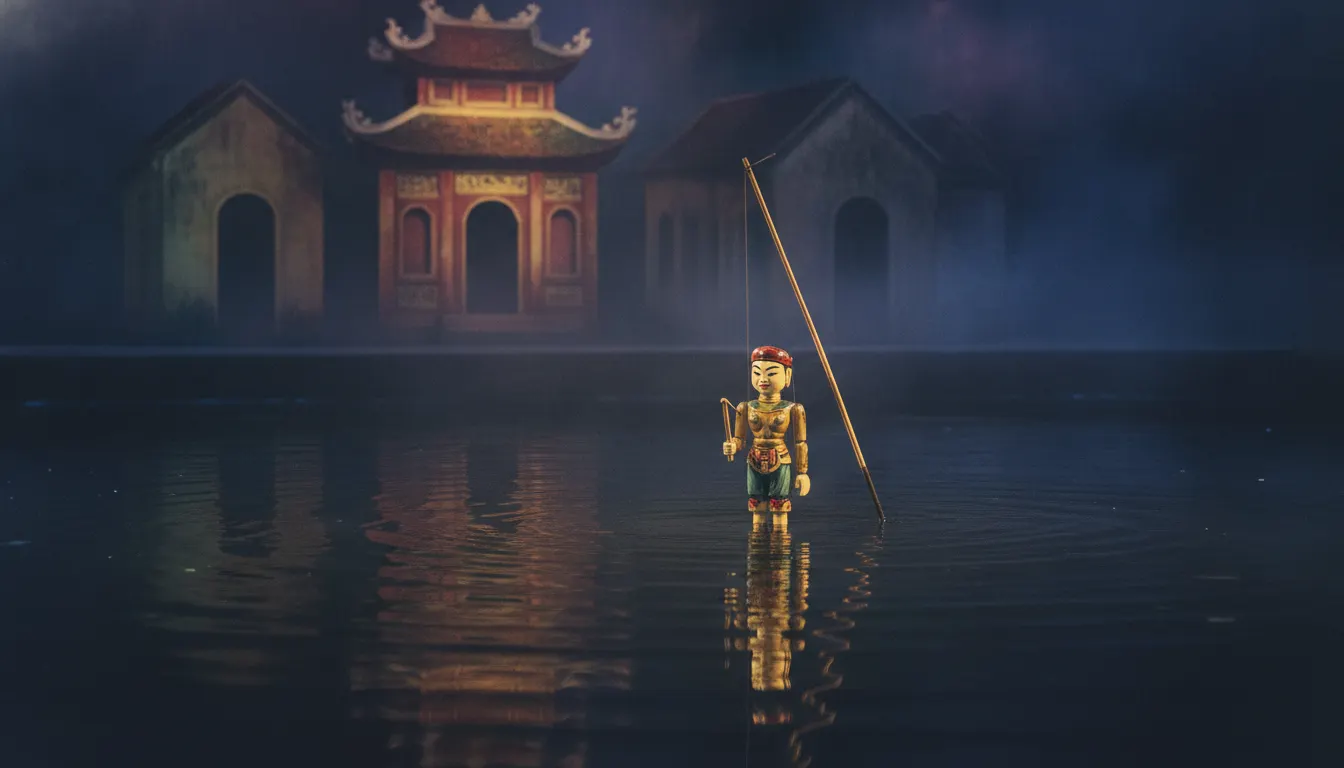
In the tradition of Vietnamese mua roi nuoc water-puppet theater. Lacquered wooden puppets on bamboo rods performing on a waist-deep water stage, painted village pagoda backdrop.
The moves a human crew would use to get here. Cue applies them for you, and knowing their names is how you ask for a change.
Puppets are controlled through bamboo rods and wire mechanisms hidden under the water surface, allowing complex movement while the operator remains concealed.
Sung (fig) wood carved puppets 40-60 cm tall, sealed in multiple lacquer coats for waterproofing and painted in red, gold, green, and black.
Dragon puppets contain embedded mechanisms enabling them to spit fire and spray water as performance effects.
The performance pool (typically a temple pond or purpose-built pool) with a curtained pavilion behind which operators stand waist-deep.
Live eight-piece ensemble with đàn bầu (monochord), đàn tranh (zither), trống (drums), and gongs provides the sonic narrative that cues puppet action.
Red, gold, black, and green derived from Vietnamese lacquerware conventions; colours are symbolic (gold for royalty, green for nature).
Múa rối nước (literally: dancing puppets on water) is a performance art unique to the Red River Delta of northern Vietnam, where puppets carved from fig wood are manipulated by puppeteers standing waist-deep behind a bamboo curtain in a chest-deep pool, moving the figures across the water surface through submerged bamboo rods and wire mechanisms. The tradition dates to at least the 11th century CE: a stone stele at the Đọi Sơn Pagoda (Hà Nam province) records a royal water puppet performance in 1121, during the reign of Emperor Lý Nhân Tông.
Water puppet theatre originated in the flooded rice paddy landscape of the Red River Delta, where communities in Hà Tây, Nam Định, Thái Bình, Ninh Bình, and Hải Dương provinces developed their own distinct puppet traditions. The art was originally performed in village ponds at spring festivals and communal ceremonies honouring the rice harvest, the Dragon King, and protective spirits.
Royal patronage during the Lý dynasty (1009-1225) elevated water puppetry to a court art. The Thăng Long Water Puppet Theatre (Nhà hát Múa rối Thăng Long), founded in Hanoi in 1969, is the premier contemporary venue and performs daily for tourists and locals; its productions draw on the Northern Vietnamese village traditions while adding theatrical staging and an eight-piece traditional music ensemble (with đàn bầu, trống, and mái chèo - traditional instruments).
Water puppets are carved from sung (fig/Ficus) wood, which is water-resistant and light. Each puppet is 40-60 cm tall, painted in bright lacquer - red and gold for imperial and dragon figures, green for frogs and animals, natural wood tones for peasant figures. Dragon puppets can spit fire and spray water using embedded pyrotechnic mechanisms. The lacquer surface is traditionally finished with red, gold, and black in a palette derived from Vietnamese lacquerware (sơn mài) conventions.
Performances enact scenes from Vietnamese rural life (rice farming, fishing), folk legends (the restored sword of King Lê Lợi, the phoenix legend), national history, and animal fables. The water surface itself becomes an active visual element - dragons emerge from and submerge into it; fish leap; fireworks reflect in the pool.
Vietnamese Ministry of Culture commission · Founded 1969
Premier contemporary venue; daily performances; draws on all major northern Vietnamese village traditions
Various village and professional troupes · Traditional narrative, various productions
Most performed narrative; Golden Turtle returns King Lê Lợi's sword to Hoàn Kiếm Lake; central national myth
Lý Nhân Tông reign court records · 1121
The earliest documentary evidence of water puppet performance in Vietnam
Vietnamese government cultural authorities · 2010
Formal international recognition of múa rối nước as intangible heritage; includes performance documentation
Affiliated village troupes from Hà Tây and Nam Định · Ongoing
Outdoor pool performances using village-tradition puppets distinct from the Thăng Long Theatre repertoire
Đào Đức Hiếu, Vietnamese Institute of Culture · 1996
Standard academic documentation of village-level traditions in Hà Tây province
A Look is not a filter. It is a set of stored decisions the pipeline reads before it makes a single frame, so two videos in the same Look actually match.