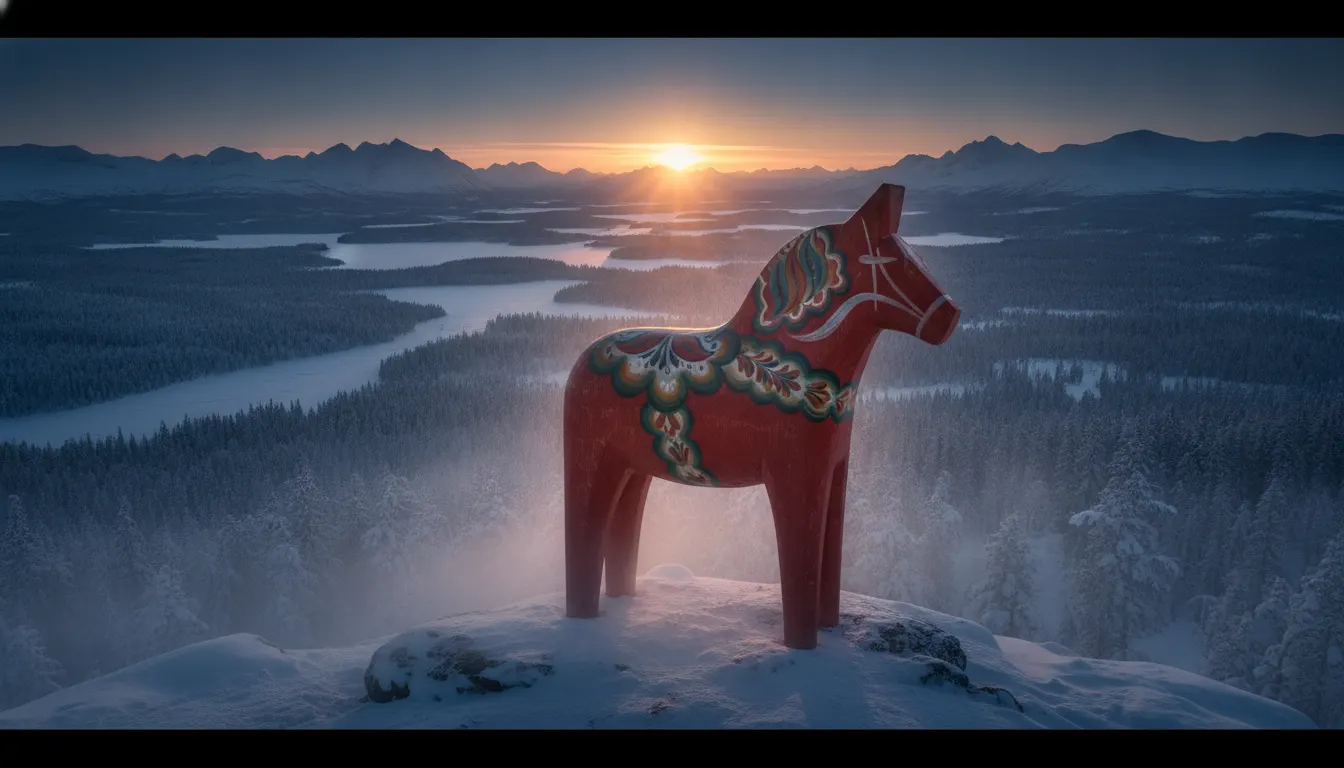
Grannas A. Olsson workshop Dala horses
Grannas A. Olsson Hemslöjd AB, Nusnäs · 1928-present
The most renowned and copied production workshop; standardised the canonical form and kurbits pattern
In the tradition of the Swedish Dalecarlian Dala horse (Dalahast). Carved wooden horse painted in red ochre with kurbits floral saddle pattern.
The moves a human crew would use to get here. Cue applies them for you, and knowing their names is how you ask for a change.
Deep ox-blood rust red derived from Falun copper mine pigment; the canonical ground colour for the standard Dala horse.
Stylised curved plant forms with simple flower heads, leaves, and tendrils in white, yellow, and blue painted over the base ground.
The horse's back and flanks carry a simplified geometric saddle pattern in contrasting colours demarcating the riding surface.
The horse body is carved to a standardised smooth toy-like profile; visual interest is entirely surface-paint driven.
Multiple varnish coats over the painted decoration give the finished horse a gloss depth that makes colours appear saturated.
Floral elements are outlined in a slightly darker or contrasting colour to define them clearly against the red ground.
The Dala horse (Dalahäst) is a carved and painted wooden horse figurine originating in the Dalarna region of central Sweden. Though horses have been whittled in Dalarna since at least the 17th century, the recognisable standardised form with its specific painted decoration was formalised in the early 20th century and the object became Sweden's most iconic folk export, selected as the country's national symbol at the 1939 New York World's Fair.
Wood carving of horses in Dalarna grew from the long winters that kept farmers and forestry workers indoors, with materials close at hand. Early horses were simpler, less standardised objects carved as children's toys. The Nusnäs village tradition - carried primarily by the Grannas A. Olsson workshop (founded 1928) - codified the form and its kurbits painted decoration into a reproducible craft product.
The classic Dala horse is carved from alder wood (earlier, pine) in a stylised horse profile: arched neck, compact body, short thick legs, and a rounded rump. The carving itself has a smooth, toy-like quality; visual interest comes entirely from the painted surface. The horse is primed in a bold base colour - the Mora red (a deep ox-blood rust derived from traditional Falun red mine pigment) is the archetype, though blue, green, and yellow variants exist. Over this ground, decorative painters (kurbitsmalare) apply the kurbits motif: stylised flowers, leaves, and curved plant forms in white, yellow, and blue over a varnished surface. A simplified geometric saddle pattern in contrasting colours marks the back.
Dalarna (Dalecarlia) has a distinct cultural identity within Sweden as the keeper of folk traditions. The kurbits decorative vocabulary was also applied to furniture, wall paintings, and household objects in the region, but the horse form made it portable and exportable. Contemporary versions range from the 8 cm tourist souvenir to the giant painted Dala horse sculptures installed in Avesta and other towns. The horse became embedded in Swedish national identity and is frequently used in Swedish brand and tourism contexts.
Grannas A. Olsson Hemslöjd AB, Nusnäs · 1928-present
The most renowned and copied production workshop; standardised the canonical form and kurbits pattern
Swedish government cultural display · 1939
The moment the Dala horse was officially designated Sweden's national symbol for international audiences
Commissioned by Avesta municipality · 2016 (latest incarnation)
13-metre outdoor sculpture; world's largest Dala horse; frequent tourism photograph
Swedish Olympic Committee · various
Recurring use of Dala horse in national sports and cultural promotion
IKEA design teams · various
Mass-market application of Dalarna folk visual vocabulary in global homeware retail
Various Dalarna craftspeople · ongoing
Comprehensive institutional collection documenting Dalarna painting and carving from 17th century
A Look is not a filter. It is a set of stored decisions the pipeline reads before it makes a single frame, so two videos in the same Look actually match.