Maliutin-Zvyozdochkin first matryoshka
Sergei Maliutin (design) / Vasily Zvyozdochkin (carving) · 1890
The original set; peasant girl with rooster; now in the Russian Toy Museum, Sergiev Posad
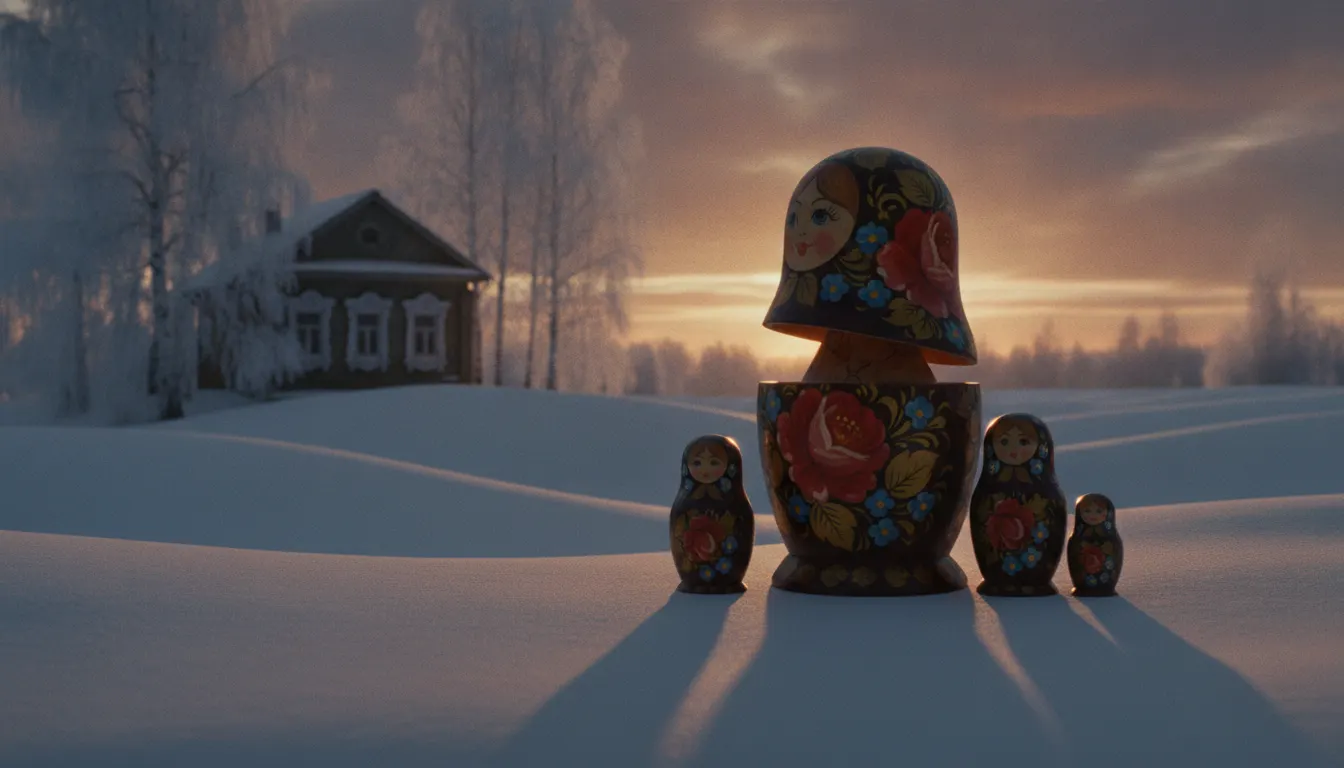
Inspired by the Russian matryoshka nesting doll tradition. Bright lacquered floral painting on rounded wooden form, headscarfed peasant figure repeated in scale.
The moves a human crew would use to get here. Cue applies them for you, and knowing their names is how you ask for a change.
Each doll blank is turned on a lathe from lipa (lime/linden) wood, then sanded smooth before painting.
Facial cheeks are painted as softly graduated circles of pink-to-white, the defining identity mark of the Sergiev Posad face style.
Loose, spontaneous rose and daisy motifs in gouache cover the body, with visible brushstroke energy rather than tight commercial precision.
Each floral element is outlined in thin black paint after colour fill, adding graphic definition characteristic of Russian folk-art line grammar.
Hem, headscarf edge, and border divisions are highlighted with metallic gold gouache or gilded lacquer.
Finished dolls receive multiple coats of clear nitro-lacquer, giving them the characteristic high-gloss depth.
The matryoshka (Russian: матрёшка) is a set of wooden dolls of decreasing size nested inside one another - and the painted surface of each doll is one of the most recognisable visual languages in Russian folk art. Despite its apparent antiquity, the matryoshka was invented in 1890 at the Abramtsevo artists' colony near Sergiev Posad, north of Moscow.
The design was conceived by artist Sergei Maliutin and carved by craftsman Vasily Zvyozdochkin, inspired by a Japanese kokeshi doll brought to the colony by patron Savva Mamontov's wife. The first set depicted a peasant girl (Matryona - hence the name) in a sarafan with a rooster, and was manufactured commercially by the Abramtsevo workshop. The dolls won a bronze medal at the 1900 Paris World Exposition and entered mass production at Sergiev Posad, which remains the primary centre of matryoshka craft.
Traditional Sergiev Posad matryoshki feature rounded oval faces with softly blended pink cheeks, large dark eyes, arched brows, and a small red mouth - painted in gouache on a smooth lime-wood (lipa) lathe-turned blank. The figure wears a sarafan (traditional dress) in a single dominant colour - red, blue, green, or yellow - covered with simplified floral motifs: roses, daisies, and leaves executed in a loose, spontaneous brushwork that resembles Zhostovo tray painting. Black contour lines define each floral element. Gold metallic paint highlights borders.
The Semyonov style (from the town of Semyonov, Nizhny Novgorod region) uses a bolder, more graphic approach with larger flowers, stronger colour contrast, and a yellow body with a characteristic apron panel. Polkhov-Maidan dolls (a third regional tradition) emphasise rose-hip (shipovnik) motifs in strong outlines on a cream ground.
Matryoshki became Soviet-era export objects and propaganda tools (some dolls depicted Soviet leaders nested within one another). Post-Soviet kitsch production expanded the form to include pop-culture figures and political caricature. The Abramtsevo colony connection ties the matryoshka to the broader late-19th-century Neo-Nationalist movement in Russian art, which sought to elevate peasant craft traditions to fine-art status alongside painters like Viktor Vasnetsov and Ilya Repin.
Sergei Maliutin (design) / Vasily Zvyozdochkin (carving) · 1890
The original set; peasant girl with rooster; now in the Russian Toy Museum, Sergiev Posad
Abramtsevo workshop craftspeople · c. 1900-1910
Early commercial production period; won bronze medal at 1900 Paris World Exposition
Semyonov workshops, Nizhny Novgorod region · c. 1930s-present
Bold graphic large-flower variant; yellow body with apron panel
Polkhov-Maidan village craftspeople · c. 1930s-present
Shipovnik (rose-hip) motif on cream ground; distinctive regional variant
Various post-Soviet workshops · c. 1990s
Cultural document of the kitsch-ironic expansion of the form after 1991
Various · ongoing
Definitive institutional collection tracing matryoshka history from 1890 to present
A Look is not a filter. It is a set of stored decisions the pipeline reads before it makes a single frame, so two videos in the same Look actually match.