Ukrainian Institute of Folk Art pysanky collection, Kyiv
Various regional folk artists · 19th century-present
National reference collection documenting all major regional traditions
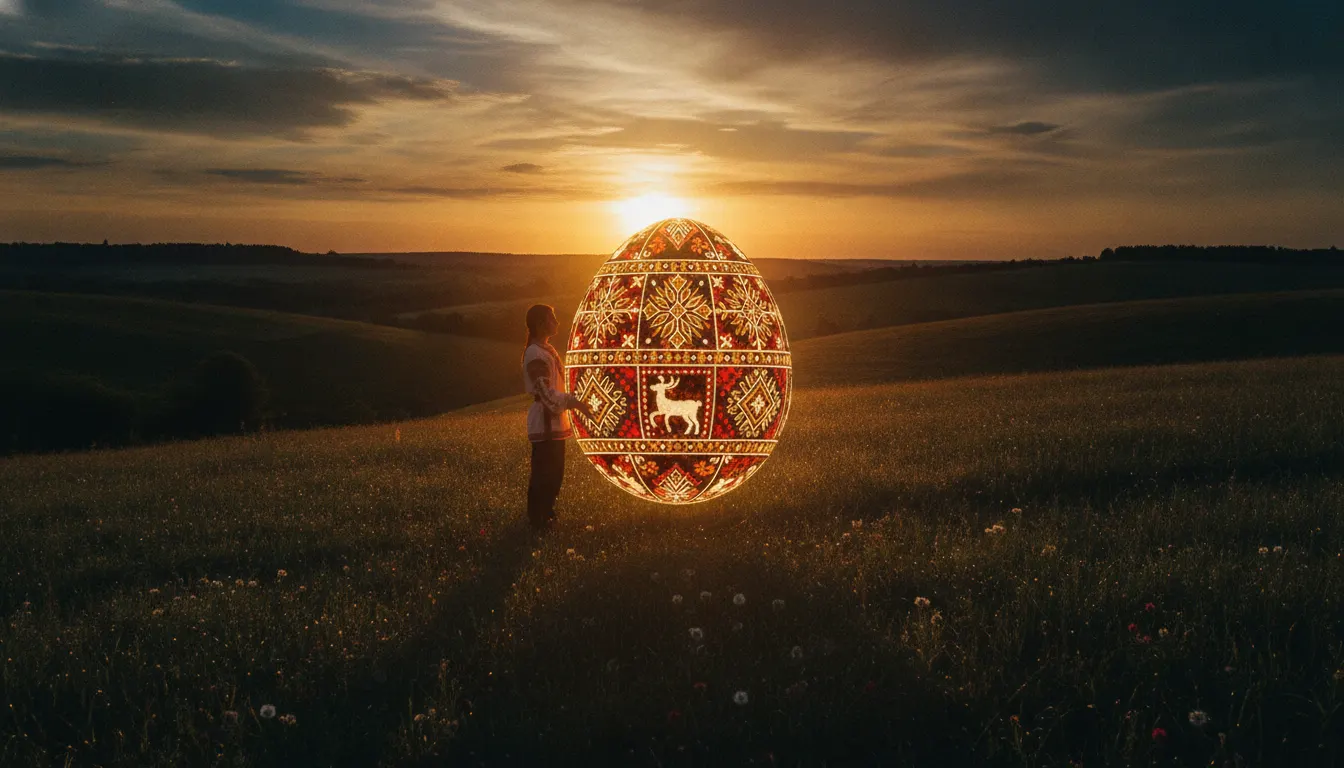
In the tradition of Ukrainian pysanky wax-resist decorated eggs. Intricate geometric and folk-symbol pattern in red, black, white, and yellow over the curved egg form.
The moves a human crew would use to get here. Cue applies them for you, and knowing their names is how you ask for a change.
Hot beeswax applied through a funnel stylus deposits resist on the eggshell surface; successive dye baths build the colour layers from light to dark.
Dyeing proceeds from yellow through orange, red, dark red, purple, green to black; each lighter colour is preserved by wax before the next dip.
The central motif of many pysanky; a geometric solar symbol that appears in most regional traditions.
A continuous geometric line with no beginning or end, symbolising eternity; typically used as a border or dividing element.
Geometric Hutsul Carpathian, curvilinear Poltava floral, and Podillia white-dominant styles each carry distinct regional identity readable to practitioners.
Yellow (sun/harvest), red (life/love), black (earth protection), white (purity) encode intentions; the colour programme of a pysanka communicates a specific wish.
Pysanky (Ukrainian: писанки, singular pysanka) are Ukrainian decorated eggs created through a wax-resist dyeing process - a technique closely analogous to batik - that produces intricate geometric and figurative patterns of extraordinary precision on the curved surface of a whole eggshell. The tradition is among the oldest continuously practiced Ukrainian folk arts, with pre-Christian origins connected to spring fertility rites and sun worship, and continues as a central Easter practice.
The basic method uses a kistka - a stylus with a small funnel tip that holds a reservoir of beeswax heated over a candle flame. The artist draws with the kistka on the eggshell, depositing hot wax that solidifies immediately and resists dye. The egg is then dipped in the lightest dye colour (typically yellow). After drying, the artist applies more wax over areas to be preserved in yellow, then dips in the next darker colour. This layering continues through orange, red, dark red, purple, green, and finally black - the deepest tone. When all dyeing is complete, the wax is melted off in a candle flame, revealing the full multi-colour pattern. The interior of the egg is either blown out beforehand or allowed to dry over time.
Different regions of Ukraine developed distinct pysanky vocabularies. The Hutsul tradition (Carpathian mountains, western Ukraine) uses strong geometric forms - meanders, triangles, and eight-pointed stars - in bold contrast. The Poltava and Kharkiv traditions (eastern Ukraine) favour more curvilinear floral and animal motifs. The Podillia tradition uses white areas prominently. The Kyiv region tradition balances geometric and naturalistic elements. Regional identity is legible to specialists in colour palettes, motif types, and compositional organisation.
Traditional pysanky carry encoded symbolic meanings: the bezkonechnik (endless line) represents eternity; the eight-pointed star (zirka) represents the sun; the svarha (Slavic swastika variant) predates its appropriation and represents the life-giving cycle; deer and horses represent wealth; fish represent abundance; birds represent good wishes and messengers. Colours also carry meanings: yellow represents the sun and harvest; red represents life and love; black represents the protection of the earth; white represents purity. Individual eggs were traditionally given as gifts with specific wishes encoded in their patterns.
Various regional folk artists · 19th century-present
National reference collection documenting all major regional traditions
Various Hutsul and western Ukrainian artists · 2000, collection ongoing
Dedicated pysanky museum in the Hutsul heartland; over 6,000 examples
Ukrainian-Canadian diaspora artists · 19th-20th century
Documents the diaspora transmission of pysanky practice to Canada
Luba Petryshyn Perchyshyn · 1972
Standard English-language instructional and documentary reference for the tradition
Various · ongoing
Academic documentation of symbolism and regional variation; scholarly reference
Ron Resch (designer), aluminium sculpture · 1975
9-metre aluminium pysanka sculpture; diaspora monument demonstrating the form's international reach
A Look is not a filter. It is a set of stored decisions the pipeline reads before it makes a single frame, so two videos in the same Look actually match.