Bishop Museum ngatu collection, Honolulu
Various Tongan women's kautaha groups · 19th-20th century
Major holding; documents full range of ngatu motif vocabulary across islands
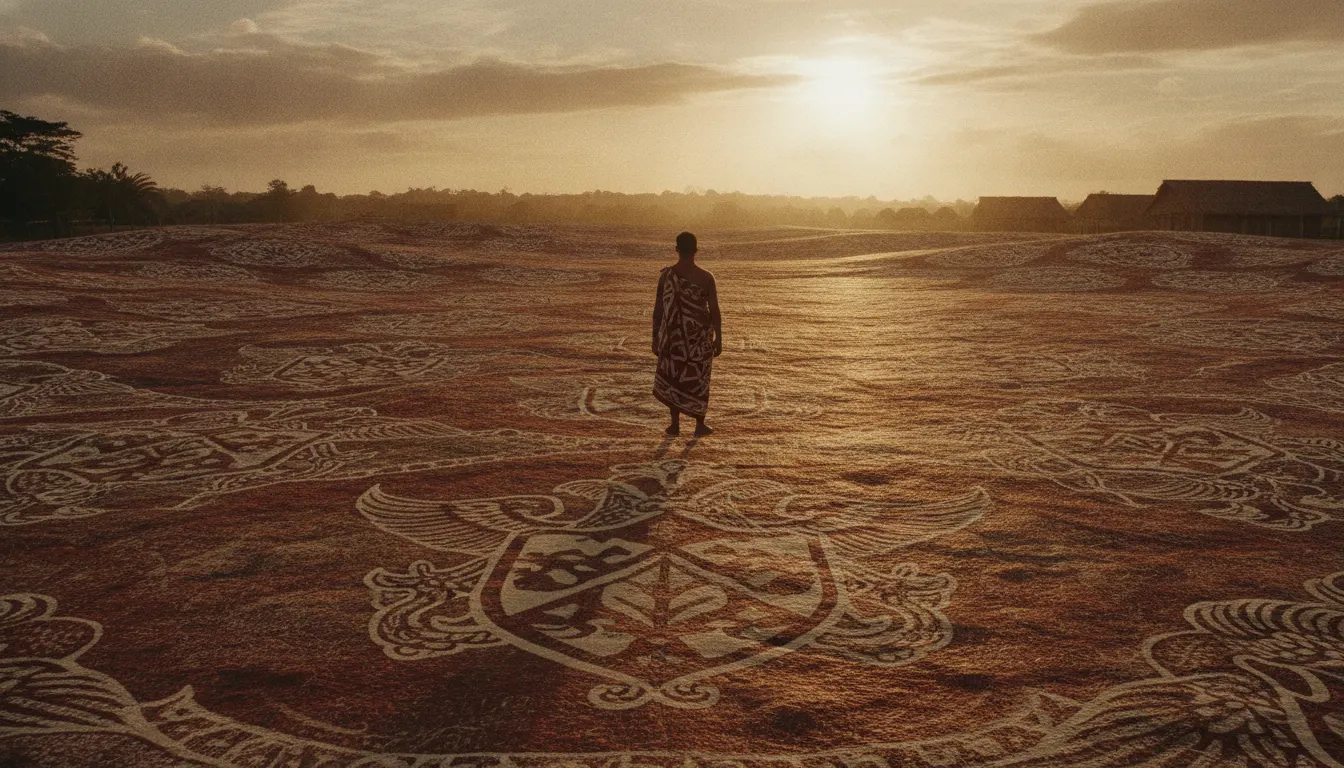
In the tradition of Tongan ngatu painted tapa, long bark-cloth strips rubbed over kupesi design boards and hand-painted with iconic motifs of royal crest, eagle, and turtle.
The moves a human crew would use to get here. Cue applies them for you, and knowing their names is how you ask for a change.
Multiple women work simultaneously to beat and felt bark strips into large continuous cloth sheets without adhesive.
Carved low-relief tablets placed under cloth; dye-loaded pad rubbed across to transfer pattern geometry.
Reddish-brown dye from Bischofia javanica (koka) bark; tongo mangrove provides supplementary black.
Double-bird and house-middle motif modules with strongly angular, rectilinear grammar repeated across panel fields.
Full-length ngatu can reach 100 metres; panel dimensions and motif scale are designed for ceremonial procession and display.
Narrow geometric border strips alternate with wider field panels bearing the primary repeating motifs.
Ngatu is the Tongan term for barkcloth, a fabric beaten from the inner bark of the paper mulberry (hiapo, Broussonetia papyrifera), and the tradition of its production and painted decoration is one of the most socially significant arts in the Kingdom of Tonga. While ngatu shares broad material and technical origins with Samoan siapo and Hawaiian kapa, Tongan ngatu has developed a distinct aesthetic vocabulary with larger panel formats, a richer range of geometric motifs, and a social system of collective production that makes each large ngatu a community artefact.
Ngatu production is women's work, and the beating and decoration process is carried out in communal kautaha (production groups) where multiple women work simultaneously. Bark strips from the paper mulberry are soaked, beaten with a grooved mallet on a rounded anvil, then felted together into large sheets by a wet-beating process that bonds overlapping pieces without adhesive. A single large ceremonial ngatu can be 100 metres long and 1-2 metres wide.
Decoration uses two techniques: kupesi rubbing (placing a tablet carved in low relief - equivalent to Samoan upeti - under the cloth and rubbing a dye-loaded pad across the surface to transfer the pattern) and freehand painting with a brush of pandanus leaf or other plant material. Dyes are made from koka bark (Bischofia javanica, giving rich reddish-brown) and tongo mangrove bark (giving black).
Ngatu patterns centre on geometric modules called manulua (double bird), lotofale (house middle), tokelau, and many others, each with distinct formal grammar and social association. The geometry is angular and rectilinear compared with Samoan siapo, with larger dominant motifs and more explicit bilateral symmetry. A standard large ngatu alternates geometric border panels with wider field areas bearing repeating motif blocks. Colour is brown-and-black on the natural cream ground - a warm, earth-toned palette with no added colours in the traditional system.
Ngatu are essential objects in Tongan ceremonial exchange (koloa - valuables). They are presented at births, funerals, weddings, royal installations, and church events. The receipt of ngatu signals respect and honour; gifting a large ngatu is among the highest social gestures. King Tupou VI's coronation (2015) involved the display of enormous ngatu panels, demonstrating the tradition's continuing royal and national significance.
Various Tongan women's kautaha groups · 19th-20th century
Major holding; documents full range of ngatu motif vocabulary across islands
Various Pacific Island artisans · ongoing
Comparative Pacific tapa collection with strong Tongan ngatu representation
Tongan women's groups, national production · 2015
Large-scale ngatu displayed at King Tupou VI's coronation; contemporary example of royal ceremonial use
Various Tongan communities · 19th-20th century
Carved rubbing tablets that transfer geometric patterns; documents the pattern vocabulary in three-dimensional form
Vava'u island women's kautaha · ongoing
Active production community; source of some of the finest contemporary ngatu in the archipelago
Michael Mel and others · 1999
Academic catalogue documenting ngatu production, motif grammar, and ceremonial exchange context
A Look is not a filter. It is a set of stored decisions the pipeline reads before it makes a single frame, so two videos in the same Look actually match.