ASIAN EXTENDED · CONTEMPORARY-FOLK · PHILIPPINES
Filipino Jeepney Painted Art (Philippines)
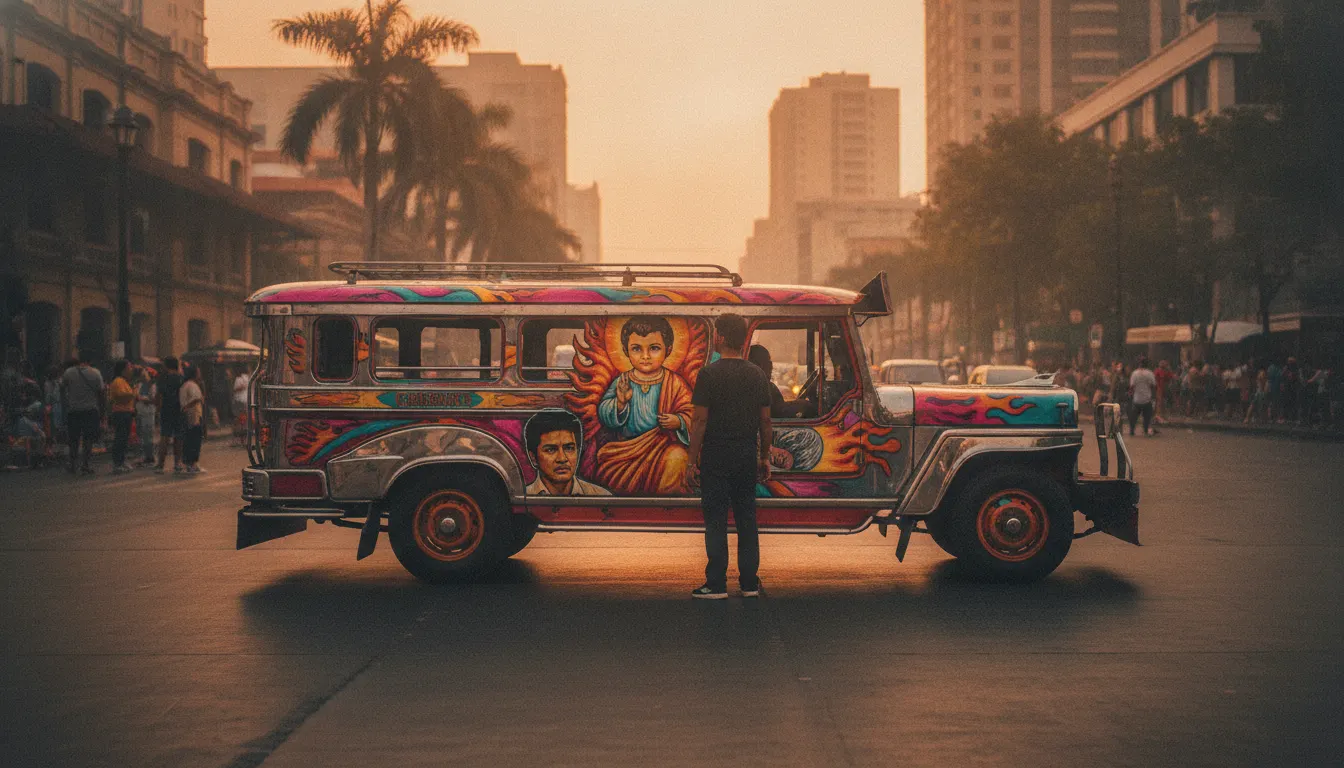
In the tradition of Filipino jeepney folk-painting from Manila streets. Chrome-trimmed stainless body bursting with airbrushed religious icons, Sto. Nino, flames, and pop-culture portrait panels.
jeepneyfilipinoairbrushstreet-folk
LUT jeepney-chrome-airbrush
WHEN TO USE
- Philippine tourism, cultural celebration, and national heritage content
- Filipino diaspora community events, festivals, and cultural pride campaigns
- Street art, mural art, and urban folk-art editorial content
- Maximalist, high-chroma graphic design and motion-title sequences that need exuberant visual energy
- Content exploring post-colonial re-appropriation of US material culture by Asian communities
- Brand campaigns that celebrate craft artisanship in vernacular or populist registers
WHEN NOT TO USE
- Minimalist, corporate, or restrained brand contexts where the maximalism will overwhelm all other messaging
- Content that uses the aesthetic as generic 'Southeast Asian street style' without Filipino cultural specificity
- Premium luxury brands where the populist, commercial-sign-painting heritage may conflict with brand positioning
- Content where religious iconography (Santo Nino, Virgin Mary) would be contextually inappropriate or disrespectful
SIGNATURE TECHNIQUES
How the look is made.
The moves a human crew would use to get here. Cue applies them for you, and knowing their names is how you ask for a change.
- 01Hand
painted horse motif in full gallop -- typically palomino on red or gold, the defining jeepney symbol
- 02Catholic iconography (Santo Nino, Virgin Mary, crucifix) integrated with secular celebrity and hero imagery
- 03Sign
painting technique: freehand line work, smooth brush gradients, and 1970s-onward airbrushed transitions
- 04Chrome ornamentation
hood ornaments, side bars, mirror balls, and stainless-steel horse figurines
- 05Vivid chroma palette
cadmium red, chrome gold/yellow, royal blue, and chrome silver with black outline
- 06Maximalist all
surface coverage -- no panel left undecorated, text and image in continuous field
- 07Personal name, route, hometown, and devotional text integrated as design elements
HISTORY & CONTEXT
Where it comes from.
Filipino Jeepney Art Painted
The Filipino jeepney is simultaneously a vehicle, a folk-art canvas, and a national symbol. After World War II, the US military left behind thousands of Willys MB jeeps. Filipino entrepreneurs lengthened the wheelbase, added passenger benches, and began operating them as shared public transit. Beginning in the late 1940s, a tradition of elaborate hand-painting and decoration rapidly developed, turning utilitarian surplus transport into rolling popular-art installations.
Origins and Social History
The earliest jeepneys were decorated modestly: a painted name, a horse motif (symbolizing speed and pride), some chrome accents. By the 1950s and 60s the decoration escalated dramatically. Individual drivers and owner-operators commissioned sign painters -- most famously the shops around Paco Market in Manila -- to cover every panel with imagery reflecting their personal identity, faith, aspirations, and cultural loyalties. The chrome accessories industry grew in parallel: hood ornaments, mirror balls, protruding stainless-steel side bars, and horse statuettes became standard.
Visual Language
Jeepney art is unashamed maximalism. Imagery combines without hierarchy: the Santo Nino (Holy Infant Jesus of Cebu, first evangelized 1521) alongside action movie stars; the Virgin Mary next to basketball heroes; Philippine national heroes (Jose Rizal, Andres Bonifacio) alongside pop-music idols. The horse motif -- typically a palomino in full gallop against a red or gold ground -- is the single most persistent image. Chrome is used liberally. Text includes the jeepney's route name, the owner's nickname, religious phrases (Salamat sa Diyos, Viva Santo Nino), and hometown references.
Painting Technique
The painting tradition is sign-painting with fine-art ambition: house paint on sheet metal, applied freehand without masking, using both flat brush and detail sable. Skilled jeepney painters (pintor ng dyipni) could replicate photographic likeness from a printed reference purely by hand. The style prizes crisp outlines, smooth gradients (air-brush technique entered the vocabulary in the 1970s), and vivid chroma. Red, gold/yellow, blue, and chrome silver are the dominant colors; black is used for shadow and outline.
Contemporary Status
The Philippine government's Public Utility Vehicle Modernization Program (PUVMP), launched 2017-2023, has been phasing traditional jeepneys out in favor of Euro-4 compliant modern mini-buses. This has made the hand-painted jeepney an increasingly documented and mourned cultural artifact. Organizations such as Sarao Motors (the most celebrated manufacturer, founded by Leonardo Sarao in 1953) have been recognized as national cultural heritage. Jeepney painting has been claimed as an inspiration by contemporary Filipino graphic designers and muralists.
NOTABLE WORKS
Where you have seen it.
Paco Market sign-painting shops, Manila -- historic center of jeepney fine-art decoration, active from 1950s onward
Damian Domingo (1790-1834) -- earlier Filipino folk-painting ancestor whose secular portraiture tradition prefigures jeepney vernacular
Francisco 'Botong' Carlos murals, Manila City Hall -- national muralism contemporary with jeepney tradition's rise
1953
National Museum of the Philippines folk-art collection -- documents jeepney body panels as museum objects
Film: *Jeepney* (documentary, 2002) -- records the painting tradition and Sarao Motors manufacturing
THE RECIPE
The exact knobs
the renderer turns.
A Look is not a filter. It is a set of stored decisions the pipeline reads before it makes a single frame, so two videos in the same Look actually match.
SettingValue
GradeColour LUT applied to every frame
jeepney-chrome-airbrushTransitionHow one shot becomes the next
hard cuts · 200ms · linearKen BurnsCamera move applied to stills
Slow push · 0.04 · centerTypographyDisplay / body / mono pairing
Bungee · Inter · CourierMusic moodWhat the bed under the voice sounds like
opm-pop · manila-soundPrompt suffixAppended to every shot prompt in this Look
inspired by Filipino jeepney street folk painting tradition Manila, chrome stainless body, airbrushed religious icon Sto Nino, flame motif, pop-culture portrait panel, tropical vibrancyPALETTE
Primary
#C8101A
Secondary
#F5C144
Accent
#1FA8C9
Text/Light
#1A0808
Text/Dark
#FFF1D0
BG 900
#0F0808
BG 800
#1A1010
RELATED LOOKS
Next to it on the shelf.
Your first cut
is on us.
+ New videoFree plan · no card · 1080p export