Fan Ho
1954
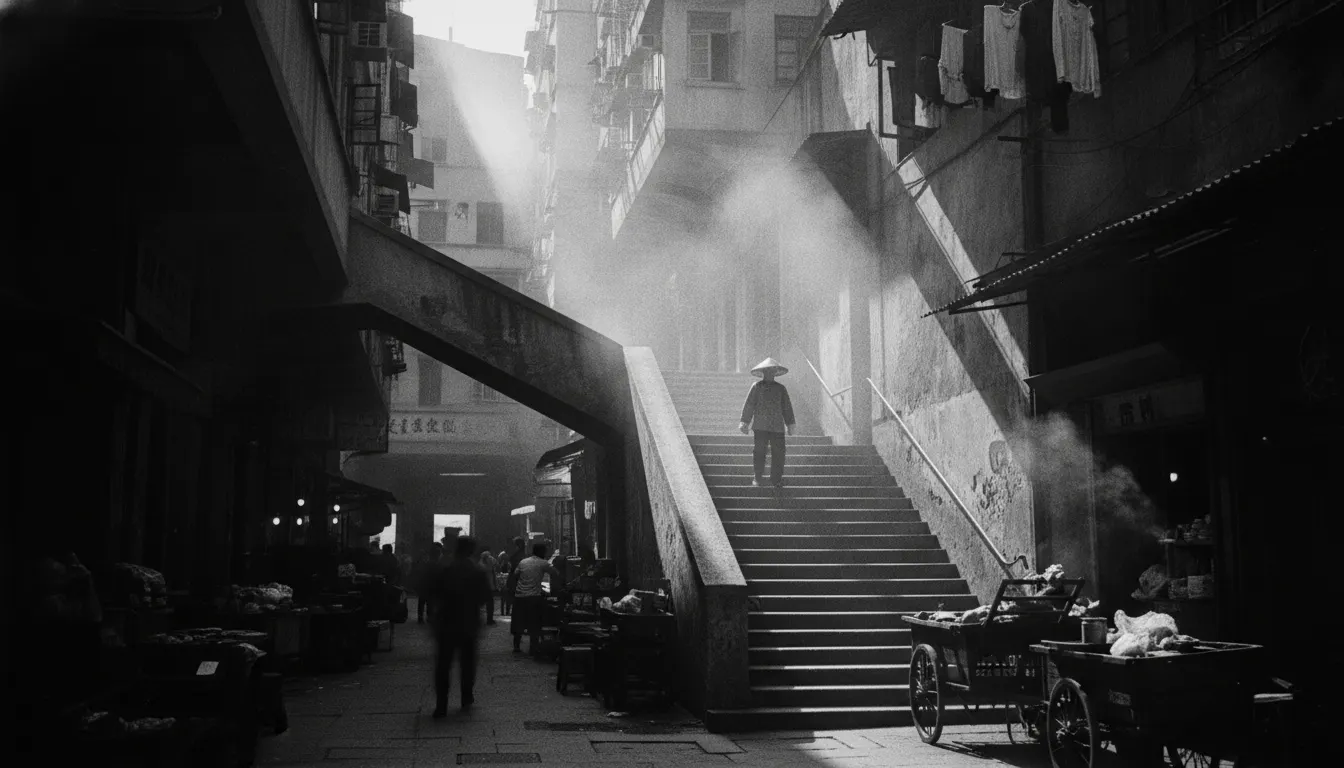
*Approaching Shadow* , Kowloon street, multiple international salon prizes
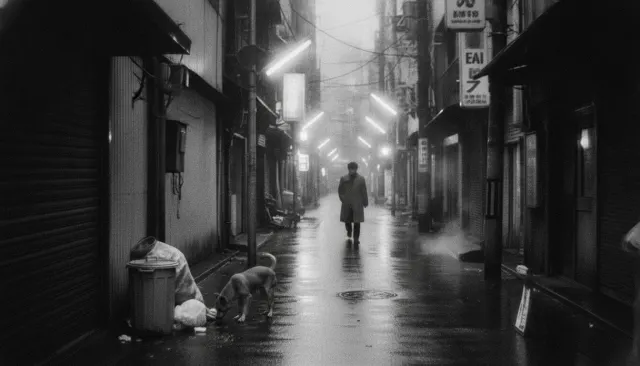
Fan Ho 1950s Hong Kong. Diagonal shaft of light through alley smoke, lone figure climbing stairs, geometric chiaroscuro, Approaching Shadow.
The moves a human crew would use to get here. Cue applies them for you, and knowing their names is how you ask for a change.
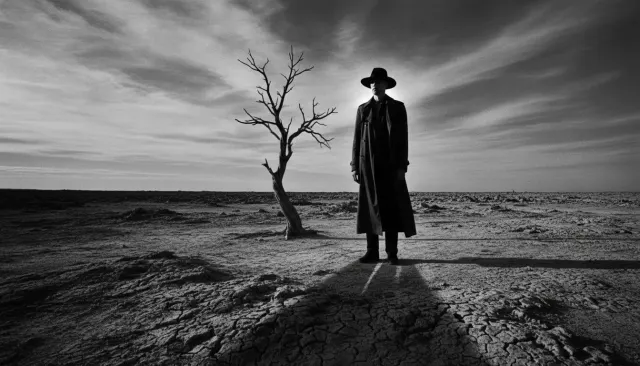
contrast darkroom printing: deep blocked shadows with bright, almost white highlight areas
visualized positioning: location scouted, composition set, wait for the right subject to enter
angle framing from ground level or staircase height to dramatize vertical architecture
staircases, alley walls, shadow edges - driving the eye
Fan Ho (范乃義, 1931-2016) is one of the most significant photographers of post-war Asia and among the most technically accomplished street photographers anywhere in the 20th century. Born in Shanghai, Fan Ho moved to Hong Kong in 1949, where he would spend the following decade and a half creating the body of work that defines his legacy: a series of black-and-white images of the city's streets, docks, markets, and alleyways that approach the visual language of cinema and classical painting rather than documentary reportage.
Fan Ho's most famous image, Approaching Shadow (1954), was made on the streets of Kowloon. A young woman walks toward the camera while dramatic diagonal light and shadow stripes - cast by an unseen structure overhead - cross the pavement and her figure. The geometric precision of the shadows, the figure's movement into the dark, and the compositional tension between geometry and humanity make this one of the most reproduced Asian photographs of the 20th century. It won first prize at multiple international salons.
Fan Ho was largely self-taught but deeply influenced by both Chinese ink painting (using negative space and tonal graduation as compositional forces) and Western pictorialism and cinema. He shot primarily with a Rolleiflex twin-lens reflex camera and later a 35mm Leica, using fine-grain film printed on high-contrast paper in his own darkroom. His signature technique was to pre-visualize the light geometry of a location, then wait patiently for a human subject to enter the compositional field - sometimes returning to the same spot on multiple days.
Fan Ho's images document a Hong Kong that no longer exists: the narrow lanes of old Kowloon, sampan fishing communities on the harbor, street hawkers and herbal medicine vendors, and a pre-skyscraper skyline. His photographs are simultaneously art and social history, providing the most comprehensive visual record of mid-century Hong Kong street life available.
1954
*Approaching Shadow* , Kowloon street, multiple international salon prizes
*A Hong Kong Memoir* (1997, revised 2017), career retrospective photobook
*Reminiscence* series (1950s-1960s), street and harbor life documentation
1958
*Condensation* , steam and geometry abstract street image
1954
*Fisherman's Melody* , sampan harbor photography
also worked as a filmmaker and actor in Hong Kong cinema of the 1950s-1970s
A Look is not a filter. It is a set of stored decisions the pipeline reads before it makes a single frame, so two videos in the same Look actually match.